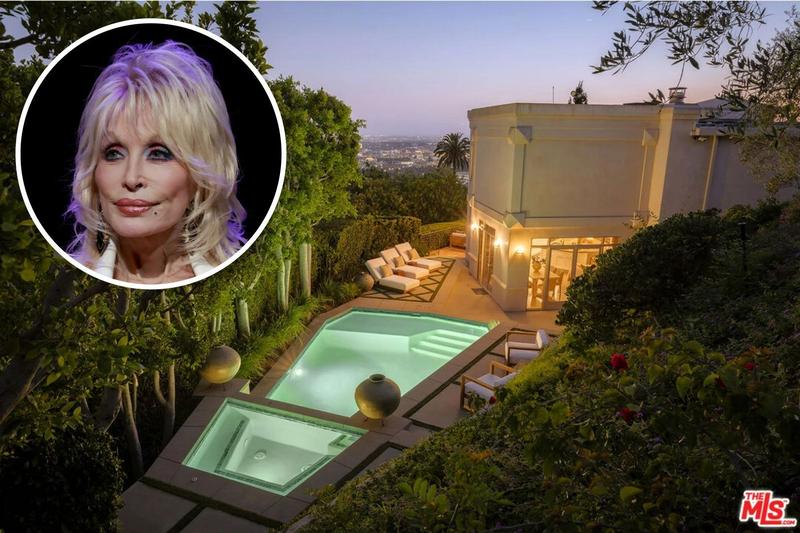
Dolly Parton’s longtime Hollywood Hills estate has been listed for $7.95 million, giving fans a rare window into the West Coast home the country legend used while she conquered film, television, and awards season far from Nashville.
The listing is not a housing-market story. It is a Dolly story.
For decades, the Tennessee-born singer kept a foothold in the hills above Los Angeles. The house sat above the city that made her a movie star. It was never the farm. It was never Dollywood. It was the other address, the one that made dawn call times possible.
What looks like a celebrity real-estate headline actually started on Locust Ridge, in Sevier County, with a girl who wrote songs before the industry had a category big enough to hold her.
A West Coast Address for a Tennessee Star
Dolly Rebecca Parton was born on January 19, 1946, in Sevierville, Tennessee. She left the Smoky Mountains with a guitar, a catalog of original songs, and a plan that did not require California.
Nashville came first. The Grand Ole Opry came first. Porter Wagoner’s television show came first.
Hollywood came later, when the songs had already made her famous and the movies wanted the person attached to them.
The Hollywood Hills estate was the practical answer to a new kind of calendar. Film sets. Soundstages. Press junkets. Award shows on the West Coast. A mountain girl who had already become a Nashville institution needed a bed within driving distance of a studio gate.
She did not move her life to California. She parked a life there.
That distinction matters. Country music has always been suspicious of stars who go Hollywood. Parton never gave the suspicion much to eat. The wigs stayed. The accent stayed. The Tennessee businesses stayed. The hills house was a tool.
Taste of Country reported the $7.95 million asking price and published a look at the estate that fans immediately treated as a memory object, not a comparable sale.
What $7.95 Million Buys in the Hollywood Hills
The property sits in the Hollywood Hills, the folded ridges above Los Angeles where actors, musicians, and executives have bought quiet and a view since the studio era.
Widely reported listing details describe a Mediterranean-style residence of roughly 4,400 square feet, with four bedrooms and five bathrooms, at 2567 Bowmont Drive. An infinity-edge pool. Outdoor living space. City views that drop toward the basin.
Those are the specs. They are not the story.
The story is a country songwriter sleeping above a city that once treated country music as a novelty act. The story is a woman from a one-room cabin learning the geography of canyons named for old movie money.
Hollywood Hills real estate has always sold a myth: privacy, elevation, light. Parton’s career sold a different myth: rags, rhinestones, and a work ethic that outlasted trends.
The two myths shared a driveway for a while.
Mediterranean villas in those canyons are common. A Grand Ole Opry member owning one, while still punching the clock at a theme park in Pigeon Forge, is not.
Neighbors in that zip code have included generations of film people. Parton was film people only on the days she had to be. The rest of the year belonged to Tennessee.
Bowmont Drive is not Mulholland in the postcards. It is a residential fold of the hills, gated enough for quiet, close enough to studios that a 5 a.m. car could still make a call time. For a woman who measured success in songs written and jobs created, the address was logistics wearing stucco.
Dolly Parton’s Hollywood Years
The Hollywood chapter has dates. They are specific, and they explain the house.
The on-ramp was music, not movies. In 1977, Here You Come Again pushed Parton from country radio into pop. The title track hit No. 1 on the Billboard Hot Country Songs chart and crossed onto the Hot 100. A Nashville writer had become a national voice. Los Angeles noticed.
In 1980, she starred with Jane Fonda and Lily Tomlin in 9 to 5. She also wrote the title song. The single hit No. 1 on the Billboard Hot 100. The song earned an Academy Award nomination for Best Original Song.
She drafted the groove on set, using her nails as a typewriter. A country writer had walked into the center of American pop culture through a side door marked office comedy.
The movie required Los Angeles. The press required Los Angeles. The Oscars required Los Angeles.
In 1982, she starred with Burt Reynolds in The Best Little Whorehouse in Texas. In 1984, she paired with Sylvester Stallone in Rhinestone. In 1989, she joined Sally Field, Shirley MacLaine, Olympia Dukakis, Daryl Hannah, and Julia Roberts in Steel Magnolias.
That is a decade of call sheets.
Steel Magnolias itself was shot in Natchitoches, Louisiana, not on a Hollywood backlot. The industry that financed it, promoted it, and awarded it still ran through Los Angeles. A hills address remained useful even when the cameras were in another state.
Television specials filled the gaps between features. Talk shows. Award-show performances. The American Music Awards. The Grammys. The kind of appearances that make a Nashville star into a household name in households that do not play country radio.
Parton’s filmography is not a side note. It is the reason a Hollywood Hills address ever made sense.
According to her public biography, she remained a Tennessee artist who took Hollywood work, not a Hollywood celebrity who visited the South. The distinction is the whole plot.
Why a Mountain Girl Needed a Hills House
Country stardom in the 1960s and 1970s could be built entirely inside a triangle of Nashville studios, the Opry, and a tour bus.
By 1980, the triangle had a fourth point. Movies paid. Movies expanded the audience. Movies also demanded presence.
Jane Fonda had recruited Parton for 9 to 5 after seeing her on television. The offer was a fork in the road. Take the part and become a different kind of famous. Decline it and stay inside the country lane.
She took the part.
Taking the part meant hair, wardrobe, and a city that runs on appointments. It meant being available. The Hollywood Hills estate was availability made of plaster, glass, and a view.
She was already a member of the Grand Ole Opry, inducted on January 4, 1969. She had already written “Jolene” and “I Will Always Love You” in the early 1970s. The songs were finished. The second act was beginning.
Los Angeles did not invent Dolly Parton. It rented her.
That rental needed a house.
Fans studying listing photos are not really shopping for tile and sightlines. They are looking for evidence of the second act. A piano. A porch. A bedroom that might have heard a melody hummed after a 14-hour day on a soundstage.
The public may never know which rooms heard which drafts. The nostalgia does not require a floor plan. It requires the fact of the address.
She chose the hills, not the beach. Malibu sells ocean and distance. Beverly Hills sells status at street level. The canyons sell elevation. A woman raised in the Smokies understood elevation. The Hollywood Hills were a California version of high ground.
Tennessee Always Came First
Pigeon Forge never lost her.
Dollywood opened in 1986 on the bones of a previous park in the Smokies. The business was not a vanity signature. It was jobs, tourism, and a permanent physical claim on the mountains that made her.
The Imagination Library, launched in Sevier County in 1995, mailed books to children. It grew into a global literacy program. None of that work required a canyon road in Los Angeles.
Her marriage to Carl Dean, sealed on May 30, 1966, was famously private and famously Tennessee. Dean avoided the red carpet. The Hollywood Hills house was a work site. The life was elsewhere.
Dean died on March 3, 2025, at 82. The fact belongs to the record of her life, not to the listing. The house was never the marriage. The marriage was never a Hollywood story.
Related: Taylor Swift Dethrones Ella Langley on the Billboard Hot 100
Nashville remained the music capital she had entered as a teenager. She played by its rules even when Los Angeles wrote bigger checks.
That is why this listing reads as nostalgia rather than relocation news. Nobody serious about Parton thought she was about to become a full-time Angeleno. The wigs were a brand. The mountains were a home.
Official pages for Dollywood still describe a park rooted in her childhood landscape, not in California real estate.
The listing, then, is a closing of a compartment. Film work did not end. West Coast trips did not end. The need for a permanent hills address could end.
Country Stars and the Hollywood Bargain
Parton was not the first country star to keep a California key.
The 1960s and 1970s sent Nashville talent west for television. Variety hours. Cameo roles. Network awards. Glen Campbell hosted a show. Johnny Cash did too. Kenny Rogers crossed into film. Reba McEntire later took sitcom work. The pattern is older than any single listing.
The bargain was always the same. Hollywood offered scale. Nashville offered identity. The artists who survived the bargain kept the identity and used the scale.
Parton survived it in rhinestones.
She collected honors on both coasts. Grammys. CMA Awards. A star on the Hollywood Walk of Fame. Kennedy Center Honors in 2006. The National Medal of Arts. Induction into the Rock & Roll Hall of Fame in 2022, after she had initially declined a nomination on the grounds that she was country. She accepted later and then recorded the 2023 album Rockstar to earn it in public.
That sequence is the Hollywood Hills story in miniature. She would go west. She would not pretend the west invented her. She would do the work, then go home.
A $7.95 million ask in the hills is a Los Angeles number. The woman it describes is still a Sevier County number.
Linda Ronstadt and Emmylou Harris pulled her west in another way. The 1987 Trio album tied Parton to Los Angeles country-rock royalty and won a Grammy. Music, not only movies, gave the hills house a reason to exist.
What Fans Are Actually Passing Along
The photos travel because the photos are a proxy for a life people have followed since AM radio. A pool above Los Angeles is a strange artifact in a biography that begins with a cabin and a coat made from scraps.
The contrast is the point.
Rags to rhinestones is the official myth. The hills house is rhinestones with a zip code. It proves the myth had a forwarding address.
It also proves the myth had limits. She did not sell the farm energy. She did not retire the Tennessee businesses. She did not become a person who is only famous in the places famous people live.
The estate is a chapter heading. Hollywood Years. Then the book continues.
Listing prices in the Hollywood Hills move with interest rates, celebrity, and view corridors. None of that is why the screenshots spread. The screenshots spread because Dolly Parton slept there, wrote there, or at least unpacked a suitcase there between 9 to 5 and the next flight home.
That is enough.
Country fans do not need a property tour. They need the feeling that the woman who sang “Coat of Many Colors” also had a key to a canyon door, and that the key never replaced the mountain one.
Soundstages called. Limousines waited. The Opry still had her name.
Tennessee kept the life. California kept the call times. The hills kept a house.
Dolly.
Frequently asked questions
How much is Dolly Parton's Hollywood Hills house listed for?
Dolly Parton's longtime Hollywood Hills estate has been listed for $7.95 million. Coverage of the sale, including reporting from Taste of Country, has treated the price as a window into her West Coast years rather than a housing-market data point.
Where is Dolly Parton's Los Angeles home?
The estate is in the Hollywood Hills of Los Angeles. Widely reported listing details place the Mediterranean-style house at 2567 Bowmont Drive, with about 4,400 square feet, four bedrooms, five bathrooms, a pool, and city views.
Did Dolly Parton live in Hollywood or Nashville?
Dolly Parton kept a Hollywood Hills house as a West Coast work base during her film and television years, but Tennessee remained home. She was born in Sevierville on January 19, 1946, joined the Grand Ole Opry in 1969, opened Dollywood in Pigeon Forge in 1986, and built her private life with Carl Dean in Tennessee.
Why is Dolly Parton selling her Hollywood Hills estate?
Public reports on the $7.95 million listing have not laid out a detailed personal reason for the sale. The house is widely described as her Los Angeles foothold from the movie years, including 9 to 5 in 1980 and Steel Magnolias in 1989, while her businesses and private life stayed rooted in Tennessee.
What movies did Dolly Parton make while working in Hollywood?
Parton's major Hollywood-era films include 9 to 5 (1980) with Jane Fonda and Lily Tomlin, The Best Little Whorehouse in Texas (1982) with Burt Reynolds, Rhinestone (1984) with Sylvester Stallone, and Steel Magnolias (1989). She also wrote the Oscar-nominated title song for 9 to 5, which hit No. 1 on the Billboard Hot 100.
Sponsored · Buying, selling or investing in property? JL Group works with owners and investors in Springfield, Missouri and beyond. jlgroup.online · Advertise on ByteSize Network