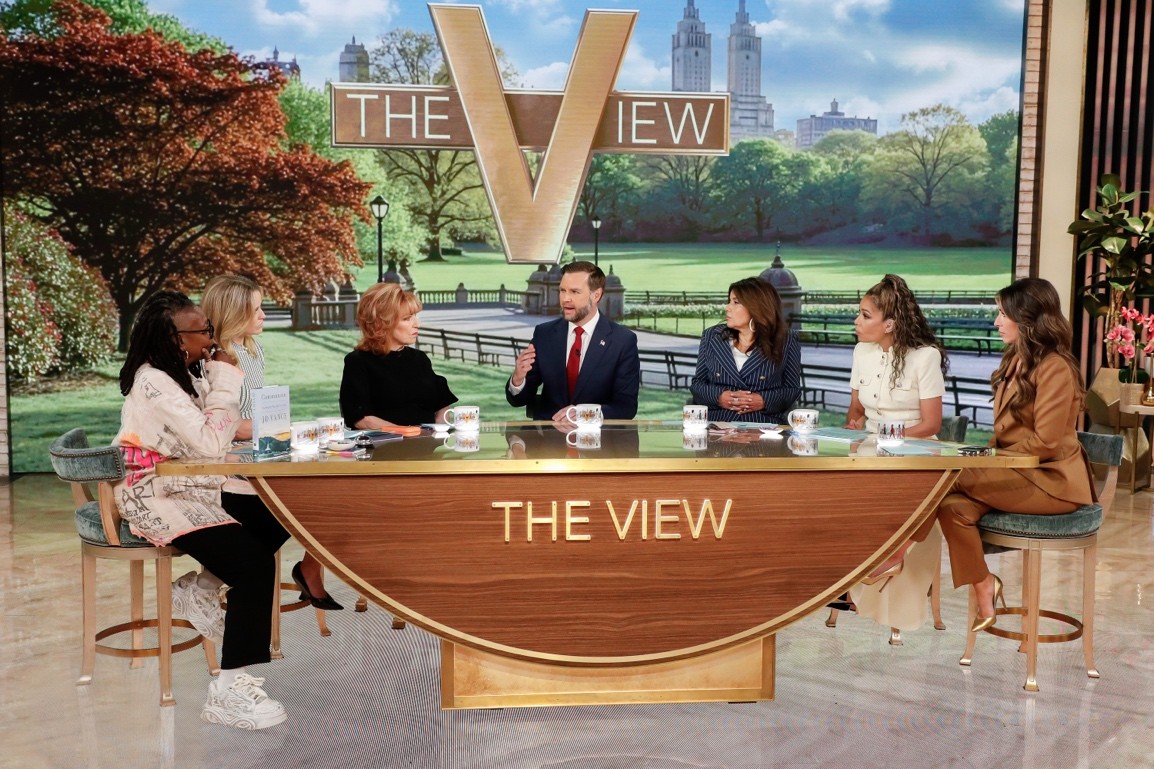
On June 18, 2026, Ohio Senator JD Vance appeared on ABC’s The View, drawing 3.3 million total viewers to the daytime broadcast. Nielsen Media Research data confirmed this as the talk show’s highest-rated episode since the 2024 presidential election cycle. The broadcast generated massive engagement in the key 25-54 demographic, proving that high-profile political interviews still command linear television audiences despite industry-wide streaming migration. But the story of this ratings spike extends beyond simple viewership metrics.
The television landscape in 2026 remains highly fragmented. Audiences routinely bypass live television for on-demand platforms. Yet, the established broadcast infrastructure of ABC News retains the ability to consolidate national attention. The 3.3 million figure represents a statistical anomaly for a Thursday morning broadcast. It underscores a specific media strategy utilized by political figures seeking mass audience penetration.
Networks track these anomalies closely. Politicians analyze the demographic data. The viewers provide the baseline metric for advertising rates and campaign reach. The June 2026 broadcast operated as a highly coordinated media event.
The Nielsen Data and Demographic Breakdown
Nielsen Media Research serves as the undisputed arbiter of television viewership. Their overnight data for the June 18 broadcast revealed a distinct viewing pattern. Audiences did not simply drift into the program following Good Morning America. They actively tuned in at 11:00 AM Eastern Standard Time specifically for the interview segment.
The 11:00 AM timeslot traditionally struggles to retain viewers moving from morning news programs into daytime syndication. Network executives refer to this as the mid-morning audience bleed. The June 18 broadcast reversed this trend entirely. Instead of losing viewers at the top of the hour, ABC News captured an influx of new viewers migrating from rival networks and cable news channels. This specific acquisition metric demonstrates the pull of a high-stakes political interview.
The 3.3 million total viewer count pushed the show significantly above its 2026 daily average of 2.4 million. The demographic breakdown offered deeper insights for ABC executives. The broadcast saw a 42 percent spike in the critical 25-54 demographic compared to the previous week. This specific age bracket dictates daytime television advertising rates. It also represents the exact voting bloc political campaigns spend millions of dollars to reach.
Hitting three million viewers on daytime television in 2026 requires an event-level catalyst. Legacy soap operas like General Hospital currently average under two million viewers. Standard celebrity promotional interviews rarely move the needle past the established baseline. Political figures engaging with adversarial panels remain one of the few reliable magnets for live, synchronous viewership.
The geographic distribution of the audience highlighted key political battlegrounds. Nielsen data indicated outsized viewership in major suburban television markets. Atlanta, Philadelphia, Phoenix, and Detroit registered the highest localized ratings spikes. These regions heavily influence national electoral outcomes, making the broadcast highly relevant for political strategists.
Regional data provided by Nielsen further illuminated the demographic shift. While coastal markets like New York and Los Angeles maintained their standard high viewership levels, the true growth occurred in the Midwest. Television markets in Ohio, Pennsylvania, and Michigan saw viewership increases of over 50 percent compared to the show’s 2026 baseline. This regional spike aligns perfectly with JD Vance’s political base and the targeted messaging deployed during the broadcast.
Minute-by-minute retention metrics further validated the draw of the appearance. Viewership steadily climbed during the first ten minutes of the broadcast. The audience peaked at the 11:30 AM mark, precisely when the panel discussion shifted to domestic economic policy and manufacturing initiatives in the Rust Belt. Viewers stayed through the commercial breaks, an increasingly rare behavior in modern television consumption.
The Economics of Attention at ABC News
Audience volume translates directly to network revenue. ABC News operates within a highly competitive daytime advertising market. A broadcast guaranteeing over three million viewers fundamentally alters the daily ad-rate calculus.
Standard daytime advertising rates remain a fraction of primetime costs. However, event-television dynamics shift the pricing model. When a network schedules a high-profile political interview, commercial inventory becomes highly sought after. Brands operating in the 2026 consumer market must weigh the benefits of massive exposure against the context of political debate. Major pharmaceutical companies, household goods manufacturers, and automotive brands heavily populated the commercial breaks during the Vance interview.
- Thirty-second ad spots command a 15 to 20 percent premium during highly anticipated political broadcasts.
- Live viewership minimizes commercial skipping, a persistent challenge for modern television networks.
- Post-broadcast digital syndication on platforms like YouTube adds a secondary, highly monetizable revenue stream.
The financial implications of a 3.3 million viewer broadcast extend into the broader Disney corporate ecosystem. ABC News leverages these high-performing episodes to cross-promote other network properties. During the June 18 broadcast, premium commercial inventory was allocated to promote upcoming primetime investigative specials and the network’s evening news flagship, World News Tonight. This internal synergy maximizes the financial utility of the daytime ratings spike.
Advertisers recognize the unique value proposition of live political television. Unlike scripted dramas or reality programming, political interviews generate immediate, emotional engagement. Viewers are less likely to utilize dual-screen behaviors when watching a tense exchange between a politician and a hostile panel. This undivided attention translates to higher ad recall metrics, allowing ABC to justify premium pricing for the 11:00 AM hour.
The economic model of The View relies on maintaining a steady baseline while capitalizing on periodic viewership surges. A daily audience of 2.4 million sustains the production budget. A spike to 3.3 million generates surplus revenue. JD Vance provided ABC News with a highly lucrative hour of television programming. In exchange, the network provided the Senator with unfiltered access to a massive daytime audience.
Media buyers closely monitor these spikes. The cost per thousand impressions, known as CPM, fluctuates based on guaranteed live viewership. ABC’s sales division leverages these high-performing episodes to negotiate favorable rates for future quarters. The June 18 broadcast serves as a critical data point for the network’s upcoming upfront presentations to major advertisers.
The Architecture of the Table
The physical and conversational setup of The View is highly intentional. Broadcast pioneer Barbara Walters designed the format in 1997 to foster intimate, multi-generational debate. In 2026, that same curved table operates as a structured environment for political interrogation.
The current panel of hosts, including veterans Whoopi Goldberg and Joy Behar alongside Alyssa Farah Griffin and Sunny Hostin, hold established authority within the studio. They dictate the pacing of the conversation. They control the transitions to commercial breaks. A political guest entering this space operates at a structural disadvantage. The set is not a neutral news desk in Washington D.C. It is a daytime entertainment environment located in New York City.
The structural design of daytime television relies on emotional resonance. When political figures enter that space, the format amplifies the intensity of the exchange.
The physical proximity of the hosts to the guest creates an inherent visual tension. The curved table measures exactly eight feet across, forcing a conversational intimacy that standard news desks intentionally avoid. When a host leans forward to interject, the camera captures the physical encroachment. This design choice strips away the formal distance usually afforded to sitting U.S. Senators, placing them on equal visual footing with daytime entertainers.
Audio engineering plays a crucial role in this architecture. The studio is mic’d to capture not just the primary speakers, but the ambient reactions of the panel and the live studio audience. A sharp intake of breath, a whispered aside, or a sudden burst of applause are all integrated into the final audio mix. This sensory density makes the broadcast feel urgent and unpredictable, directly contributing to the high viewer retention rates recorded by Nielsen.
JD Vance navigated this specific broadcast architecture. The dynamic was firmly established before the first segment began. The audience at home understood the assigned roles. The conservative Senator from Ohio sat opposite a predominantly liberal-leaning panel. The live studio audience provided real-time auditory feedback. The production values mirrored a theatrical event anchored in real-world political stakes.
This established architecture explains the ratings success. Traditional Sunday morning political shows like Meet the Press or Face the Nation offer structured, policy-driven interviews. The View offers visceral, unscripted reactions. The 3.3 million viewers tuned in specifically for the unvarnished exchange of opposing viewpoints.
The set design itself reinforces this dynamic. The hosts are positioned closely together, presenting a unified visual front. The guest sits on the periphery of the curve. The lighting is bright and unforgiving. Every element of the studio is engineered to maximize the visual and emotional impact of the conversation.
The Strategic Deployment of the Hostile Interview
Political media strategy in 2026 demands calculated risks. The era of politicians exclusively utilizing friendly media platforms yields diminishing returns. Echo chambers solidify existing support but fail to expand audience reach. Politicians who step into adversarial broadcast environments generate immediate earned media.
The decision-making process behind these appearances involves extensive risk assessment. Political communication directors analyze the historical performance of previous guests on The View. They map out potential lines of questioning regarding controversial legislation, past voting records, and current campaign rhetoric. JD Vance’s team recognized that the inherent hostility of the panel could be weaponized to highlight ideological contrasts.
This strategy also serves to bypass the traditional political press corps. White House correspondents and Capitol Hill reporters operate with a specific set of journalistic norms. The hosts of The View operate as opinion commentators. By engaging with commentators rather than traditional journalists, politicians can pivot away from granular policy details and focus entirely on broad cultural narratives. This pivot is highly effective for reaching voters who consume politics through an emotional rather than technical lens.
JD Vance’s appearance on The View represents a strategic deployment of the hostile interview tactic. The objective is rarely to persuade the panel of hosts. The objective is to demonstrate rhetorical resilience to the viewers watching at home.
For a conservative figure, facing a panel of liberal hosts offers distinct strategic advantages. If the interview becomes overly combative, the political base rallies around narratives of media bias. If the politician effectively counters the hosts’ arguments, they project strength under pressure. Both outcomes serve broader political communication goals heading into the 2026 midterm elections.
Suburban women constitute a massive portion of The View’s daily audience. This specific demographic remains one of the most fiercely contested voting blocs in the United States. Reaching them directly, without the intermediate filter of a primetime news anchor or a social media algorithm, holds immense strategic value. An adversarial interview ensures the politician’s message is delivered directly to this critical demographic.
Campaign strategists recognize the efficiency of this approach. A single appearance on a highly rated daytime show can generate more national conversation than weeks of localized campaign rallies. The risk of a negative soundbite is outweighed by the guarantee of a massive, attentive audience.
The 2024 Benchmark and Historical Context
The specific metric utilized by Nielsen matters. The designation “highest-rated since 2024” anchors the June 2026 broadcast in recent television history.
The 2024 presidential election cycle represented a high-water mark for political media consumption. The intense national focus drove record ratings across all broadcast and cable networks. The View routinely crossed the three-million viewer threshold during the final months of that campaign, peaking during the weeks immediately preceding the November election. Audiences were highly attuned to daily shifts in the political landscape.
Following the 2024 election, viewership across daytime and primetime political programming experienced a predictable normalization. The baseline audience returned to standard levels. Hitting 3.3 million viewers in a non-presidential election year signals a resurgence of intense political interest.
The View has a long history of hosting high-profile political figures. Barack Obama made history as the first sitting president to appear on the show in 2010. Donald Trump frequently called into the program prior to his political career. The June 2026 appearance by JD Vance joins a long lineage of politicians utilizing the daytime platform to bypass traditional news structures.
Comparing 2026 to the 2022 midterm cycle reveals a distinct shift. During the 2022 midterms, daytime talk shows struggled to capture the political zeitgeist. The success of the Vance broadcast suggests that political polarization has re-established itself as a dominant driver of daytime television viewership.
The Secondary Market of Viral Syndication
Live television ratings only tell half the story in 2026. The true reach of the June 18 broadcast extends far beyond the initial 3.3 million viewers. Modern media consumption relies heavily on the secondary market of social media syndication.
Within minutes of the live broadcast concluding, isolated clips flooded platforms like X, TikTok, and Instagram. Political action committees, news aggregators, and individual users clipped specific exchanges between Vance and the hosts. These micro-videos generated tens of millions of secondary impressions over the following 48 hours.
The digital afterlife of the broadcast is meticulously tracked by both the network and the political campaign. Social media managers utilize advanced analytics to monitor which specific clips generate the highest engagement velocities. A 15-second exchange regarding inflation metrics might generate minimal traction, while a terse back-and-forth about cultural values can amass millions of views within an hour. This real-time feedback loop informs future media strategies for both the politician and the network.
This secondary syndication is highly curated. Conservative accounts isolated moments where Vance successfully challenged the hosts on economic policy. Liberal accounts isolated moments where the hosts pushed back on Vance’s assertions regarding federal legislation. The single 45-minute broadcast provided enough raw material to fuel digital discourse for an entire news cycle.
The monetization of this secondary market represents a massive shift in television economics. While ABC News captures the primary ad revenue during the live 11:00 AM broadcast, the network also monetizes the digital syndication through pre-roll advertising on YouTube and sponsored content on Facebook. The 3.3 million live viewers serve as the catalyst, but the tens of millions of digital impressions represent the long-tail financial value of the JD Vance interview.
ABC News actively participates in this secondary market. The network uploads full segments to its official YouTube channel. These official uploads generate millions of additional views, capturing audiences who were at work or school during the live 11:00 AM broadcast. The combination of linear television ratings and digital syndication makes The View one of the most potent media properties in the Disney corporate portfolio.
The algorithms that govern platforms like TikTok and X in 2026 heavily prioritize high-engagement political conflict. A heated exchange on a daytime talk show perfectly aligns with these algorithmic preferences. The broadcast effectively transitions from a linear television event into a decentralized digital phenomenon.
The media landscape fragmented. The streaming platforms dominated. The algorithms isolated.
Television.