
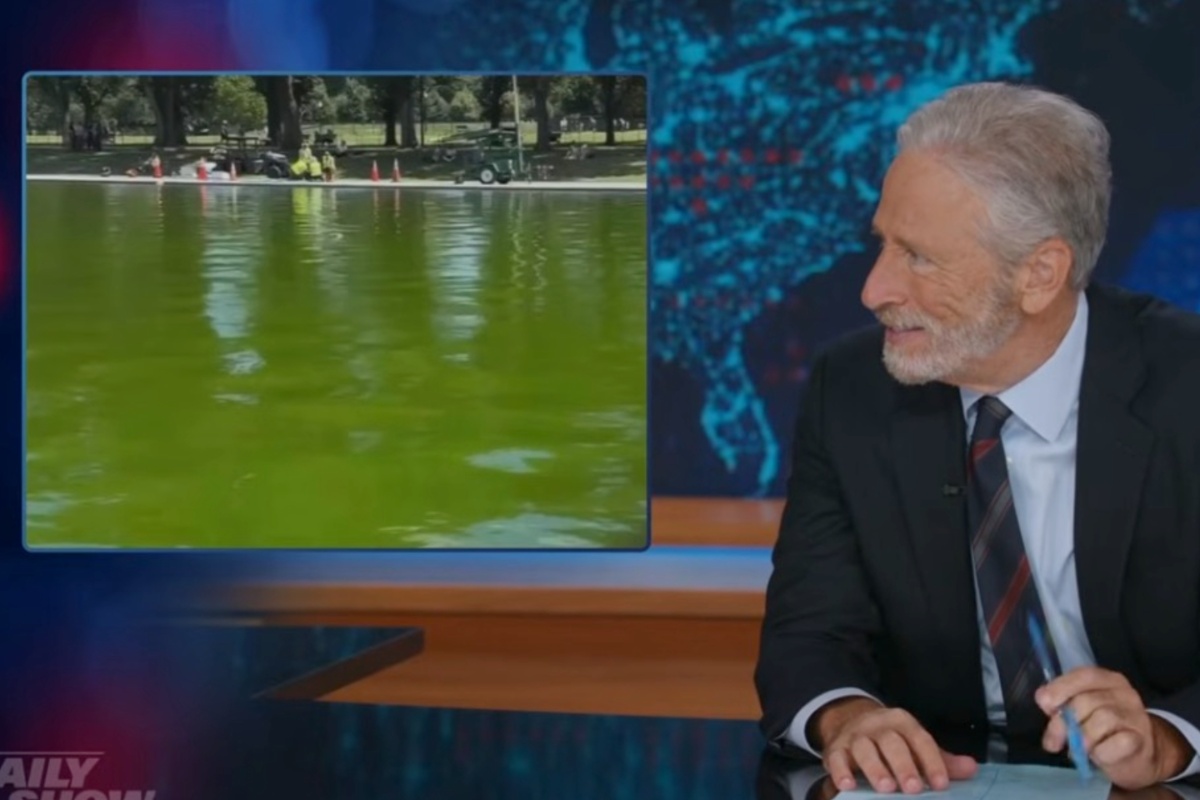
On Monday night, Jon Stewart used his platform on Comedy Central’s The Daily Show to mock the severe algae infestation currently choking the Lincoln Memorial Reflecting Pool in Washington, D.C., famously asking if the National Park Service had “replaced the water with Mountain Dew.” The neon-green bloom has transformed the iconic 6.75-million-gallon water feature into a symbol of infrastructure decay. Stewart’s commentary tapped into a shared national frustration. It framed a hyper-local maintenance issue as a symptom of broader environmental and bureaucratic neglect.
The joke landed. The audience laughed. But the observation cut deeper than standard late-night comedy. Stewart used the algae infestation at the National Mall’s most famous water feature to highlight a stark American reality. Infrastructure is failing. Maintenance is deferred. The monuments to American history are quite literally turning into a swamp.
A Neon Green National Mall
The Lincoln Memorial Reflecting Pool stretches 2,029 feet from the steps of the Lincoln Memorial toward the Washington Monument. It is 167 feet wide. It is designed to be a pristine mirror. It is meant to reflect the obelisk of the Washington Monument and the sky above the capital.
In June 2026, it reflects very little. Extreme summer temperatures have baked the Mid-Atlantic. The shallow water of the pool has heated rapidly. Algae has bloomed with aggressive speed. The water has turned a thick, unnatural shade of neon green.
Tourists from Ohio, California, and international destinations arrive at the National Mall expecting a postcard view. Instead, they find a stagnant pond. The smell of organic decay hangs in the humid air. The visual contrast is jarring. White marble monuments stand against a backdrop of bright green sludge.
This is the scene Jon Stewart brought to his viewers. The visual absurdity provided perfect comedic fodder. But Stewart’s comedic architecture always relies on an underlying civic truth. The “Mountain Dew” comparison was not just about color. It was about artificiality. It was about the degradation of a natural and historical space into something hyper-processed and toxic-looking.
The Daily Show Intervention
Stewart returned to the anchor chair of The Daily Show to dissect the absurdities of American politics. His focus often shifts from the halls of Congress to the literal ground outside of it. The Reflecting Pool segment followed this exact blueprint.
He displayed an image of the infested pool. He delivered the punchline. “Did they replace the water with Mountain Dew?”
From there, Stewart pivoted. He moved from the visual joke to the systemic failure. He pointed out the irony of political leaders in Washington debating global environmental policy while they cannot keep the algae out of their own front yard. He referenced the persistent political rhetoric of “draining the swamp,” noting that the federal government was currently cultivating an actual swamp at the feet of Abraham Lincoln.
Stewart’s framing works because it is undeniable. The evidence is visible from space. The National Park Service (NPS), which oversees the National Mall and Memorial Parks, is tasked with an impossible job. They must maintain a shallow body of water in a city built on a tidal floodplain during an era of rising global temperatures.
The Anatomy of a Monument
To understand why the pool turns into a Mountain Dew commercial, one must understand its engineering. The Reflecting Pool is massive in surface area but incredibly shallow in depth. It is only 18 inches deep along the sides. It drops to a maximum depth of 30 inches in the center.
Shallow water heats quickly. When the ambient temperature in Washington D.C. reaches 95 degrees Fahrenheit, the water temperature in the pool spikes. Warm water holds less oxygen. It becomes a perfect incubator for cyanobacteria and various strains of algae.
The pool was designed in 1922 by architect Henry Bacon. It was built for aesthetics, not for ecological stability. For decades, the National Park Service filled the pool using the city’s potable water supply. They used millions of gallons of drinking water to keep the reflection clear. When the water grew stagnant, they drained it, scrubbed the concrete bottom, and filled it again.
This method was environmentally irresponsible and economically unsustainable. It had to change.
The 34 Million Dollar Filter
In 2010, the National Park Service initiated a massive overhaul. The project cost $34 million. It was funded by the American Recovery and Reinvestment Act of 2009. The goal was to modernize the pool, fix structural leaks, and implement a sustainable water management system.
The Louis Berger Group led the engineering redesign. The pool was rebuilt. The water source was changed. Instead of draining the city’s drinking water, the new system drew water from the nearby Tidal Basin.
The engineers installed a complex circulation system. The water from the Tidal Basin is pumped into the pool, circulated, and passed through an ozone filtration system. The ozone is meant to kill bacteria and prevent algae growth. The filtered water is then pumped back into the Tidal Basin.
The system was activated in 2012. It was heralded as a triumph of modern green engineering. It was supposed to end the era of stagnant water on the National Mall.
Fourteen years later, the system is failing to keep up with the climate.
Why the System Fails
The $34 million system works under normal conditions. June 2026 is not normal. The ozone filtration system requires a specific flow rate to effectively treat the 6.75 million gallons. When temperatures soar, the algae reproduces faster than the pumps can circulate the water through the ozone chambers.
The Tidal Basin itself is an estuary connected to the Potomac River. It carries its own sediment, nutrients, and biological material. Pumping Tidal Basin water into the shallow, heated pan of the Reflecting Pool is like pouring fertilizer into a greenhouse.
When the bloom hits critical mass, the National Park Service has few options. Chemical treatments are limited. Aggressive algaecides can damage the surrounding ecosystem and harm local wildlife. The NPS often has to resort to manual cleaning or simply waiting for the weather to break.
Ducks, Parasites, and Past Plagues
Stewart’s commentary is not the first time the Reflecting Pool has made national news for biological hazards. The pool has a dark history of ecological imbalance.
In the summer of 2017, the pool became a death trap. Approximately 80 mallard ducks were found dead in the water. The National Park Service launched an investigation. The culprit was a microscopic parasite.
The parasites grew inside snails that lived on the bottom of the pool. The snails thrived in the warm, shallow water. The parasites infected the ducks, causing a fatal condition. The same parasites caused “swimmer’s itch” in humans, though wading in the pool is strictly prohibited.
To stop the 2017 outbreak, the NPS had to completely drain the 6.75 million gallons. They spent days scrubbing the concrete floor with chemical treatments to kill the snails and the parasites. They then refilled the pool.
The 2026 algae bloom is a different biological problem, but it stems from the same structural vulnerability. The pool is an artificial environment that constantly fights against nature. Nature usually wins.
The Infrastructure Backlog
Stewart’s critique resonated because it touched a nerve regarding public spending. The visual of a decaying monument sits uncomfortably alongside the reality of the National Park Service’s budget.
The NPS currently faces a deferred maintenance backlog exceeding $22 billion. This backlog covers crumbling roads in Yellowstone, failing water systems in the Grand Canyon, and deteriorating memorials in the nation’s capital.
The Reflecting Pool is a high-visibility asset. It receives priority funding. Yet, even with priority status and a $34 million modern filtration system, it still turns into a vat of Mountain Dew. If the federal government cannot keep the water clean at the foot of the Lincoln Memorial, citizens naturally question the state of infrastructure in less visible parts of the country.
This is the core of the Daily Show segment. Stewart uses the localized failure as a proxy for national decline. The algae is a punchline. The neglected infrastructure is the tragedy.
The Cultural Resonance of Decay
Comedy relies on shared observation. When Stewart asked if the water was replaced with Mountain Dew, the audience recognized the brand. They recognized the unnatural neon color. They recognized the feeling of looking at something that is supposed to be grand and finding it cheapened.
Public spaces are reflections of civic pride. The National Mall is designed to be the ultimate expression of American ideals. The monuments are built of white marble to project permanence, purity, and strength.
A green, foul-smelling pool undercuts that projection. It introduces reality into a space designed for myth-making. It reminds tourists and politicians alike that maintenance is required. Grand ideas must be supported by functioning plumbing.
The Bureaucratic Response
Following the public mockery and the viral spread of Stewart’s clip, the National Park Service issued standard statements. They acknowledged the algae bloom. They cited the extreme heat. They explained the limitations of the ozone filtration system.
Crews in small boats were dispatched to manually skim the thickest layers of algae from the surface. It is a Sisyphean task. As fast as they skim, the algae reproduces. The true cure is a sustained drop in ambient temperature, which the meteorologists do not forecast anytime soon.
The NPS is caught in a no-win scenario. They manage an architectural marvel that is ecologically flawed. They do so under intense public scrutiny, with limited funds, while late-night hosts turn their daily struggles into national entertainment.
The Mirror Remains Broken
Jon Stewart will move on to another topic. The news cycle will shift. But the water in the Reflecting Pool will remain.
It will sit in the shallow concrete pan. It will absorb the summer sun. The circulation pumps will hum beneath the surface, pushing water through ozone chambers that cannot keep pace with the biology of a warming world.
The tourists will continue to arrive. They will walk down the steps of the Lincoln Memorial. They will raise their cameras to capture the iconic reflection of the Washington Monument.
They will look at the water. They will smell the decay. They will remember the joke.
Green.