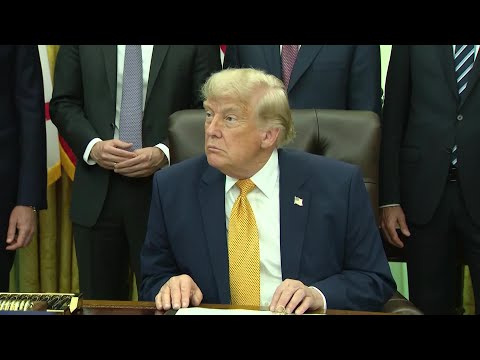
Donald Trump delivered a blunt ultimatum to Tehran during a Q&A session on Bloomberg Television, stating, “If Iran doesn’t behave, I will do what I need to do.” This declaration anchors a renewed hardline posture toward the Islamic Republic. It signals a potential return to the “maximum pressure” campaign that defined US-Iran relations during his presidency. For global markets and international diplomats watching in 2026, the message is unambiguous. The threshold for American military and economic retaliation remains tied directly to Iranian compliance.
The phrasing is intentionally broad. It leaves the specific mechanisms of enforcement unstated. But the historical context provides the blueprint.
In diplomacy, strategic ambiguity serves a purpose. It forces the adversary to calculate the worst-case scenario. Trump has utilized this tactic consistently regarding Middle Eastern affairs, forcing both allies and adversaries to constantly evaluate American red lines.
The Bloomberg Television Q&A
The venue for this statement matters. Bloomberg Television broadcasts directly to trading floors, corporate boardrooms, and international financial institutions. When a prominent American political figure discusses potential conflict with Iran, the immediate ripple effect hits energy markets. Oil futures react instantly to instability in the Persian Gulf.
Trump used the platform to draw a clear line. The phrase “do what I need to do” encompasses a wide spectrum of geopolitical tools. It ranges from secondary sanctions targeting global banks to direct kinetic military action against Iranian infrastructure.
The interviewer pressed for specifics regarding potential responses to Iranian aggression. Trump maintained his preferred stance of unpredictability. He declined to outline exact parameters regarding Iranian uranium enrichment levels or proxy militia attacks. The refusal to provide a detailed matrix of escalation is a core component of his negotiating style. It deprives Tehran of a clear boundary to safely push against.
The Legacy of Maximum Pressure
To understand the weight of the 2026 statement, one must look back to 2018. On May 8, 2018, the United States officially withdrew from the Joint Comprehensive Plan of Action (JCPOA). The Obama-era nuclear agreement was systematically dismantled.
In its place, the Trump administration instituted the “maximum pressure” campaign. This strategy sought to isolate Tehran from the global financial system completely. It targeted the Iranian energy sector, shipping networks, and the central banking apparatus.
The goal was economic strangulation. By penalizing foreign entities that did business with Iran, the United States effectively weaponized the dominance of the US dollar. Iranian crude oil exports plummeted. The rial lost massive value against foreign currencies. Multinational corporations abandoned joint ventures in Tehran to protect their access to American markets.
Trump’s recent comments on Bloomberg suggest a desire to return to this exact architecture. If Iran “doesn’t behave,” the first lever pulled is almost always economic. The strict enforcement of secondary sanctions on nations purchasing Iranian oil, specifically China, would likely be the opening move of any renewed pressure campaign.
The Kinetic Threshold: January 2020
Economic pressure is only one half of the equation. The phrase “do what I need to do” carries a specific kinetic weight due to the events of early 2020.
On January 3, 2020, an American MQ-9 Reaper drone fired missiles at a two-vehicle convoy leaving Baghdad International Airport. The strike killed Major General Qasem Soleimani. Soleimani was the commander of the Quds Force, the elite extraterritorial operations wing of Iran’s Islamic Revolutionary Guard Corps (IRGC).
This was an unprecedented escalation. For decades, the US and Iran had engaged in a shadow war. Proxy forces clashed. Cyberattacks disrupted critical infrastructure. But the direct, overt assassination of a top state official crossed a long-established red line in Middle Eastern geopolitics.
Trump ordered the strike. He stated that Soleimani was planning imminent attacks on American diplomats and military personnel. The action proved that Trump’s threats of decisive action were not purely rhetorical. He was willing to authorize lethal force against the highest echelons of the Iranian military apparatus.
When Trump warns Iran in 2026, Tehran remembers the Baghdad strike. The historical willingness to authorize lethal force changes how his public statements are analyzed by foreign intelligence services. The threat is not viewed as an empty bluff.
Iran’s Posture in 2026
The geopolitical landscape of the Middle East has evolved significantly since Trump last held the presidency. Iran has not remained static. The Islamic Republic has adapted to years of economic isolation and shifting regional dynamics.
Uranium enrichment levels remain a primary concern for Western intelligence. The International Atomic Energy Agency (IAEA) consistently monitors Iranian nuclear facilities. Tehran has pushed enrichment closer to weapons-grade purity. They maintain that the program is strictly for civilian energy and medical research. The United States and Israel operate on the assumption that Iran is a threshold nuclear state, capable of rapid weaponization if the political decision is made.
Furthermore, Iran has solidified its alliances outside the Western sphere. Military cooperation with the Russian Federation has deepened. Iranian unmanned aerial vehicles (UAVs), specifically the Shahed series loitering munitions, have become a highly visible staple of modern asymmetric warfare globally.
Economic ties with Beijing have also strengthened. China remains a vital lifeline for Iranian oil exports. Tehran bypasses Western financial networks through localized currency exchanges, barter systems, and a massive “dark fleet” of covert oil tankers operating with disabled transponders.
If Trump intends to “do what is needed,” the diplomatic and economic hurdles are higher in 2026. Isolating Iran now requires confronting the broader Eurasian bloc that currently sustains its economy.
The Axis of Resistance
Direct conflict with Iran is rarely direct. Tehran projects power through a complex network of proxy militias known as the Axis of Resistance.
This network includes Hezbollah in Lebanon, various Shia militias in Iraq and Syria, Hamas in the Gaza Strip, and the Houthi movement in Yemen. These groups allow Iran to strike adversaries while maintaining plausible deniability on the international stage.
In recent years, the Houthis have demonstrated the ability to severely disrupt global shipping in the Red Sea and the Bab-el-Mandeb strait. This maritime chokepoint is critical for global trade. Iranian-backed militias in Iraq and Syria frequently target US military installations in the region.
When Trump demands that Iran “behave,” the demand extends to this entire proxy network. The American security apparatus holds Tehran directly responsible for the actions of its funded, trained, and equipped militias. Retaliation for a proxy strike could mean direct action against Iranian sovereign assets.
Domestic Politics and the Cultural Defense
Foreign policy is inextricably linked to domestic politics. Trump’s hardline stance on Iran plays a specific role in American political discourse.
It falls into a category of cultural defense. For his base of support, a muscular, unapologetic approach to adversaries signals national strength. The rhetoric of “doing what is needed” appeals to voters who feel the United States has become overly cautious, apologetic, or entangled in endless, fruitless diplomatic negotiations.
This stance provokes immediate, emotional responses across the political spectrum. Supporters view it as necessary deterrence. They argue that peace is achieved exclusively through overwhelming strength. They point to the Abraham Accords, the historic normalization agreements between Israel and several Arab nations brokered during the Trump administration, as proof that isolating Iran actually stabilizes the broader region.
Critics view the rhetoric as reckless. They argue that abandoning the JCPOA accelerated Iran’s nuclear program rather than halting it. They warn that ambiguous threats of military action dramatically increase the risk of miscalculation. A localized skirmish in the Persian Gulf could rapidly escalate into a broader, catastrophic regional war.
This intense polarization ensures that any statement Trump makes regarding Iran dominates the news cycle. It forces political opponents to respond. It galvanizes his supporters. It turns foreign policy into a domestic litmus test.
The Strait of Hormuz and Global Energy
The economic implications of Trump’s warning cannot be overstated. The global economy relies on the uninterrupted flow of petroleum.
Roughly 20 percent of the world’s petroleum passes through the Strait of Hormuz. This narrow waterway separates Iran from the Arabian Peninsula. Iran has repeatedly threatened to close the strait in response to military or economic aggression from the West.
A closure, even a temporary one, would send immediate shockwaves through global markets. Oil prices would spike dramatically. Supply chains would fracture. The resulting inflation would impact consumers worldwide, halting economic growth in both developed and developing nations.
The United States Navy’s Fifth Fleet, headquartered in Bahrain, is tasked with keeping these vital sea lanes open. Any American action against Iran must account for the vulnerability of this maritime chokepoint. “Doing what is needed” requires securing the strait against Iranian fast-attack craft, naval mines, and shore-based anti-ship missile batteries.
The Future of US-Iran Relations
The dynamic between Washington and Tehran remains one of the most volatile geopolitical fault lines in 2026. The structural animosity runs deep. It is rooted in decades of historical grievances, ideological opposition, and fiercely competing regional interests.
Trump’s statement on Bloomberg Television is not a new policy direction. It is a reaffirmation of an established worldview. It prioritizes heavy deterrence over dialogue. It favors unilateral American action over multilateral consensus building.
The approach carries inherent, massive risks. Maximum pressure leaves little room for diplomatic off-ramps. When an adversary is backed into a corner with no economic relief in sight, the incentive to escalate militarily often increases.
Yet, the threat of overwhelming force remains a potent tool of statecraft. The US military possesses unparalleled capability to project power into the Middle East. The Iranian leadership is acutely aware of the vast disparity in conventional military strength.
The global community watched. The markets reacted. The proxies maneuvered.
Diplomats analyzed. Military planners prepared. The cameras rolled.
Ultimatum.