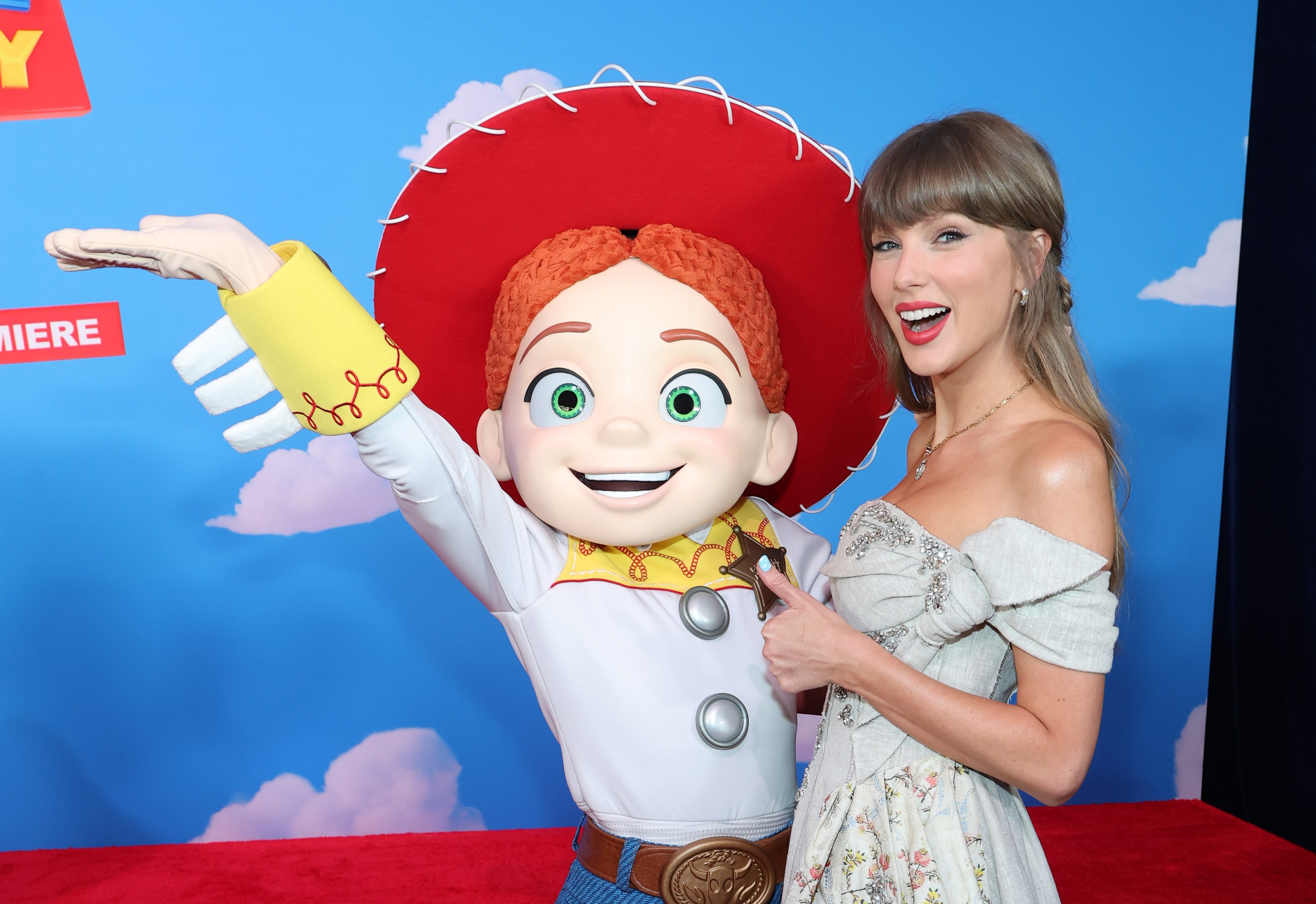
Taylor Swift’s original song “I Knew It, I Knew You” from the Disney Pixar Toy Story 5 soundtrack debuted at No. 1 on the Billboard Hot 100 in June 2026, marking her 15th career chart-topping single. The acoustic-driven ballad, released alongside the highly anticipated animated sequel, achieved massive first-week metrics across streaming, radio, and digital sales platforms. By claiming the top spot, Swift breaks her historical tie with Rihanna, securing sole possession of the position for the most No. 1 hits by a female artist behind only Mariah Carey.
The convergence of a global pop phenomenon and a legacy animation franchise created an inescapable cultural moment. It was not merely a music release. It was a synchronized corporate event.
The Billboard Hot 100 measures U.S. streaming, radio airplay, and sales data tracked by Luminate. To debut at No. 1 in the modern music economy requires a perfect storm of algorithmic dominance, physical media mobilization, and terrestrial radio support. Swift and Disney engineered exactly that.
The Numbers Behind the Debut
Luminate data for the tracking week ending June 18, 2026, reveals the sheer scale of the release. “I Knew It, I Knew You” generated 68.4 million official U.S. streams. It secured 42 million radio airplay audience impressions. It sold 74,000 equivalent digital and physical units.
These metrics did not happen by accident. The release strategy utilized multiple physical variants. Four distinct CD singles and three 7-inch vinyl records were made available exclusively through Swift’s official webstore and Target locations nationwide. Each physical edition featured alternate cover art featuring different character pairings from Toy Story 5, Woody and Buzz, Jessie and Bullseye, Rex and Hamm.
Physical sales accounted for a significant portion of the track’s chart points. In an era where streaming pays fractions of a cent, physical media remains the ultimate lever for chart dominance. Fans mobilized to collect the set. The numbers surged.
Radio adoption was equally swift. iHeartMedia stations across the Pop, Adult Contemporary, and Hot AC formats placed the track on hourly rotation. The song’s acoustic pop production allowed it to bridge multiple formats seamlessly. It played in grocery stores. It played in minivans. It played on TikTok.
Climbing the All-Time Ranks
The Billboard Hot 100 has served as the definitive metric of American musical success since its inception on August 4, 1958. Achieving a No. 1 hit is difficult. Amassing 15 is a historical anomaly.
With this debut, Swift alters the upper echelon of the all-time charts. The Beatles hold the ultimate record with 20 No. 1 singles. Mariah Carey follows closely with 19. Swift now stands at 15, moving past Rihanna, who holds 14, and Michael Jackson, who secured 13 during his lifetime.
Swift’s journey to 15 spans over a decade of continuous reinvention. Her first No. 1 came in 2012 with “We Are Never Ever Getting Back Together.” She dominated the 2010s with tracks like “Shake It Off” and “Blank Space.” She conquered the streaming era with “Anti-Hero” and “Cruel Summer.” Now, she extends her reign through cinematic synergy.
The velocity of her recent chart success is notable. Six of her 15 No. 1 hits have occurred in the 2020s. While legacy acts often see their chart performance wane as their careers progress, Swift’s commercial gravity has only intensified. She does not just compete with contemporary artists. She competes with history.
The Disney Synergy Machine
The partnership between Taylor Swift and The Walt Disney Company represents a masterclass in cross-promotional leverage. The relationship was solidified when Disney CEO Bob Iger secured the exclusive streaming rights to Taylor Swift: The Eras Tour (Taylor’s Version) for Disney+ in early 2024. That deal reportedly cost Disney $75 million. It paid immediate dividends in subscriber retention.
Securing Swift for Toy Story 5 was the logical next step. Pixar Animation Studios, led by Chief Creative Officer Pete Docter, needed a cultural anchor for the franchise’s fifth installment. The Toy Story series has historically relied on the musical genius of Randy Newman, whose 1995 classic “You’ve Got a Friend in Me” defined the emotional landscape of the original films.
Swift was not brought in to replace Newman. She was brought in to expand the universe. “I Knew It, I Knew You” plays during the film’s climactic third-act montage, a narrative space previously occupied by Sarah McLachlan’s devastating “When She Loved Me” in Toy Story 2.
Disney utilized its entire corporate apparatus to promote the track. ESPN featured the song during NBA Finals broadcasts. ABC’s Good Morning America hosted the exclusive music video premiere. Theme parks in Anaheim and Orlando integrated the melody into their nightly fireworks displays. The song was inescapable because the distribution network was infinite.
The Anatomy of the Anthem
Musically, “I Knew It, I Knew You” is a precise piece of engineering. Co-written and co-produced by Swift and her longtime collaborator Jack Antonoff, the track blends the acoustic intimacy of her Folklore era with the expansive pop sensibilities of 1989.
The instrumentation is grounded. A finger-picked Martin acoustic guitar drives the verse. A swelling string section, arranged by Bryce Dessner, elevates the chorus. Antonoff’s signature analog synthesizers pulse quietly in the background, providing a modern heartbeat to a traditional ballad structure.
The lyrics operate on two distinct levels. For the audience of Toy Story 5, the song speaks directly to the enduring, evolving relationship between Woody and Buzz Lightyear, a meditation on loyalty across decades. For Swift’s core fanbase, the lyrics easily translate into a reflection on long-term friendship, shifting eras, and the comfort of being deeply understood.
The Soundtrack Resurgence
The success of the single underscores a broader shift in the music industry: the return of the blockbuster movie soundtrack. For much of the late 2010s, original songs for films struggled to break the upper tiers of the Hot 100, often relegated to Adult Contemporary charts or Oscar campaigns.
That paradigm shifted with Black Panther in 2018 and exploded with Barbie in 2023. Billie Eilish’s “What Was I Made For?” and Dua Lipa’s “Dance The Night” proved that theatrical releases could still drive massive pop consumption. Film studios realized that a hit song acts as a four-minute, highly repeatable trailer for the movie.
Disney recognized this mechanism. By releasing “I Knew It, I Knew You” two weeks prior to the theatrical premiere of Toy Story 5, they ensured the film dominated cultural conversation before a single ticket was scanned. The song drove anticipation. The anticipation drove box office sales. The box office sales drove further streams. The feedback loop was absolute.
The Economics of a No. 1 Debut
Debuting at No. 1 is a capital-intensive endeavor. It requires meticulous timing and significant financial investment from the record label. Republic Records, Swift’s label under Universal Music Group, executed a flawless rollout.
The marketing spend for the first week was heavily front-loaded. Digital billboards in Times Square and Piccadilly Circus. Promoted audio on Spotify’s free tier. Sponsored hashtags on TikTok. The goal is never a slow climb. The goal is immediate, overwhelming market dominance.
This strategy also starves competitors of oxygen. By dropping a high-profile soundtrack single with physical variants, Swift effectively blocked other major releases from the top spot. In the modern music industry, real estate at the top of the Billboard Hot 100 is finite. You either hold the crown, or you are blocked by the person who does.
The Cultural Permanence
The intersection of Taylor Swift and Toy Story bridges a massive generational divide. The original Toy Story premiered in 1995. Many of the children who watched it in theaters are now parents taking their own children to see Toy Story 5. Simultaneously, Swift’s career, which began in 2006, has soundtracked the entire lives of Millennials and Generation Z.
When those demographics converge in a movie theater, the emotional resonance is compounded. The song acts as a trigger for nostalgia while remaining firmly planted in the present cultural moment. It is a calculated, highly effective piece of emotional engineering.
As the tracking week closed, the outcome was inevitable. The data compiled. The algorithms processed. The chart refreshed.
Fans streamed. Stations broadcasted. Registers rang.
History.