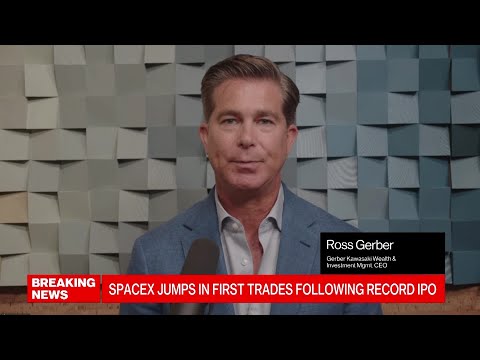
A merger between Tesla and SpaceX is increasingly viewed as a “foregone conclusion” by prominent investors, including Gerber Kawasaki CEO Ross Gerber. Speaking on Bloomberg Television, Gerber outlined a future where Elon Musk consolidates his sprawling corporate empire into a single, unified technology conglomerate. The logic rests on shared engineering resources, overlapping executive oversight, and Musk’s historical preference for centralized control. What sounds like corporate science fiction is now being openly debated on Wall Street.
The lines separating an electric vehicle manufacturer and an aerospace company are already blurring. Tesla engineers frequently consult on SpaceX projects. SpaceX material science finds its way into Tesla vehicles. The financial and operational firewalls between the entities exist on paper, but the intellectual capital flows freely.
Investors are watching this convergence. They are calculating the endgame. For analysts managing billions in assets, the current fragmented structure of Musk’s empire looks increasingly temporary.
The Bloomberg Television Declaration
Ross Gerber did not mince words. Appearing on Bloomberg Television, the CEO of Gerber Kawasaki Wealth and Investment Management laid out a stark prediction for the future of the world’s most valuable automaker.
Gerber manages roughly $2.2 billion in assets. His firm has been a long-time stakeholder in Tesla. He understands the rhythms of the company and the behavioral patterns of its chief executive.
“It’s a foregone conclusion that Tesla and SpaceX will eventually merge,” Gerber stated.
This was not a casual observation. It was a thesis based on operational reality. Gerber pointed to the undeniable fact that Musk’s attention is currently divided across multiple massive enterprises. Tesla requires absolute focus. SpaceX is attempting to colonize Mars. X, formerly Twitter, demands constant crisis management. Neuralink and The Boring Company operate in the background. xAI is racing to catch OpenAI.
For a fiduciary like Gerber, divided attention is a risk factor. Consolidation is the remedy. By rolling the entities under one roof, the corporate governance structure would finally match the operational reality. Musk would not be a part-time CEO of five companies. He would be the absolute chief of one mega-corporation.
The Precedent of SolarCity
History supports the merger thesis. Elon Musk has executed this exact maneuver before, albeit on a smaller scale.
In 2016, Tesla acquired SolarCity for $2.6 billion in stock. At the time, SolarCity was a separate, publicly traded solar panel installation company founded by Musk’s cousins, Lyndon and Peter Rive. Musk was the chairman and largest shareholder of both companies.
The rationale presented to the public was synergy. Tesla was building the Powerwall. SolarCity was building the panels. Combining them created an integrated sustainable energy company. You generate the power on your roof, store it in your garage, and drive it to work.
Wall Street was skeptical. Many analysts viewed the deal as a bailout of a struggling solar company using Tesla’s highly valued equity. Institutional investors pushed back. Lawsuits were filed in the Delaware Court of Chancery. Shareholders accused Musk of orchestrating a conflicted transaction to save his own investment.
Musk ultimately won the lawsuit. The Delaware judge ruled that while the process was flawed, the acquisition price was entirely fair. SolarCity was absorbed. The brand was folded into Tesla Energy. Today, the integration is complete.
The SolarCity acquisition proved two things. First, Musk is willing to merge his companies when he believes the operational synergy outweighs the financial friction. Second, he is willing to endure years of litigation to force that vision into reality.
Materials, Minds, and Shared DNA
The argument for a Tesla and SpaceX merger goes beyond corporate governance. It is rooted in hard engineering.
The two companies already operate as a Venn diagram of technological development. When Tesla set out to build the Cybertruck, they required an ultra-hard, cold-rolled stainless steel alloy. This was not an automotive industry standard. It was a material science problem.
SpaceX had already solved it. The aerospace company developed a proprietary stainless steel alloy for the exterior hull of the Starship rocket at its Starbase facility in Boca Chica, Texas. Tesla leveraged that exact material science for the Cybertruck.
The overlap extends to software and talent. When Tesla faced production hell during the Model 3 ramp-up in 2018, Musk pulled engineers from SpaceX to help rewrite logistics software on the factory floor in Fremont, California. When SpaceX needs advanced battery management systems for its spacecraft, it looks to Tesla’s energy division.
- Material Science: Shared use of proprietary steel alloys and advanced casting techniques.
- Manufacturing: Cross-pollination of gigapress technology and automated assembly lines.
- Software: Shared talent pools in machine learning, vision systems, and logistics software.
- Leadership: A rotating cast of executives and engineers who move seamlessly between Hawthorne, Austin, and Boca Chica.
If the talent is already shared, and the materials are already shared, the corporate boundary becomes an artificial construct. A merger simply formalizes an integration that has existed for a decade.
The Artificial Intelligence Catalyst
The most pressing driver for consolidation is artificial intelligence. Specifically, the emergence of xAI.
In early 2024, Elon Musk issued an ultimatum on X. He stated he was uncomfortable growing Tesla into an AI and robotics leader without having roughly 25 percent voting control of the company. If he did not secure that control, he threatened to build products outside of Tesla.
This sent a shockwave through institutional investors. Tesla’s sky-high market capitalization, often hovering between $500 billion and $800 billion, is not based on selling sedans. It is based on the promise of Full Self-Driving (FSD), the Optimus humanoid robot, and the Dojo supercomputer. If Musk diverts AI development to a private company like xAI, Tesla’s valuation collapses.
A mega-merger solves the control problem. If Tesla, SpaceX, and xAI are rolled into a single holding company, the equity structures can be renegotiated. Musk could secure the super-voting shares he desires. The intellectual property of xAI could flow directly into Tesla’s Optimus robots and SpaceX’s autonomous drones without violating fiduciary duties to separate shareholder bases.
AI is the connective tissue. It requires massive capital. It requires massive compute. Pooling the resources of Tesla and SpaceX creates an AI juggernaut capable of rivaling Microsoft, Alphabet, and Meta.
The Mechanics of a Mega-Merger
Predicting a merger is easy. Executing it is a logistical nightmare.
Tesla is a publicly traded company on the NASDAQ. It has millions of retail investors and massive institutional backing from Vanguard, BlackRock, and State Street. It is subject to daily market volatility and quarterly earnings pressure.
SpaceX is a private company. It operates with a long-term horizon, insulated from the daily whims of the stock market. In late 2023, secondary market tender offers valued SpaceX at roughly $180 billion. It is the most valuable private company in the United States.
How do you combine them? You cannot simply have Tesla buy SpaceX. Tesla does not have $180 billion in cash, and issuing that much stock would massively dilute existing shareholders. Conversely, SpaceX cannot buy Tesla.
The “X Holdings” Solution
The most viable path is the Alphabet model. In 2015, Google reorganized. It created a new holding company called Alphabet Inc. Google became a subsidiary. Waymo became a subsidiary. DeepMind became a subsidiary.
Musk could execute a similar maneuver. He could form a new publicly traded holding company, likely named X Holdings. Tesla shareholders would trade their TSLA stock for shares in X Holdings. SpaceX private shareholders would do the same.
Under this umbrella, Tesla, SpaceX, xAI, Neuralink, and The Boring Company would operate as wholly owned subsidiaries. They would share a central treasury, a centralized AI computing cluster, and a single board of directors.
This structure allows the public markets to invest in the entirety of the Musk ecosystem. It allows SpaceX to access the massive liquidity of the public markets without undergoing a traditional Initial Public Offering (IPO). It allows Tesla to benefit from the halo effect of SpaceX’s technological milestones.
The Starlink Financial Engine
Any discussion of a SpaceX merger must account for Starlink. The satellite internet constellation is the financial engine that makes SpaceX a viable business.
Launching rockets is a low-margin, high-risk endeavor. Providing global broadband internet is a high-margin software and services business. Starlink has deployed thousands of satellites into low Earth orbit. It is generating billions in recurring subscription revenue.
Musk previously stated that Starlink might be spun off into its own publicly traded company once its cash flow became predictable. A merger with Tesla changes that calculus.
If Starlink is folded into a unified corporate structure, its massive cash flow can be used to fund Tesla’s capital-intensive factory expansions and xAI’s server farms. Furthermore, the integration with Tesla vehicles is obvious. Every Tesla could become a rolling Starlink terminal, guaranteeing connectivity anywhere on Earth. The subscription revenue could be bundled. You buy a Tesla, you get Starlink internet, you get FSD software.
This creates an unbreakable ecosystem. Apple built its empire on locking users into hardware and software. A combined Tesla-SpaceX-Starlink entity would lock users into transportation, energy, and global communications.
Regulatory Roadblocks and the SEC
The primary barrier to this vision is not financial. It is regulatory.
The Securities and Exchange Commission (SEC) has a famously combative relationship with Elon Musk. Any attempt to merge a $600 billion public company with a $180 billion private company will trigger intense scrutiny. The SEC will demand absolute transparency regarding valuations, conflicts of interest, and shareholder voting procedures.
Furthermore, SpaceX is not just a technology company. It is a defense contractor. SpaceX launches classified payloads for the Department of Defense. It provides critical infrastructure for NASA. The United States government relies on the Falcon 9 and Starship architectures for national security.
The Pentagon will have a say in any merger. Allowing a defense contractor to be absorbed into a massive public conglomerate, especially one with significant manufacturing exposure in Shanghai, China via Tesla’s Gigafactory, presents complex geopolitical risks. The Committee on Foreign Investment in the United States (CFIUS) would likely review the transaction.
Tesla’s reliance on the Chinese market is the Achilles heel of the merger thesis. The Chinese government is a major supporter of Tesla, providing land and loans for the Shanghai plant. However, the Chinese government views Starlink as a national security threat. Combining a company deeply embedded in China (Tesla) with a company deeply embedded in the U.S. military-industrial complex (SpaceX) creates a diplomatic tightrope.
The Inevitable Collision
Despite the regulatory hurdles and the sheer financial complexity, the logic of consolidation remains compelling. Ross Gerber’s prediction on Bloomberg Television simply vocalized what many on Wall Street have quietly modeled in their spreadsheets.
The current structure is inefficient. The talent overlaps. The technologies overlap. The leader is the same.
As AI becomes the dominant force in global technology, the need for centralized compute and centralized capital will force Musk’s hand. He cannot afford to have his best engineers siloed. He cannot afford to have his capital divided across separate balance sheets.
The holding company is the logical conclusion. The silos will fall. The ledgers will merge. The lines between an automaker, an aerospace contractor, and an artificial intelligence lab will vanish completely.
Capital gathers. Engineers gather. Ambitions gather.
Convergence.