
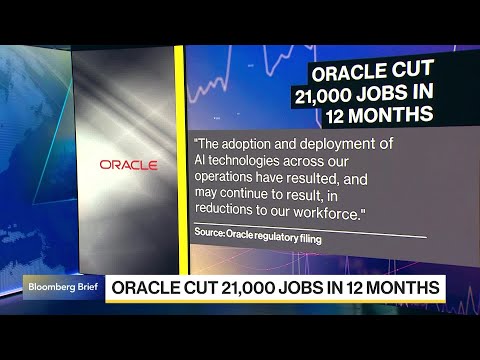
Oracle Corporation, a prominent entity in enterprise software and cloud computing, executed a substantial workforce reduction over a 12-month period ending in 2026. The company decreased its global employee base by approximately 21,000 positions. This strategic adjustment aligns with Oracle’s intensified integration of artificial intelligence (AI) and automation into its core operations, leading to optimized efficiency and a redefined organizational structure.
This transformation at Oracle highlights a broader industry trend. Technological advancements, particularly in AI, are reshaping how large corporations manage their human capital and operational workflows. The shifts observed at Oracle serve as a case study for the evolving relationship between technology and employment in the modern economy.
The Scale of Oracle’s Workforce Adjustment
The reduction of 21,000 jobs represents a significant demographic shift within Oracle’s global operations. This figure encompasses positions across various departments and geographical locations. The changes were not confined to a single business unit but rather spread throughout the enterprise as automation capabilities expanded.
The company has been actively investing in AI research and development for several years. These investments have now matured into deployable solutions. These solutions are capable of handling tasks traditionally performed by human employees.
Oracle’s cloud infrastructure, known as Oracle Cloud Infrastructure (OCI), has been a primary beneficiary of these AI integrations. Automated systems manage server provisioning, network optimization, and routine maintenance tasks. This reduces the need for extensive human oversight in these areas.
The financial implications of such a large-scale reduction are substantial. Labor costs represent a significant portion of operating expenses for technology companies. Streamlining the workforce through automation can lead to considerable savings, which can then be reinvested into further technological development or returned to shareholders.
Impact on Specific Roles and Departments
The job reductions at Oracle were not uniform across all job functions. Roles susceptible to automation were primarily affected. These often included positions in customer support, data entry, quality assurance, and certain administrative functions.
Customer support, for example, has seen the deployment of advanced chatbots and AI-driven virtual assistants. These tools can resolve common customer queries and provide technical assistance without human intervention. Complex issues are escalated to human agents, but the volume of such escalations has decreased.
In data management, AI algorithms now perform tasks like data cleansing, migration, and analysis with greater speed and accuracy than manual processes. This has optimized Oracle’s ability to manage its vast databases and provide insights to clients.
Quality assurance (QA) departments also experienced changes. Automated testing frameworks, powered by machine learning, can identify bugs and performance issues in software code more efficiently. This shifts the focus of human QA professionals towards developing and refining these automated tools, rather than executing repetitive tests.
Artificial Intelligence: A Catalyst for Change
Artificial intelligence is not merely a tool for efficiency; it is a transformative force. Oracle’s adoption of AI reflects a strategic decision to embrace this transformation. The company aims to remain competitive in a rapidly evolving technological landscape.
AI’s role extends beyond simple task automation. It involves predictive analytics, machine learning algorithms, and natural language processing. These capabilities allow systems to learn from data, make informed decisions, and interact with users in more sophisticated ways.
The development of Oracle’s autonomous database, an AI-powered cloud database that automates patching, tuning, and upgrading, exemplifies this shift. This product reduces the need for human database administrators to perform routine maintenance, freeing them to focus on more strategic tasks.
Larry Ellison, Oracle’s co-founder and Chairman, has consistently championed the power of automation. His vision for autonomous systems has guided much of Oracle’s product development and internal operational strategies over the past decade.
The Broader Economic Context of AI Adoption
Oracle’s workforce adjustments are not isolated incidents. They are part of a larger economic trend. Industries worldwide are grappling with the implications of AI and automation. Many companies are exploring how these technologies can enhance productivity and reduce costs.
Reports from institutions like the World Economic Forum indicate that AI is expected to displace millions of jobs globally in the coming years. However, these reports also suggest that AI will create new jobs, often requiring different skill sets.
Economists refer to this phenomenon as job displacement and job creation. The challenge for the workforce and policymakers is to manage this transition. This includes investing in retraining programs and fostering adaptability among workers.
Governments and educational institutions are increasingly recognizing the need to prepare the labor force for an AI-driven economy. Curricula are being updated to include data science, machine learning, and robotics. This aims to equip future generations with the skills required for new roles.
Strategic Reorientation at Oracle
Oracle’s decision to reduce its workforce is a component of a larger strategic reorientation. The company is intensifying its focus on high-growth areas. These areas include cloud computing, AI services, and industry-specific solutions.
The acquisition of Cerner Corporation for approximately $28.3 billion in June 2022 was a pivotal move in this strategy. Cerner, a leading provider of digital information systems for hospitals and health networks, brought Oracle deeper into the healthcare technology sector. Oracle aims to leverage AI to innovate healthcare solutions.
Oracle’s cloud business has been a key driver of its recent growth. The company competes directly with Amazon Web Services (AWS) and Microsoft Azure. AI integration is seen as a way to differentiate its cloud offerings and provide superior performance and cost-efficiency.
The company also continues to expand its enterprise resource planning (ERP) and customer relationship management (CRM) software suites. These platforms are increasingly powered by AI to offer predictive insights and automated workflows to business clients.
Investment in Emerging Technologies
Beyond AI, Oracle is investing in other emerging technologies. These include blockchain, the Internet of Things (IoT), and advanced analytics. These investments are designed to complement its AI initiatives and create a comprehensive technology ecosystem.
Blockchain technology is being explored for secure data management and supply chain transparency. IoT integration allows Oracle’s platforms to collect and process data from a vast network of connected devices. This provides real-time insights.
These technological advancements require a specialized workforce. Oracle is actively recruiting talent in areas such as machine learning engineering, data science, and cloud architecture. This reflects a shift in demand for specific skills within the company.
The company’s campus in Austin, Texas, and its headquarters in Austin, Texas, serve as hubs for much of this innovation. These locations attract top technical talent and foster a culture of technological advancement.
The Human Element: Adaptation and Reskilling
While automation reduces the need for certain roles, it also creates opportunities for others. The human element in this technological transition involves adaptation and reskilling. Employees whose roles are impacted by AI often face the challenge of acquiring new competencies.
Oracle has implemented internal programs aimed at reskilling its existing workforce. These programs focus on training employees in areas such as AI development, cloud architecture, and data analytics. The goal is to transition employees into new roles that support the company’s strategic direction.
However, the scale and speed of technological change can outpace these efforts. Not all employees may be able to transition successfully into new roles. This creates societal challenges related to unemployment and economic disparity.
The responsibility for managing these transitions often falls on both corporations and individuals. Corporations are expected to provide support and training. Individuals are expected to embrace continuous learning and skill development.
Future Outlook for the Workforce
The trend observed at Oracle suggests a future workforce that is increasingly integrated with AI and automation. Human workers will likely focus on tasks that require creativity, critical thinking, emotional intelligence, and complex problem-solving – areas where AI currently has limitations.
The demand for AI trainers, ethicists, and system designers is expected to grow. These roles involve overseeing and guiding AI systems, ensuring they operate effectively and responsibly.
The partnership between humans and AI is becoming a central theme in discussions about the future of work. The goal is not necessarily to replace humans entirely but to augment human capabilities with AI, leading to a more productive and innovative workforce.
Companies like Oracle are at the forefront of this evolution. Their actions provide insights into the challenges and opportunities that lie ahead for the global labor market. The transition is ongoing. The full impact of AI on employment patterns is still unfolding.
Companies adapt. Technologies evolve. Workforces reshape.
The future of work.