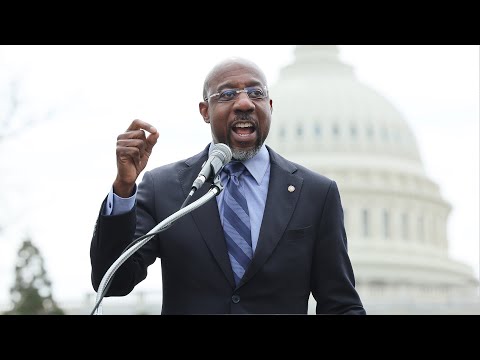
During a June 2026 interview on Bloomberg Television, Georgia Democratic Senator Raphael Warnock explicitly labeled the modern Republican Party a cult, citing an inability to govern due to internal ideological demands. The statement immediately shifted the national political conversation. The anchor had asked a routine question about congressional gridlock. Warnock did not offer a routine answer. He bypassed standard political complaints about partisanship and delivered a clinical, terminal diagnosis of his opposition.
Warnock delivered the remark calmly. He did not raise his voice. The setting was a standard financial and political policy discussion broadcast from a bright Washington D.C. studio. The word choice caught the anchor off guard. It caught Washington off guard.
But the story does not begin with a single television segment. What looks like a sudden escalation in partisan rhetoric actually reveals a calculated shift in how Democratic leadership plans to frame the 2026 election cycle. The era of the high road is over. The era of blunt force categorization has arrived.
The Bloomberg Television Interview
The morning of the interview began with standard economic fare. Bloomberg Television caters to markets, investors, and policy analysts. The discussion centered on inflation metrics, Federal Reserve interest rates, and the stalled 2026 infrastructure appropriations bill. Warnock sat in the guest chair to discuss Georgia’s growing manufacturing sector.
The pivot occurred halfway through the segment. The anchor asked about the mechanics of negotiating with the Republican-controlled House of Representatives. The 119th Congress had been paralyzed by internal GOP leadership battles. Passing routine spending bills required weeks of brinkmanship. The anchor wanted to know how the Senate planned to bridge the divide.
Warnock leaned forward. He stated that negotiation requires two rational actors operating in good faith. He then stated that the Democratic Party was currently trying to negotiate with a cult. The sentence hung in the air. The anchor pressed for clarification. Warnock did not retreat. He doubled down, describing a political apparatus entirely captured by personality and ideological purity tests, incapable of basic legislative function.
The clip hit social media before the broadcast ended. Within an hour, it was the top trending topic on X. Within two hours, it was leading the afternoon coverage on Fox News and MSNBC. A single word transformed a dry policy interview into the defining political moment of the week.
A Departure from the Pulpit
To understand the shockwave, one must understand the source. Raphael Warnock is not a backbench provocateur. He is the Senior Pastor of Ebenezer Baptist Church in Atlanta. He preaches from the same pulpit once held by Martin Luther King Jr. His entire political brand is built on pastoral grace and moral elevation.
During his grueling 2021 runoff campaign against Kelly Loeffler, Warnock absorbed millions of dollars in negative advertising without returning fire in kind. He spoke of unity. He spoke of a shared American destiny. During his 2022 runoff victory over Herschel Walker, he maintained the same disciplined, unifying tone. His campaign slogan reminded voters that Americans are all in the same boat.
Using the word cult is a secular, clinical, and combative choice. It is a psychological diagnosis weaponized for political combat. It strips the opposition of their legitimacy. A political party is an organization you can compromise with. A cult is an organization you must defeat.
This rhetorical shift from the pulpit to the trenches was not an accident. Warnock is a highly disciplined communicator. When a disciplined communicator changes their vocabulary on national television, it signals a broader strategic directive.
The Anatomy of a Political Label
The word cult carries specific historical and cultural weight. In the American lexicon, it invokes images of compound sieges, charismatic manipulation, and a total detachment from objective reality. Injecting this word into mainstream political discourse is a deliberate escalation.
For years, progressive commentators and left-leaning media figures have used the term to describe the MAGA movement’s devotion to Donald Trump. But elected Democratic officials usually danced around the word. They preferred terms like extreme, radical, or misguided. Those words leave room for eventual reconciliation. The word cult burns the bridge entirely.
By June 2026, the political landscape had hardened. The Republican Party had spent years purging its moderate wing. Primary elections punished any incumbent who deviated from the core ideological line. Democratic strategists watched this internal consolidation and realized that appealing to a shared sense of bipartisanship was no longer yielding electoral dividends.
Warnock put the label on the record. He gave permission to the rest of the Democratic caucus to stop treating the opposition as a traditional political party. The label reframes the 2026 midterms. It is no longer a choice between two competing tax policies. It is framed as a choice between democratic governance and authoritarian devotion.
Gridlock in the 119th Congress
The context of Warnock’s frustration is rooted in the legislative reality of 2026. The 119th Congress has been defined by historically low output. Major bipartisan initiatives on border security, artificial intelligence regulation, and defense spending have died in committee.
Senate Democrats point to the House of Representatives as the bottleneck. The Republican majority, operating with a razor-thin margin, remains beholden to its most aggressive members. Any compromise with the Senate or the White House triggers threats of leadership removal. The incentive structure rewards obstruction over legislation.
Warnock’s state of Georgia relies heavily on federal infrastructure grants and agricultural subsidies. Delays in Washington translate to stalled projects in Atlanta, Savannah, and Macon. The Senator’s frustration on Bloomberg Television was not merely abstract. It was tied to millions of dollars in delayed federal investment.
By labeling the obstructionist faction a cult, Warnock attempted to explain the gridlock to the American public. He argued that the failure to pass laws was not a failure of the system, but a failure of the opposition’s psychological capacity to govern.
The Outrage Economy and Fundraising
Modern politics is fueled by outrage. Outrage drives engagement. Engagement drives donations. Warnock’s comment fed perfectly into the digital fundraising machine.
The Republican National Committee moved instantly. Within three hours of the Bloomberg interview, fundraising emails hit millions of inboxes. The subject lines were variations of the same theme: They Hate You. The emails argued that Warnock’s comment was not just an attack on politicians, but an attack on everyday conservative voters.
Conservative political action committees capitalized on the moment. WinRed servers processed a massive influx of small-dollar donations. Reports indicated that GOP-aligned groups raised over $3.2 million in the 48 hours following the interview. The outrage was monetized immediately.
But the outrage economy works both ways. Democratic fundraising platforms also saw a spike. ActBlue processed millions from progressive donors who were thrilled to finally hear a prominent Democrat take the gloves off. For years, the Democratic base had begged its leaders to stop bringing policy papers to a knife fight. Warnock delivered the rhetorical strike they had been waiting for.
The Suburban Voter Calculation
Elections in 2026 will not be decided by the deep red rural counties or the deep blue urban centers. They will be decided in the sprawling, affluent suburbs. Places like Cobb County in Georgia, Maricopa County in Arizona, and Bucks County in Pennsylvania hold the keys to the Senate and the House.
Suburban swing voters are typically exhausted by political chaos. They prioritize economic stability, good schools, and functional government. Warnock’s strategists understand this demographic intimately. Georgia’s suburbs delivered his previous victories.
Calling the GOP a cult is a calculated play for these voters. It is an attempt to isolate the Republican base from the moderate middle. The message to the suburban voter is clear: You may not agree with every Democratic policy, but the alternative is institutional madness. You cannot trust a cult with your 401k. You cannot trust a cult with your child’s education.
It is a high-risk, high-reward strategy. It risks alienating moderate conservatives who might feel insulted by the broad brush. But it rewards Democrats by keeping the focus entirely on Republican dysfunction rather than incumbent fatigue.
The Media Ecosystem Reacts
The fragmentation of the American media ecosystem ensured that Warnock’s comment was consumed in entirely different ways depending on the channel. Fox News dedicated its prime-time lineup to dissecting the arrogance of the coastal elite, despite Warnock’s deep southern roots. Pundits demanded apologies. They drew parallels to Hillary Clinton’s infamous basket of deplorables comment from 2016.
On MSNBC and CNN, the reaction was analytical and largely supportive. Commentators praised Warnock for his blunt honesty. They hosted panels of psychologists and political scientists to debate the academic definition of a cult, ultimately concluding that the Senator’s assessment was factually defensible.
On YouTube and TikTok, the clip lived a different life. It was remixed, reaction-streamed, and spliced into thousands of short-form videos. The algorithmic reward for polarized content pushed the clip onto millions of screens. Warnock, a 56-year-old pastor, briefly became the most viral figure on the internet.
The Long-Term Impact on Political Discourse
The normalization of extreme rhetoric is a one-way street. Once a taboo is broken, it rarely returns. By elevating the word cult to the level of a Sunday morning television interview, Warnock shifted the Overton window of acceptable political combat.
Future campaigns will look back at the 2026 cycle as a turning point. The language of diplomacy has been replaced by the language of existential threat. If the opposition is a cult, then every election is a battle for the survival of reality itself. There is no room for a loyal opposition.
The immediate political benefits for Warnock and the Democrats are clear. They fired up the base. They framed the narrative. They forced the Republicans to defend their internal dynamics. But the long-term cost to American civic life remains uncalculated. When both sides view the other not as fellow citizens, but as brainwashed adversaries, the mechanics of a republic begin to fracture.
The interview ended. The cameras turned off. The clip lived forever. Pundits debated the decorum. Strategists calculated the polling. Donors opened their wallets. Washington.