
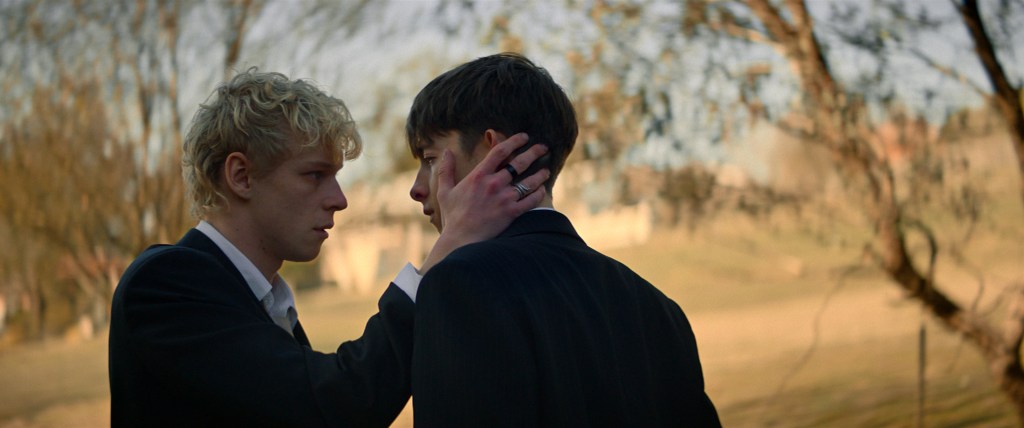
The 2026 horror film Leviticus answers a difficult cultural question by turning real-world trauma into cinematic terror. Directed by Thomas Vance, the film stars Joe Bird and Stacy Clausen as two closeted teenagers sent to a remote conversion therapy camp that harbors literal demons. The project uses the framework of psychological horror to explore the documented abuses of a practice that remains a flashpoint in American cultural politics.
But the story of Leviticus does not begin with jump scares. It begins with a fierce cultural debate about who gets to monetize trauma.
As the film hits theaters in June 2026, audiences are divided. Some view the horror genre as the perfect vehicle to expose the psychological violence of conversion therapy. Others argue that turning real-world suffering into Friday night entertainment crosses an ethical line. The film sits squarely at the center of this cultural defense matrix.
The Preparation of Joe Bird and Stacy Clausen
Actors Joe Bird and Stacy Clausen carried the weight of the production. Bird, who gained international recognition following his breakout role in the 2022 horror hit Talk to Me, stepped into the role of David. Clausen, known for her nuanced work in independent Australian cinema, plays Sarah. Both characters are teenagers forced into a secluded wilderness camp by their deeply religious families.
Preparing for the roles required more than standard line memorization. The actors spent four months working with survivors of actual conversion therapy programs. They partnered with advocacy groups, including The Trevor Project and the Born Perfect campaign. The goal was rigorous factual anchoring.
Bird and Clausen read psychological evaluations. They watched archival footage from the 1990s and early 2000s, an era when “ex-gay” ministries operated with minimal public oversight. They studied the specific language used by camp counselors in the film. The dialogue in Leviticus relies heavily on real-world manuals published by defunct organizations like Exodus International.
The actors isolated themselves during the six-week shoot in the Adelaide Hills of South Australia. The production design team transformed a derelict logging camp into “Camp Redemption,” the film’s fictional setting. Bird and Clausen remained on location. They minimized contact with the outside world. They wanted the isolation to bleed into their performances on screen.
The History of Conversion Therapy in Cinema
Hollywood has tackled this subject before, but rarely through the lens of horror. In 2018, films like Boy Erased and The Miseducation of Cameron Post approached conversion therapy as prestige drama. They relied on somber realism to convey the emotional devastation of the camps. They earned award nominations and critical acclaim.
Leviticus abandons prestige drama for visceral terror. Director Thomas Vance argued that traditional dramas often fail to capture the subjective, nightmarish reality experienced by the victims. By utilizing the horror genre, Vance aimed to make the audience physically feel the panic, the claustrophobia, and the existential dread of the teenagers.
This is not an entirely unprecedented move. The horror genre has a long history of processing societal fears. In the 1950s, giant radioactive monsters represented the dread of the atomic bomb. In the 1970s, films like The Texas Chain Saw Massacre reflected the brutal disillusionment of the Vietnam War era. By 2026, the genre has pivoted inward, focusing on institutional and psychological rot.
Horror as a Mirror for Real-World Trauma
Leviticus belongs to a subgenre often labeled “trauma horror.” This category replaces supernatural boogeymen with systemic abuse, mental illness, or religious extremism. The monster in Leviticus is not a vampire or a werewolf. The monster is the institution.
Vance made a deliberate structural choice. He refused to include traditional supernatural elements until the third act. For the first sixty minutes, the horror is entirely grounded in reality. The sleep deprivation. The forced confessions. The psychological manipulation. The physical exhaustion of manual labor.
This structural choice forces the audience to sit with the mundane terror of the camp. When the supernatural elements finally erupt, they feel like a psychological manifestation of the teenagers’ fractured minds. The demons are literal, but they are born from the very real abuse inflicted by the camp counselors.
The Psychological Toll on the Cast
Shooting a film rooted in deep psychological trauma requires strict on-set protocols. The production employed full-time intimacy coordinators and mental health professionals. The emotional safety of the cast was a primary concern for the producers at Causeway Films.
Clausen spoke openly about the difficulty of detaching from the character of Sarah at the end of the day. The scenes involving forced group confessions were particularly grueling. These sequences required the actors to tap into profound vulnerability while surrounded by hostile, aggressive adult characters.
Bird echoed these sentiments. He described the physical toll of the performance, noting that the constant state of hyper-vigilance required by the script left him physically exhausted. The actors relied heavily on each other for support, forming a tight bond that translates directly to the screen.
The Cultural Defense and the Backlash
The release of Leviticus in mid-2026 ignited immediate controversy. The film touches a raw nerve in the ongoing culture wars. As of June 2026, the legislative battle over conversion therapy remains active. While 24 states have banned the practice for minors, the remaining states continue to debate its legality.
Conservative advocacy groups quickly condemned the film. Organizations issued press releases ahead of the movie’s premiere. They accused the filmmakers of demonizing traditional religious beliefs. They argued that the film paints all faith-based counseling with a broad, malicious brush.
On the other side of the political spectrum, some progressive critics expressed their own reservations. Cultural commentators debated whether the film exploits LGBTQ+ trauma for box office profit. Reviews in major publications questioned the ethics of the horror framing. If real people survived these camps, is it appropriate to turn their nightmares into a popcorn thriller?
This dual-sided backlash created a massive cultural footprint for the film. Controversy generates curiosity. When Leviticus debuted at the South by Southwest (SXSW) Film Festival in March 2026, the screening sold out in four minutes. The subsequent theatrical rollout by IFC Films capitalized on the intense public discourse.
The Mechanics of Cinematic Isolation
The technical execution of Leviticus amplifies its thematic weight. Cinematographer Elena Rostova utilized a claustrophobic visual style. The camera rarely leaves the perspective of David and Sarah. The audience only knows what the teenagers know.
Rostova shot the film using vintage anamorphic lenses. This choice distorts the edges of the frame. It creates a subconscious feeling of being trapped. The lighting design relies heavily on practical sources. Flickering fluorescent bulbs in the camp’s dining hall. Harsh, blinding flashlights cutting through the dark woods.
The sound design acts as a secondary antagonist. The camp is surrounded by dense, unyielding forests. The ambient noise of the woods is amplified to an oppressive volume. Crickets sound like sirens. Snapping twigs sound like bone fractures. The soundscape isolates the characters just as much as the physical location.
The score, composed by Colin Stetson, avoids traditional orchestral swells. Instead, it relies on rhythmic, atonal breathing and distorted brass instruments. The music feels like a panic attack. It builds tension without offering any melodic release.
The Evolution of the Teen Horror Protagonist
For decades, teenagers in horror films were disposable. They existed to be chased, slashed, and discarded by masked killers. They were archetypes. The jock. The cheerleader. The nerd.
Leviticus represents the total abandonment of those tropes. David and Sarah are not archetypes. They are complex, deeply wounded individuals navigating an impossible situation. Their sexuality is not a plot device. It is the very reason they are in danger.
This shift reflects a broader change in how Hollywood approaches young adult narratives in 2026. Audiences demand authenticity. They reject the shallow characterizations of the past. Bird and Clausen understood this mandate. They refused to play the characters as mere victims. They infused David and Sarah with defiance, resilience, and a quiet, desperate strength.
The dynamic between the two leads carries the emotional core of the film. They are strangers forced into proximity. They become allies out of necessity. Their shared trauma creates a bond that transcends the horrors of the camp.
The Legislative Landscape of 2026
The cultural resonance of Leviticus cannot be separated from the political reality of 2026. The American Psychological Association formally declassified homosexuality as a mental disorder in 1973. Yet, more than fifty years later, the practice of conversion therapy remains a lucrative industry in specific regions.
The film’s release coincided with a highly publicized Supreme Court petition regarding a state-level conversion therapy ban. This timing amplified the film’s relevance. It transformed a piece of genre entertainment into a talking point on cable news networks.
Advocacy groups have used the film’s release to organize awareness campaigns. Screenings in major cities are frequently followed by panel discussions featuring survivors and legal experts. The filmmakers have embraced this activism, partnering with local organizations to distribute educational materials in theater lobbies.
The Financial Reality of Niche Horror
The economics of the film industry in 2026 favor bold, polarizing concepts. Mid-budget movies often struggle to find an audience in a landscape dominated by massive franchise blockbusters. Horror remains the one reliable exception.
Leviticus was produced on a modest budget of $4.5 million. By the end of its second weekend in theaters, it had grossed over $18 million domestically. The return on investment validates the studio’s risk.
The marketing campaign leaned into the controversy. IFC Films released stark, unsettling trailers. They did not hide the film’s subject matter. The promotional materials highlighted the psychological intensity of the conversion camp setting. The tagline was simple and aggressive: “Pray for a way out.”
This financial success guarantees that Hollywood will continue to mine societal trauma for genre storytelling. When a film like Leviticus turns a profit, it signals to studios that audiences are willing to engage with difficult, uncomfortable themes.
A New Benchmark for the Genre
The legacy of Leviticus will likely be debated for years. It is a film that refuses to be ignored. It forces audiences to confront the ugly realities of systemic abuse while delivering the visceral thrills expected of the horror genre.
The performances of Joe Bird and Stacy Clausen elevate the material. They ground the supernatural terror in recognizable human pain. Their dedication to the roles ensures that David and Sarah feel like real teenagers, not just cinematic constructs.
The cultural defense mechanisms triggered by the film reveal the ongoing friction in American society. Art is supposed to provoke. It is supposed to challenge. Leviticus does both with brutal efficiency.
Critics debated. Audiences debated. Lawmakers debated.
Silence.