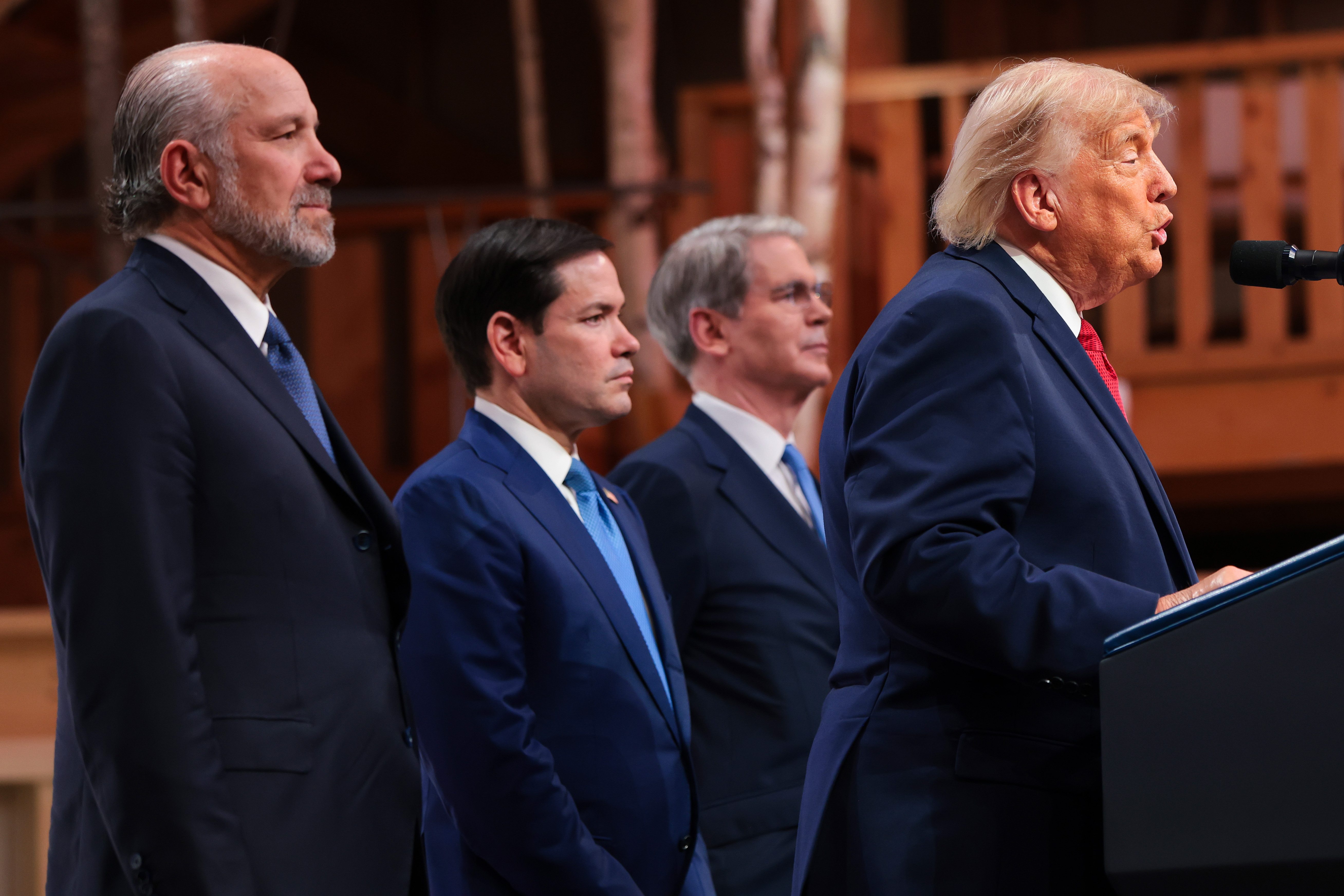

Donald Trump delivered a blunt, public warning to the Islamic Republic of Iran regarding its illicit oil revenues, signaling a promised return to the “maximum pressure” economic campaign if he reclaims the White House. Speaking to the mechanisms of global finance in a statement highlighted by Bloomberg Television, the former president outlined an aggressive strategy to choke off the billions of dollars flowing into Tehran through unsanctioned crude oil exports. The message was explicit. International buyers processing Iranian crude will face severe secondary sanctions. The United States Treasury will target the maritime networks transporting the cargo. The financial arteries sustaining the Iranian government will be severed.
This is not a new diplomatic posture. It is a resurrection of a specific economic weapon. The warning underscores a fundamental belief that national security and economic leverage are inextricably linked. By targeting the point of sale, the strategy bypasses traditional diplomatic negotiations in favor of hard financial deterrence.
The global energy market immediately registered the rhetoric. Traders understand the implications of a zero-tolerance policy on Iranian crude. Millions of barrels currently moving through shadow networks could be abruptly pulled from the global supply chain.
The Mechanics of the Shadow Market
Iran does not sell its oil on the open market. United States sanctions, enforced by the Office of Foreign Assets Control (OFAC), prohibit traditional financial institutions from facilitating Iranian energy transactions. To survive, Tehran built a parallel maritime economy.
This system relies on a “ghost fleet” of aging oil tankers. These vessels operate outside standard maritime regulations. They routinely disable their Automatic Identification System (AIS) transponders to hide their locations. They engage in dangerous ship-to-ship transfers of crude oil in open waters, often off the coast of Malaysia or in the Persian Gulf.
The logistics are complex and highly coordinated. A vessel loads crude from Iran’s Kharg Island terminal under the cover of darkness. It sails into international waters and transfers the cargo to another ship. The origin of the oil is then falsified on customs documents. It is rebranded as Omani or Malaysian crude. It is then sold at a steep discount to willing buyers.
The Role of Beijing’s Teapot Refineries
The primary destination for this rebranded crude is China. Specifically, it flows to independent refineries in Shandong province, colloquially known as “teapots.” Unlike massive state-owned energy conglomerates, these smaller refineries lack deep ties to the United States financial system. They are less vulnerable to OFAC sanctions.
The economics are simple. Iranian crude is often priced $10 to $15 below the global Brent crude benchmark. For independent refineries operating on thin margins, the discount is irresistible. Iran receives a steady stream of revenue, often settled in Chinese yuan or through localized barter systems. The teapots receive cheap feedstock. The United States embargo is effectively bypassed.
Trump’s warning directly targets this specific transaction loop. Enforcing sanctions on these teapots requires an aggressive expansion of secondary sanctions, penalizing any bank or logistics firm that facilitates the trade.
Where the Capital Flows
The revenue generated from these shadow sales does not primarily fund domestic infrastructure in Tehran. It funds regional power projection. The United States intelligence community has repeatedly documented the financial pipeline connecting Iranian oil sales to the Islamic Revolutionary Guard Corps (IRGC).
The IRGC’s Quds Force manages Iran’s extraterritorial operations. They require hard currency to arm, train, and sustain a network of proxy militias across the Middle East. The equation is linear. More oil revenue equals more regional instability.
- Hezbollah in Lebanon: Receives hundreds of millions of dollars annually for advanced munitions and operational logistics.
- Hamas in Gaza: Relies on Iranian funding for tunnel infrastructure and rocket manufacturing.
- The Houthis in Yemen: Utilize Iranian capital and technology to disrupt commercial shipping in the Red Sea and target international vessels.
By choking off the oil revenue, the proposed policy aims to starve the proxy network. It is an economic strategy designed to achieve a kinetic outcome.
The 2018 Precedent: Maximum Pressure
To understand the weight of the recent warning, one must look back to May 2018. During his presidency, Donald Trump unilaterally withdrew the United States from the Joint Comprehensive Plan of Action (JCPOA), commonly known as the Iran nuclear deal. The withdrawal triggered the immediate reimposition of crushing economic sanctions.
The stated goal was to drive Iranian oil exports to zero. The results were dramatic. Prior to the withdrawal, Iran was exporting roughly 2.5 million barrels of crude per day. Within a year of the “maximum pressure” campaign taking effect, that number plummeted to under 400,000 barrels per day. The Iranian rial collapsed. Inflation soared. The regime faced severe internal economic crises.
However, the strategy also forced Iran to innovate. The ghost fleet was expanded. Evading sanctions became a matter of national survival. The current warning acknowledges that the landscape has shifted since 2018. Iran is more adept at hiding its shipments. Cracking down today requires more sophisticated maritime tracking and a willingness to confront the foreign financial institutions facilitating the trade.
The Global Risk Matrix
Aggressively targeting Iranian oil exports carries significant geopolitical risks. The global energy market is tightly balanced. Removing over a million barrels of daily supply could trigger a spike in global crude prices, impacting consumers worldwide.
Furthermore, there is the threat of physical retaliation. The Strait of Hormuz is the world’s most critical energy chokepoint. Located between Oman and Iran, it connects the Persian Gulf to the Gulf of Oman and the Arabian Sea. Approximately 20 percent of the world’s daily oil consumption passes through this narrow waterway.
Historically, when Tehran feels its economic survival is threatened, it lashes out in the Strait. The IRGC Navy routinely harasses commercial shipping. They seize foreign-flagged tankers. They deploy naval mines. A severe crackdown on Iranian oil fees increases the probability of a maritime confrontation in the Persian Gulf.
The Enforcement Architecture
Delivering a warning is a rhetorical exercise. Enforcing it requires a vast bureaucratic and intelligence apparatus. If enacted, the policy will rely heavily on the United States Treasury Department.
OFAC will need to issue a barrage of new designations. This includes identifying specific vessels in the ghost fleet, sanctioning the shell companies that own them, and penalizing the maritime insurance firms that provide their liability coverage. The United States military and allied navies may be required to interdict vessels suspected of carrying illicit cargo.
It is a game of financial whack-a-mole. As soon as one shell company is sanctioned, another is incorporated in a highly secretive jurisdiction. As soon as one vessel is grounded, another is purchased on the secondary market. The strategy requires relentless, sustained pressure.
The Broader Geopolitical Context
The warning over oil fees does not exist in a vacuum. It is part of a broader, combative approach to foreign policy. It signals to allies and adversaries alike that economic statecraft will be the primary weapon of choice.
European allies, who largely opposed the 2018 withdrawal from the JCPOA, will likely view the renewed threats with apprehension. They fear a regional escalation. Conversely, regional partners like Israel and Saudi Arabia, who view an enriched Iran as an existential threat, will likely welcome a return to the maximum pressure doctrine.
The rhetoric sets the stage for a high-stakes standoff. The United States possesses the financial leverage to cripple the Iranian economy. Iran possesses the asymmetric capability to disrupt global shipping and destabilize the Middle East. The oil market sits caught in the middle.
The battle lines are drawn not on battlefields, but on maritime shipping lanes and international banking ledgers. The currency is crude. The weapon is the sanction. The stakes are regional hegemony.
Warnings are issued. Fleets are tracked. Markets brace. The pressure returns.