
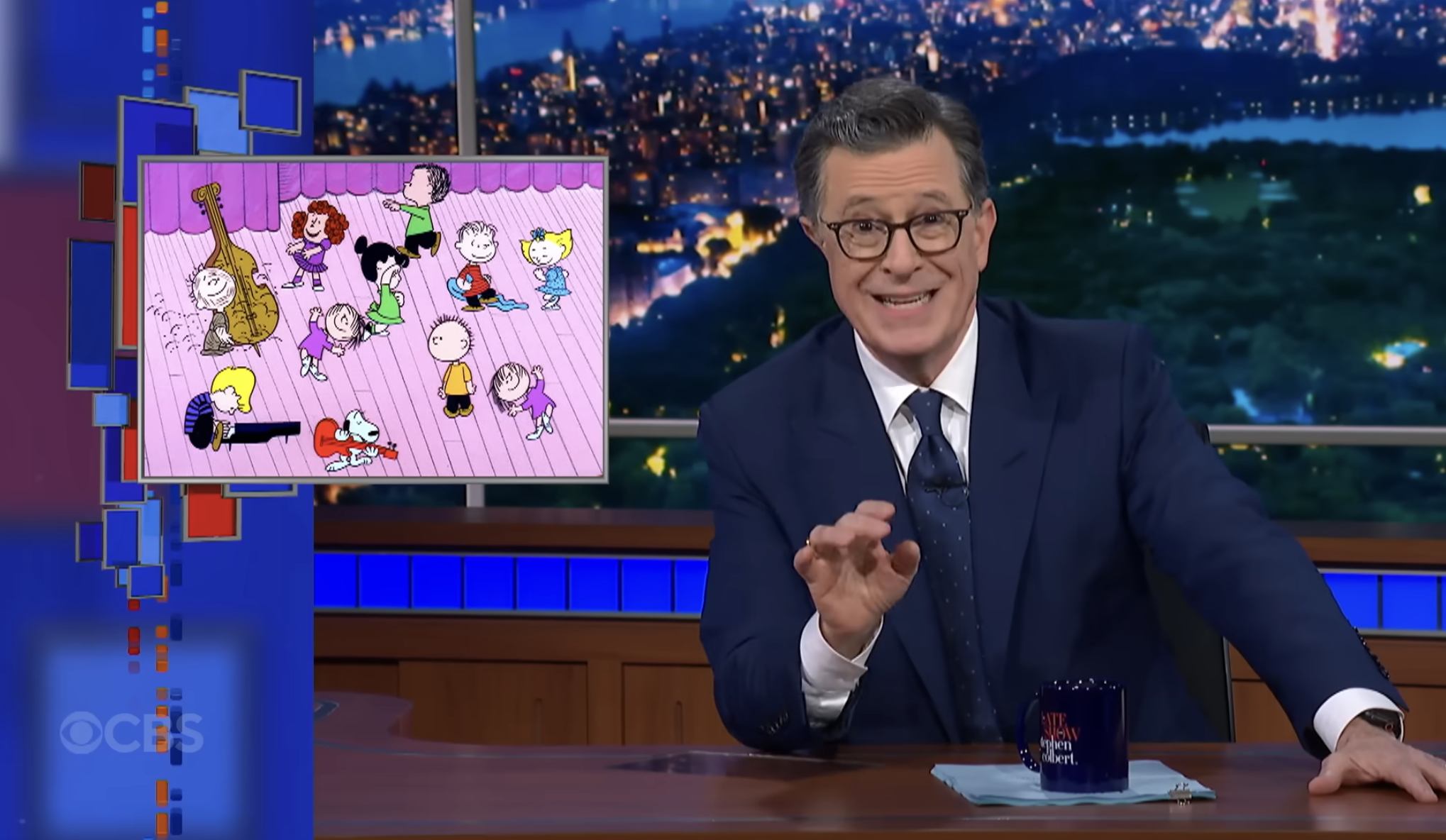
CBS and Paramount Global agreed to pay an undisclosed retroactive licensing fee and copyright penalty for the unauthorized broadcast of the Vince Guaraldi Trio’s “Linus and Lucy” during the 2026 series finale of The Late Show With Stephen Colbert. Rather than absorbing the penalty as traditional copyright damages, the intellectual property holders and network executives structured a settlement directing all proceeds to José Andrés’ World Central Kitchen. The unauthorized use occurred when the late-night house band spontaneously played the iconic Peanuts theme song during a live transition, triggering a massive synchronization rights violation across both the CBS television network and the Paramount+ streaming platform.
Live television thrives on spontaneity. Broadcast lawyers do not. The intersection of live musical performance and strict intellectual property law rarely leaves room for error. When a network broadcasts a copyrighted melody to millions of viewers, the legal mechanics of synchronization rights activate immediately. There is no grace period. There is no fair use exemption for a late-night house band feeling the energy of a studio audience. The rights must be cleared in advance. When they are not, the financial penalties scale with the size of the audience.
The 2026 finale of The Late Show With Stephen Colbert commanded one of the largest late-night television audiences of the decade. The stakes were high. The advertising rates were premium. The legal scrutiny on the broadcast was absolute. Yet, in a fleeting moment of unscripted celebration, a copyright violation slipped past the control room.
The Anatomy of a Broadcast Finale
The Ed Sullivan Theater sits at 1697 Broadway in New York City. It is a cathedral of American broadcasting. For decades, it has hosted the most heavily produced live entertainment in television history. The 2026 finale of The Late Show was engineered to be a flawless capstone to Stephen Colbert’s tenure. Network executives planned the run-of-show down to the second. Celebrity guests were vetted. Monologue jokes were legally cleared. Musical acts were contracted months in advance.
Late-night house bands operate under a unique set of pressures. They must keep the studio audience energized during commercial breaks. They must play guests on and off the stage. They must react in real-time to the host’s comedic pivots. Historically, the bandleader holds a repertoire of hundreds of recognizable riffs and melodies. Under normal circumstances, playing a famous melody inside a theater is covered by a venue’s blanket performance license through organizations like ASCAP or BMI.
Television broadcasting changes the legal reality. The moment a camera captures that performance and transmits it over public airwaves, the network requires a synchronization license. The moment that broadcast is encoded and uploaded to a streaming server on Paramount+, the network requires digital distribution rights. The house band at the Ed Sullivan Theater struck up the familiar, driving piano riff of “Linus and Lucy.” The audience clapped along. The control room let the audio feed ride. The broadcast went out to millions.
Paramount Global’s legal department woke up the next morning to an infringement notification. The song had not been cleared.
The Weight of the Peanuts Catalog
The copyright surrounding “Linus and Lucy” is one of the most fiercely protected assets in American music publishing. Composed by jazz pianist Vince Guaraldi in 1964, the song first appeared on the album Jazz Impressions of a Boy Named Charlie Brown. It became globally recognized a year later when it anchored the soundtrack to the 1965 television special A Charlie Brown Christmas.
The song is not public domain. It is not a cheap catalog asset. The publishing rights are tightly managed by Lee Mendelson Film Productions and the estate of Vince Guaraldi. The administrators of this catalog do not grant retroactive clearances lightly. They actively police the unauthorized use of the music in film, television, and digital media. The melody carries the legacy of Charles M. Schulz’s characters. The brand integrity is paramount.
When the intellectual property monitors detected the unauthorized use of “Linus and Lucy” on the CBS broadcast, the machinery of copyright enforcement engaged. Acoustic fingerprinting software routinely scans broadcast feeds and streaming platforms for unlicensed audio. The match was instantaneous. The cease-and-desist protocol followed shortly after.
The Mechanics of Synchronization Rights
Understanding the CBS settlement requires understanding the rigid architecture of music licensing. Music copyright is divided into two main halves. The first is the master recording, the actual audio file of Vince Guaraldi playing the piano in 1964. The second is the composition, the underlying sheet music, the notes, and the melody.
The Colbert house band did not play the master recording. They played the composition. Therefore, CBS did not infringe on the master rights. However, they directly infringed on the publishing rights. To pair a copyrighted composition with moving images on a screen, a network must obtain a synchronization license. This is known in the industry as a “sync right.”
Sync rights are entirely negotiable. Unlike mechanical licenses, which have statutory rates set by the government, sync rights operate in a free market. A publisher can demand fifty dollars. A publisher can demand five hundred thousand dollars. A publisher can refuse the license entirely. Because CBS broadcast the song without asking permission first, they forfeited their ability to negotiate. They were caught in a state of active infringement. The copyright holders held all the leverage.
The Discovery and the Demand
The legal letters arrived at Paramount Global headquarters in Times Square. The demands were standard for high-profile copyright infringement. The copyright holders required the immediate removal of the infringing audio from all digital replays, video-on-demand services, and Paramount+ streaming archives. They also required financial compensation for the initial live broadcast.
Editing a live broadcast after the fact is a routine, albeit frustrating, task for network post-production teams. The audio of “Linus and Lucy” was scrubbed from the streaming versions of the finale. A generic, royalty-free jazz track was mixed in to replace it. The digital footprint was erased.
The financial penalty remained. Paramount Global lawyers recognized the liability. The infringement was undeniable. The broadcast logs proved it. The streaming analytics quantified the exact number of unauthorized impressions. Going to court would be a costly and public defeat. CBS needed a settlement. The Guaraldi estate and Mendelson Productions wanted accountability.
The Pivot to Philanthropy
Corporate litigation often ends in quiet, undisclosed wire transfers between corporate bank accounts. This dispute took a different path. Recognizing the cultural weight of both the Peanuts legacy and the historic nature of the Colbert finale, the negotiating parties pivoted away from traditional punitive damages. They engineered a philanthropic settlement.
CBS agreed to pay the retroactive licensing fee and a substantial penalty. However, the intellectual property holders directed Paramount Global to route the entirety of the settlement funds to World Central Kitchen.
World Central Kitchen (WCK) was founded in 2010 by chef José Andrés. The non-governmental organization provides meals in the wake of natural disasters, conflicts, and humanitarian crises. By 2026, WCK had scaled into a massive logistical operation, deploying mobile kitchens to frontlines across the globe. They operate on rapid response. They require immense amounts of liquid capital to buy local ingredients and establish supply chains in devastated regions.
The settlement transformed a corporate legal error into humanitarian funding. For CBS, it mitigated the public relations damage of a copyright violation. For the Guaraldi estate, it enforced the boundaries of their intellectual property without appearing overly litigious against a beloved television finale. For World Central Kitchen, it provided an unexpected influx of operational capital.
The Precedent for Late-Night Television
The “Linus and Lucy” settlement sent an immediate ripple through the television industry. Late-night television relies heavily on the illusion of casual spontaneity. The host banter feels off-the-cuff. The musical walk-ons feel organic. The reality is heavily regimented.
Bandleaders across the major networks took notice of the CBS penalty. The Roots on NBC’s The Tonight Show Starring Jimmy Fallon. The 8G Band on Late Night with Seth Meyers. The house bands for Jimmy Kimmel and the various streaming talk formats. All were reminded of the strict boundaries of broadcast copyright.
Network legal departments instituted tighter protocols following the Colbert finale. Spontaneous musical tributes are now heavily discouraged unless the song is confirmed to be in the public domain. The risk of triggering a six-figure sync penalty outweighs the comedic value of a recognizable riff. The era of the freewheeling late-night house band, capable of playing any song at any moment, has been severely restricted by the digital tracking of intellectual property.
The Economics of Accountability
The exact dollar amount of the CBS settlement remains sealed under non-disclosure agreements. Industry analysts, however, understand the pricing models of premium sync licenses. A prominent feature of a globally recognized song on a network television finale can command a baseline licensing fee in the high five figures. When unauthorized use penalties are applied, the final settlement easily crosses the six-figure threshold.
This money did not vanish into corporate overhead. It was converted into tangible resources. In the hands of World Central Kitchen, corporate settlement dollars translate directly into logistical power. The funds purchase rice. The funds secure clean water. The funds fuel transport vehicles in crisis zones.
The legal system functioned exactly as designed. The intellectual property was defended. The infringement was penalized. But the routing of the capital subverted the traditional corporate narrative.
Lawyers drafted the notices. Executives signed the agreements. Chefs cooked the meals. Accountability.