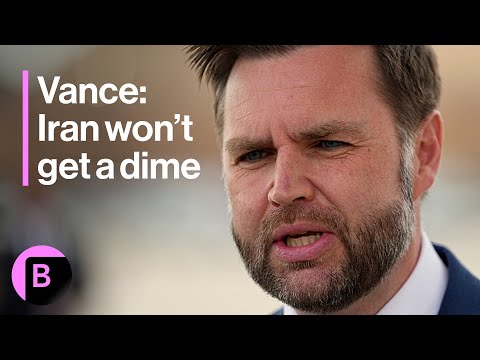
During an interview on Bloomberg Television, Republican vice-presidential nominee Senator J.D. Vance stated that under a Trump-Vance administration, the Islamic Republic of Iran would not receive “a dime” of United States taxpayer money. The declaration serves as a direct policy contrast to the Biden administration’s recent diplomatic agreements, which included the unfreezing of billions in Iranian assets. Vance’s statement anchors a broader “America First” foreign policy doctrine that seeks to eliminate financial concessions to adversarial nations.
The phrasing was deliberate. The venue was specific. Bloomberg Television caters to the financial sector, institutional investors, and global policy architects. By delivering this message on a network dedicated to global capital flows, Vance signaled a strict economic containment strategy regarding the Middle East.
The comment did not occur in a vacuum. It arrived amid escalating tensions in the Persian Gulf, shifting geopolitical alliances, and a fiercely contested American election cycle. It also tapped into a multi-decade debate over how Washington uses money to leverage behavior in Tehran.
The Bloomberg Television Declaration
Political messaging requires a target. For Vance, the target was the perceived financial leniency of the incumbent administration. Speaking to Bloomberg Television, the Ohio senator drew a sharp boundary around the federal budget.
Foreign aid has long been a wedge issue in American politics. For decades, the neoconservative wing of the Republican Party supported robust foreign intervention, backed by American dollars, to secure strategic interests. Vance represents a structural break from that era.
His faction of the party views international financial transfers with deep skepticism. The assertion that Iran will not get “a dime” is both a literal policy promise and a symbolic cultural defense. It tells a specific voting bloc that their tax dollars will remain within domestic borders.
This messaging resonates powerfully with working-class voters. When domestic inflation rises, the optics of billions of dollars moving across international borders become politically volatile. Vance’s rhetoric directly addresses this friction.
The Anatomy of US-Iran Finances
To understand the weight of Vance’s statement, one must understand the complex architecture of US-Iran financial relations. The distinction between “taxpayer money” and “unfrozen assets” is the central fault line of this debate.
Historically, the United States government does not appropriate direct taxpayer funds as foreign aid to the Islamic Republic of Iran. The legal framework of Washington prohibits it. Iran is designated by the State Department as a State Sponsor of Terrorism, a label applied in January 1984.
This designation triggers severe restrictions. It bans defense exports. It imposes strict controls over dual-use items. Most importantly, it prohibits direct financial assistance from the US Treasury.
However, the political debate rarely centers on direct Congressional appropriations. It centers on sanctions relief. It centers on the unfreezing of Iranian sovereign wealth held in foreign banks. In the court of public opinion, the unfreezing of assets is frequently conflated with the transfer of taxpayer funds.
The $6 Billion Precedent of 2023
Vance’s comments are inextricably linked to the events of September 2023. The Biden administration negotiated a prisoner swap with Tehran. Five American citizens, previously held in the Evin Prison, were released.
In exchange, the United States agreed to issue waivers allowing international banks to transfer approximately $6 billion in frozen Iranian funds. These funds were not US taxpayer dollars. They were Iranian oil revenues that had been trapped in South Korean banks due to American sanctions.
The funds were transferred from Seoul to a restricted account in Doha, Qatar. The Biden administration, via Secretary of State Antony Blinken, insisted the money could only be used for humanitarian purposes: food, medicine, and agricultural products. The US Treasury Department maintained oversight of the Qatari accounts.
Critics, including Vance, argued that money is fungible. They asserted that freeing up $6 billion for humanitarian needs simply allowed the Iranian government to reallocate $6 billion of its own domestic budget toward military operations, proxy groups, and its nuclear program.
This is the political backdrop of the “not a dime” declaration. It is a vow to end the practice of sanctions waivers and asset unfreezing.
The 2016 Pallets of Cash Controversy
The Republican base’s deep suspicion of financial dealings with Iran predates the 2023 Qatar transfer. It traces back to January 2016, during the final year of the Obama-Biden administration.
Coinciding with the implementation of the Joint Comprehensive Plan of Action (JCPOA), the Iran nuclear deal, and the release of four American detainees, the United States settled a decades-old financial dispute with Tehran. The dispute originated before the 1979 Islamic Revolution, concerning a $400 million payment the Shah of Iran had made to the US for military equipment that was never delivered.
The Obama administration agreed to return the $400 million principal, plus $1.3 billion in compromised interest. Because US law prohibited direct dollar transactions with the Iranian financial system, the initial $400 million was flown into Tehran on unmarked cargo planes in the form of euros, Swiss francs, and other fiat currencies.
The imagery of wooden pallets loaded with foreign cash arriving in Tehran became permanently etched into the conservative consciousness. It was framed by critics as a ransom payment. It became a defining grievance of the populist right.
When Vance speaks of denying Iran “a dime,” he is invoking the ghost of those 2016 cargo flights. He is assuring the electorate that the era of midnight cash transfers is over.
The Architecture of Sanctions
Enforcing the policy Vance outlined requires a massive bureaucratic apparatus. The tip of that spear is the Office of Foreign Assets Control (OFAC), a financial intelligence and enforcement agency operating under the US Treasury Department.
OFAC administers the most comprehensive sanctions regime in the modern world. The Iranian Transactions and Sanctions Regulations (ITSR) effectively cut the Iranian economy off from the global financial system. It penalizes any foreign financial institution that conducts significant transactions with the Central Bank of Iran.
Under a theoretical Trump-Vance administration, this architecture would likely return to the “Maximum Pressure” campaign utilized between 2018 and 2021. This strategy involves zero waivers for oil exports. It involves secondary sanctions on Chinese and Indian entities that purchase Iranian crude.
The goal of Maximum Pressure is economic strangulation. It forces the regime to choose between domestic stability and foreign military adventurism. By promising not to yield “a dime,” Vance is endorsing the total weaponization of the US dollar against Tehran.
The America First Foreign Policy Shift
Vance’s posture on Iran highlights a broader transformation within the Republican Party. The traditional GOP establishment, characterized by figures like John McCain and Mitt Romney, viewed American financial and military power as tools to shape the global order.
The populist wing, led by Donald Trump and intellectually articulated by figures like Vance, views the global order as a drain on American resources. They argue that decades of nation-building, foreign aid, and global policing have depleted the American middle class.
This is the “cultural defense” aspect of Vance’s messaging. When a voter in Ohio or Pennsylvania hears that a foreign adversary is receiving billions of dollars in sanctions relief, they contrast it with their own economic reality. They contrast it with rising grocery prices, stagnant wages, and decaying local infrastructure.
Vance connects the foreign to the domestic. He frames the denial of funds to Iran not just as a national security imperative, but as a moral obligation to the American taxpayer. It is a zero-sum view of global economics. A dollar allowed to flow into Tehran is viewed as a betrayal of the American worker.
The Legislative Reality of Foreign Aid
Despite the strong rhetoric, the actual mechanics of foreign aid are controlled by the United States Congress. The power of the purse resides in the House of Representatives and the Senate.
The executive branch has significant leeway in foreign policy. The President can issue executive orders. The Secretary of State can negotiate treaties. The Treasury Secretary can issue or revoke sanctions waivers.
But the outright appropriation of taxpayer funds requires legislation. The Foreign Assistance Act of 1961 governs how the US distributes economic and military aid globally. Currently, Israel, Egypt, and Ukraine are among the largest recipients of US foreign assistance.
Iran receives zero direct foreign assistance. The debate is entirely centered on indirect financial relief. When Vance promises that Iran won’t get “a dime of taxpayer money,” he is technically promising to maintain a status quo that has existed since 1979. But politically, he is promising to close the loopholes, end the waivers, and enforce a total financial blockade.
The Geopolitical Ramifications
The strategy of total financial denial carries significant geopolitical risks. Critics of the Maximum Pressure campaign argue that economic isolation does not change regime behavior. They point out that despite heavy sanctions during the Trump administration, Iran continued to enrich uranium and support proxy groups like Hezbollah, Hamas, and the Houthis.
Proponents of diplomatic engagement argue that financial leverage must be used to secure concessions. If a nation is offered no pathway to economic relief, they have no incentive to come to the negotiating table.
Vance rejects this premise. The populist view holds that adversarial regimes only respond to absolute strength. Any financial concession, whether it is taxpayer money or unfrozen sovereign wealth, is viewed as appeasement.
This worldview fundamentally alters how the US approaches the Middle East. It prioritizes containment over integration. It relies on the dominance of the US dollar to enforce global compliance.
The Final Ledger
The debate over Iranian finances will not be settled in a single television interview. It is a conflict deeply embedded in the history of the late 20th and early 21st centuries. From the storming of the US Embassy in Tehran in 1979 to the intricate banking maneuvers of 2023, money has always been the silent weapon of choice.
JD Vance utilized Bloomberg Television to draw a definitive line. He articulated a vision where American economic power is hoarded, protected, and weaponized only for domestic benefit. He spoke to a base that feels abandoned by globalist policies.
The rhetoric escalates. The sanctions hold. The dollars remain frozen. The electorate watches.
Washington.