
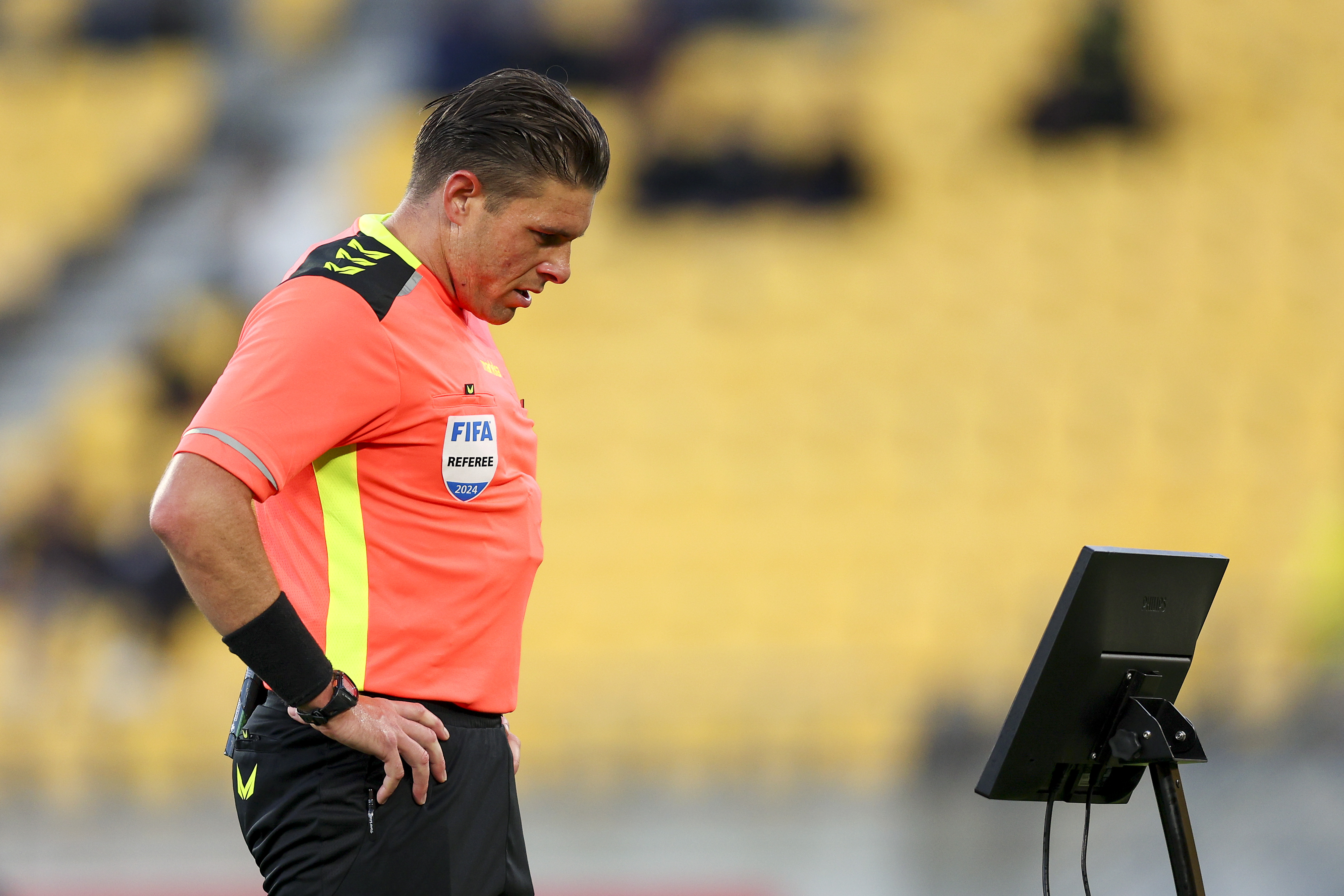
During a heavily viewed group-stage match of the 2026 FIFA World Cup, Australian referee Shaun Evans was captured on international broadcast making a hand gesture widely associated with white supremacist movements. The fleeting moment, lasting only seconds on screen, instantly ignited a global controversy. The gesture, forming a circle with the thumb and index finger while extending the remaining three fingers, has been classified by civil rights organizations, including the Anti-Defamation League (ADL), as a symbol co-opted by hate groups. The incident forced FIFA into immediate crisis management and sparked intense debate over intent, context, and the policing of symbols on the world’s largest sporting stage.
What looks like a simple hand signal actually carries a deeply complex modern history. The controversy surrounding Evans highlights the fraught intersection of global sports, digital culture, and political extremism.
The Incident on the Pitch
The moment occurred during a tense pause in play. Cameras focused on Evans as he communicated with the Video Assistant Referee (VAR) booth. In that brief window, his hand formed the controversial shape. It was not directed at a specific player or coach, but rather rested against his side. The broadcast, beamed to hundreds of millions of viewers worldwide, captured the gesture in high definition.
Within minutes, social media platforms erupted. Clips of the broadcast were isolated, zoomed in, and shared across X, TikTok, and Reddit. The narrative formed rapidly. Viewers familiar with the symbol’s recent history immediately flagged it as a potential display of white supremacist ideology. Others defended Evans, arguing the gesture was an innocuous “OK” sign, a habitual movement, or a misunderstanding of refereeing signals.
The speed of the digital reaction outpaced any official response from FIFA or the Australian governing bodies. By the time the final whistle blew, Shaun Evans was no longer just a referee; he was the center of an international cultural flashpoint.
The Evolution of a Symbol
To understand the gravity of the accusation, one must trace the evolution of the “OK” hand gesture. For decades, it was a universally recognized sign of approval or understanding. However, in 2017, a deliberate campaign originated on the anonymous message board 4chan. The goal was to trick the media and the public into believing the innocuous gesture was a secret symbol for “White Power” (with the three extended fingers forming a “W” and the circle and wrist forming a “P”).
The hoax was successful, but it also had unintended consequences. What began as an internet troll campaign was eventually adopted earnestly by actual white supremacist groups. Individuals associated with these hate groups began using the gesture in photographs and public appearances as a genuine signal of affiliation.
In 2019, the Anti-Defamation League (ADL) officially added the gesture to its “Hate on Display” database. The ADL noted that while the overwhelming majority of people who use the gesture do so innocuously, its context matters deeply. When used in specific settings or by individuals with known extremist ties, it serves as a dog whistle for hate.
Context vs. Intent
The challenge in evaluating the Shaun Evans incident lies in separating context from intent. Was the referee making a deliberate political statement on a global broadcast? Or was it a subconscious movement, utterly devoid of malice?
Referees frequently use hand signals to communicate complex information quickly. Some defenders argue that Evans may have been indicating a specific number, signaling readiness to the VAR booth, or simply resting his hand awkwardly. The lack of a clear, aggressive context, such as directing the gesture at a player of color, complicates the accusation.
However, critics argue that the burden of awareness falls on public figures. In an era where symbols are highly scrutinized, ignorance of a symbol’s modern connotations is often viewed as an insufficient defense. The sheer visibility of the World Cup demands a heightened level of situational awareness from its officials.
FIFA’s Immediate Crisis Response
The governing body of international football, FIFA, found itself navigating a public relations minefield. The organization has spent years promoting anti-racism campaigns, adopting slogans like “No Room for Racism” and implementing stricter protocols for addressing discriminatory behavior in stadiums.
The accusation against one of its own referees presented a direct challenge to these initiatives. If FIFA ignored the incident, it risked appearing complicit or dismissive of hate symbols. If it acted too swiftly without a thorough investigation, it risked unfairly penalizing an official based on internet speculation.
FIFA’s initial statement was predictably cautious. The organization confirmed it was aware of the broadcast footage and was conducting a review of the incident. It emphasized its commitment to a zero-tolerance policy regarding discrimination but stopped short of condemning Evans directly pending the investigation’s outcome.
The Role of the Australian FA
Football Australia (FA), the governing body that oversees Evans domestically, also faced immense pressure. Evans is one of Australia’s most prominent referees, having officiated in the A-League and numerous international fixtures. The FA released a statement mirroring FIFA’s caution, acknowledging the severity of the allegations while requesting patience as the facts were gathered.
The incident placed the FA in a difficult position. Defending Evans too vigorously could alienate fans and sponsors sensitive to issues of racial equity. Abandoning him before a formal ruling could be seen as capitulating to an online mob. The organization opted for a holding pattern, awaiting FIFA’s lead.
The Digital Trial and Public Opinion
While official bodies deliberated, the court of public opinion convened online. The debate fractured along predictable lines. Progressive voices and civil rights advocates demanded immediate suspension and a thorough investigation into Evans’ background and digital footprint. They argued that the normalization of such symbols, even if accidental, provides cover for actual extremists.
Conversely, conservative commentators and defenders of Evans decried the backlash as an example of “cancel culture” run amok. They pointed to the gesture’s long history as a harmless “OK” sign and accused critics of manufacturing outrage over a non-issue. The discourse rapidly devolved from an examination of the specific incident into a broader cultural proxy war.
This polarization highlights the difficulty of addressing ambiguous symbols in the digital age. When a gesture possesses dual meanings, one innocuous, one malicious, the interpretation is often dictated by the viewer’s preexisting political lens.
The Precedent for Referee Conduct
Referees are expected to maintain strict neutrality. They are the arbiters of fairness on the pitch, and any perception of bias undermines the integrity of the game. FIFA’s code of conduct strictly prohibits officials from displaying political, religious, or personal slogans or symbols.
Historically, disciplinary action against referees has focused on match-fixing, bribery, or gross incompetence. Cases involving political or ideological expression are rarer but not unprecedented. In recent years, athletes have faced sanctions for political gestures, but the standard for officials is arguably higher.
If FIFA determines that Evans intended to make a white supremacist gesture, the consequences would be severe, likely resulting in a lifetime ban from officiating. If the investigation concludes the gesture was accidental or misunderstood, FIFA still faces the challenge of communicating that finding to a skeptical public.
The Burden of Proof
Investigating intent is notoriously difficult. Unlike a clear verbal slur or a physical altercation, a hand gesture leaves room for plausible deniability. Investigators will likely examine Evans’ past behavior, his social media presence, and his interactions with colleagues to determine if there is a pattern of extremist sympathies.
Without concrete evidence of ideological alignment, proving malicious intent based solely on the broadcast footage is a high hurdle. However, the court of public opinion does not require the same standard of proof as a formal disciplinary committee. For many viewers, the image itself is the offense, regardless of the referee’s internal motivation.
The Lasting Impact on the Tournament
The controversy surrounding Shaun Evans threatens to overshadow the athletic achievements of the World Cup. The tournament is designed to be a unifying global event, a celebration of international cooperation through sport. Incidents that highlight division and extremism run counter to this narrative.
The media focus on the refereeing scandal diverts attention from the players, the host nations, and the drama of the competition. It forces broadcasters, commentators, and fans to engage with uncomfortable political realities rather than the escapism typically associated with the event.
Regardless of the investigation’s outcome, the incident serves as a stark reminder of the pervasive nature of digital culture. Symbols born in the dark corners of the internet can now manifest on the world’s brightest stages, forcing global institutions to grapple with their implications.
The game paused. The camera focused. The symbol flashed. The debate began.
Unresolved.