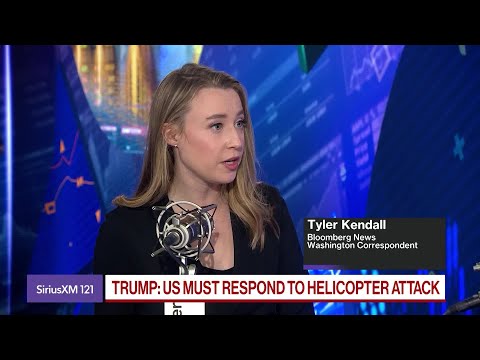
Former President Donald Trump stated in a Bloomberg Television interview that the United States must launch a direct, proportional military response against Iran following an attack on a U.S. helicopter. Speaking to the necessity of global deterrence, Trump argued that failing to retaliate against Tehran directly projects a fatal weakness that emboldens hostile state actors and endangers American service members deployed across the Middle East.
The statement cuts to the core of American foreign policy. It forces a conversation about where the lines of engagement are drawn. It demands an answer to a decades-old question.
When a proxy fires a weapon, who pays the price?
The Bloomberg Television Declaration
The interview aired on Bloomberg Television. The setting was formal. The rhetoric was uncompromising. Trump addressed the attack on the U.S. helicopter not as an isolated skirmish, but as a symptom of a collapsing global deterrence architecture.
He pointed the finger directly at Tehran. He bypassed the local militia groups entirely.
This is a calculated rhetorical strategy. For decades, the Islamic Republic of Iran has utilized a network of proxy forces to harass Western assets. This provides plausible deniability. Trump’s stated doctrine strips that deniability away. If a weapon is financed by Iranian rials, smuggled by the Quds Force, and fired at an American aircraft, Trump’s framework treats the attack as an official act of the Iranian state.
His demand for a response activates a specific cultural defense mechanism. It signals patriotism. It signals a refusal to accept American casualties as the cost of doing business in the Middle East.
The Vulnerability of Rotary-Wing Aircraft
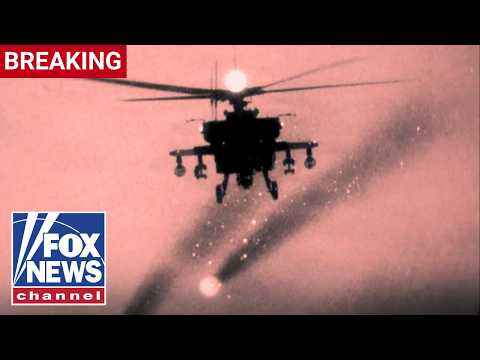
Helicopters are inherently vulnerable. They do not fly at thirty thousand feet. They do not break the sound barrier. They operate low and slow, navigating complex terrain where threats can emerge from a single rooftop or a desert ridge.
The U.S. military relies heavily on rotary-wing aircraft in the Middle East. The AH-64 Apache provides close air support. The MH-60 Black Hawk handles troop transport and medical evacuations. These machines are the lifeblood of U.S. Central Command (CENTCOM) operations.
They are also prime targets.
Iran has spent years flooding the region with man-portable air-defense systems (MANPADS). These shoulder-fired missiles are cheap. They are easy to smuggle. They are highly effective against helicopters. When an Iran-backed militia targets a U.S. helicopter, they are attacking the logistical foundation of the American military presence in the region.
An attack on a helicopter is not a warning shot. It is an attempt to inflict catastrophic casualties.
The Architecture of Maximum Pressure
Trump’s demand for retaliation is not theoretical. It is anchored in his established track record. During his presidency, he implemented a strategy known as Maximum Pressure.
The strategy began with economics. In May 2018, the United States withdrew from the Joint Comprehensive Plan of Action (JCPOA). Sanctions were reimposed. The goal was to choke off the financial pipelines that funded the Islamic Revolutionary Guard Corps (IRGC).
But the strategy also included kinetic action.
On January 3, 2020, a U.S. drone strike at Baghdad International Airport killed Qasem Soleimani. Soleimani was the commander of the IRGC’s Quds Force. He was the architect of Iran’s proxy network. The strike was a massive escalation. It was a direct message that the United States would no longer tolerate proxy attacks without targeting the Iranian leadership orchestrating them.
Trump’s recent comments on Bloomberg Television echo this exact philosophy. Deterrence is not achieved through proportional responses against low-level militants. Deterrence is achieved by making the cost of aggression unimaginably high for the state sponsoring it.
The Proxy War Apparatus
Understanding the helicopter attack requires understanding the IRGC. The IRGC operates parallel to the traditional Iranian military. Its mandate is to export the Islamic Revolution.
It achieves this through the Quds Force. The Quds Force funds, trains, and equips militias across the Middle East. The Houthis in Yemen. Hezbollah in Lebanon. Kataib Hezbollah in Iraq. These groups provide Tehran with a strategic buffer.
When the Houthis fire anti-ship ballistic missiles in the Red Sea, they do so with Iranian intelligence. When militias in Iraq launch drones at U.S. bases, they do so with Iranian hardware.
This dynamic creates a complex problem for the Pentagon. Striking the proxies is akin to treating the symptoms of a disease while ignoring the cause. The militants are replaceable. The hardware is easily restocked. Trump’s doctrine argues that the only way to stop the attacks is to strike the source.
Washington’s Political Calculus
National security is a dominant force in American politics. As the 2024 election cycle accelerates, foreign policy has become a central battleground.
The attack on the helicopter forces lawmakers to take a stance. It highlights the tension between isolationism and interventionism. Trump’s base responds strongly to a posture of strength. The concept of cultural defense is deeply tied to the image of an untouchable American military.
When American service members are attacked, the public expects a response. Hesitation is viewed as weakness. Weakness is viewed as a national embarrassment.
Trump leverages this sentiment effectively. By demanding a direct response to Iran, he positions himself as the defender of American prestige. He draws a sharp contrast with diplomatic approaches that prioritize de-escalation over retaliation.
The Mechanics of Retaliation
What does a direct response look like? The Pentagon maintains extensive target packages for Iranian assets.
A retaliatory strike would likely involve a combination of naval and air assets. The USS Dwight D. Eisenhower Carrier Strike Group operates in the region. Arleigh Burke-class destroyers carry Tomahawk cruise missiles capable of striking targets deep inside Iranian territory with pinpoint accuracy.
Air Force assets would also play a role. B-1B Lancer bombers, flying from Al Udeid Air Base in Qatar or directly from the continental United States, can deliver massive payloads. F-35 Lightning II stealth fighters can bypass advanced air defense systems.
The targets would be carefully selected to maximize damage to the IRGC while minimizing civilian casualties. Command and control centers. Drone manufacturing facilities. Naval bases along the Strait of Hormuz.
The goal is not regime change. The goal is the destruction of military capability.
The Echoes of Operation Praying Mantis
There is historical precedent for this type of escalation. In April 1988, the USS Samuel B. Roberts struck an Iranian naval mine in the Persian Gulf. The blast nearly split the frigate in half.
President Ronald Reagan ordered a direct, disproportionate response. The result was Operation Praying Mantis.
On April 18, 1988, U.S. forces systematically destroyed half of Iran’s operational fleet. American aircraft and warships sank Iranian frigates, gunboats, and speedboats. They destroyed armed oil platforms used by the IRGC to coordinate attacks on commercial shipping.
The operation lasted less than a day. It effectively ended the naval phase of the Iran-Iraq War. It reestablished American dominance in the Persian Gulf.
Trump’s demands align with the legacy of Operation Praying Mantis. When an American asset is attacked, the response must be overwhelming. It must leave no doubt about the balance of power.
The Cost of Inaction
The alternative to retaliation is de-escalation. Proponents of de-escalation argue that striking Iran directly risks triggering a regional war. They point to the volatility of the Middle East. They warn of the economic consequences of a conflict in the Strait of Hormuz, where a significant portion of the world’s oil supply transits daily.
But the doctrine of deterrence views inaction as the greater risk.
If Iran believes it can attack a U.S. helicopter without facing direct consequences, it will escalate. Today it is a helicopter. Tomorrow it is a destroyer. The day after, it is a forward operating base.
Deterrence is a psychological construct. It exists only as long as the adversary believes the threat of retaliation is credible. The moment that credibility fractures, the deterrence fails.
Rebuilding the Red Line
The Bloomberg Television interview serves as a blueprint for a potential future administration. It signals a return to Maximum Pressure. It signals a zero-tolerance policy for proxy warfare.
The attack on the helicopter is a flashpoint. It is a test of American resolve. The way Washington responds will dictate the operational tempo of the IRGC for years to come.
The Middle East respects strength. It exploits weakness. The doctrine of deterrence does not allow for ambiguity.
Diplomats drafted memos. Generals reviewed target packages. Politicians debated the escalation ladder. Deterrence.