A federal judge has officially dismissed a lawsuit seeking to block a Ultimate Fighting Championship (UFC) fight card from taking place on the South Lawn of the White House. On June 18, 2026, U.S. District Court Judge Thomas R. Sullivan ruled that the executive branch holds the constitutional authority to host sporting events on the presidential grounds. The decision clears the way for UFC CEO Dana White and President Donald Trump to stage an unprecedented combat sports spectacle at 1600 Pennsylvania Avenue.
The legal challenge is over. The injunction is dead. The event is moving forward.
What began as a logistical rumor has now survived the federal court system. The intersection of professional mixed martial arts and the executive branch represents a profound shift in American political theater. It is no longer just a partnership between a promoter and a politician. It is a fully sanctioned, federally protected broadcast event.
The Gavel Drops in Washington
The lawsuit was filed early in the year by the Washington Heritage Coalition. They were joined by a consortium of District of Columbia municipal watchdogs. The plaintiffs sought an emergency injunction to halt the construction of the Octagon.
Their arguments were multifaceted. They claimed the event violated the Hatch Act by using federal property for a politically adjacent commercial enterprise. They argued it constituted an illegal commercialization of a historic national monument. They cited a projected $4.2 million in taxpayer-funded security costs required to lock down the perimeter during a live pay-per-view broadcast.
Judge Sullivan dismantled these arguments in a comprehensive 45-page ruling. He cited over a century of executive precedent.
The court noted that presidents have historically utilized the White House grounds for cultural, athletic, and commercial exhibitions. The ruling explicitly stated that the executive branch retains broad, discretionary power over the use of the South Lawn for entertainment purposes. The judge found no direct violation of the Hatch Act, as the UFC is a private sporting entity, not a registered political action committee.
The ruling was decisive. The injunction was denied with prejudice. The plaintiffs have limited avenues for appeal before the scheduled fight week.
The Plaintiffs and the Precedent
Legal analysts watched the case closely. The Washington Heritage Coalition argued that a pay-per-view combat sports event crossed a line that previous presidential events had not. They pointed to the commercial nature of the broadcast.
Defense attorneys representing the executive branch countered with history. They pointed to public concerts broadcast from the East Room. They highlighted professional tennis matches hosted by previous administrations. They noted that the White House has frequently served as a backdrop for private athletic organizations.
Judge Sullivan agreed with the defense. He ruled that while the scale of the UFC event is unique, the underlying legal principle remains identical to a jazz festival or a championship team visit. The White House is both a residence and a stage. The president holds the right to program that stage.
Blueprinting the South Lawn Octagon
With the legal hurdles cleared, the logistical reality sets in. Building an arena on the South Lawn requires unprecedented coordination. The UFC production team is accustomed to taking over major arenas in Las Vegas, New York, and Abu Dhabi. Taking over the most secure 18 acres in the world is a different mandate.
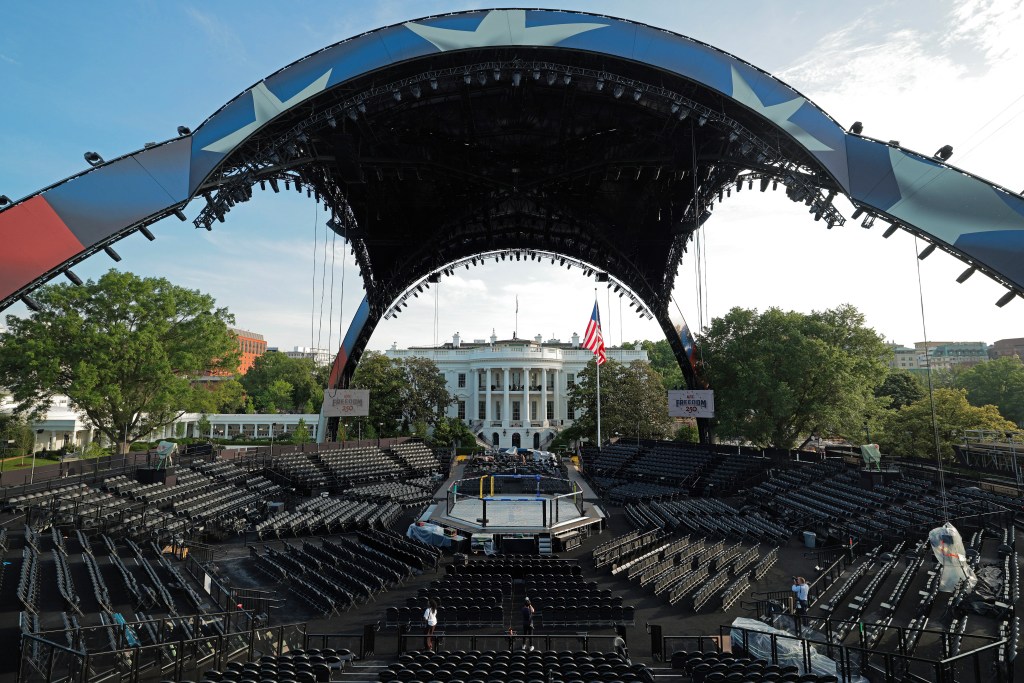
The Octagon itself weighs roughly 750 pounds. It requires a reinforced steel base. The South Lawn grass must be protected. Engineers have designed a specialized load-bearing flooring system to distribute the weight of the cage, the lighting rigs, and the seating arrangements.
An estimated 5,000 temporary seats will be erected. The grandstands will form a tight perimeter around the fighting surface. The backdrop will feature the Truman Balcony and the South Portico.
Lighting is a specific challenge. Professional mixed martial arts requires intense, focused illumination. The production team must rig overhead trusses without anchoring to any historic structures. Cranes and specialized staging equipment will be brought in through the secure gates under heavy guard.
Secret Service and Venue Logistics
The United States Secret Service is now acting as the ultimate venue security team. Every attendee, fighter, cornerman, and broadcast technician must pass through federal background checks. The standard UFC credentialing process has been superseded by Department of Homeland Security protocols.
The $4.2 million security budget cited in the lawsuit covers the expansion of the secure perimeter. Metropolitan Police Department officers will manage road closures along Constitution Avenue and E Street. Secret Service counter-sniper teams will be positioned on the roof of the White House and surrounding federal buildings.
Fighter walkouts will require specialized routing. Competitors will reportedly stage inside the Eisenhower Executive Office Building before making the walk across the grounds to the Octagon. The visual of a fighter walking out flanked by Secret Service agents will instantly become one of the most iconic images in sports broadcasting history.
A Twenty-Five Year Alliance
This event is the culmination of a twenty-five-year alliance. The relationship between Donald Trump and Dana White is well documented. It is a partnership built on mutual benefit during times of institutional exile.
In 2001, the UFC was a struggling enterprise. Cable companies refused to carry the pay-per-views. State athletic commissions refused to sanction the fights. The sport was labeled “human cockfighting” by mainstream politicians.
Donald Trump offered the Trump Taj Mahal in Atlantic City. He hosted UFC 30 and UFC 31. He sat in the front row. He gave the organization a venue when traditional arenas locked them out. Dana White never forgot the gesture.
Decades later, the dynamic inverted. When Trump faced political and institutional exile, Dana White provided a platform. White spoke at multiple Republican National Conventions. He integrated the former president into UFC broadcasts. When Trump walked into arenas in Las Vegas or Madison Square Garden, the UFC production team treated it like a heavyweight champion’s entrance.
From the Taj Mahal to Pennsylvania Avenue
The South Lawn event is the ultimate return on investment for both men. For Dana White, it is the final validation of a sport that was once banned from television. Hosting a card at the White House elevates the UFC above traditional sports leagues. It is an achievement the NFL, NBA, and MLB have never attempted.
For the president, it is a massive cultural flex. It bypasses traditional media. It speaks directly to a young, male, working-class demographic that consumes combat sports. It turns the seat of the federal government into a populist arena.
The alliance has reshaped the cultural footprint of both organizations. The UFC is no longer just a sports league. It is a cultural signifier. The White House is no longer just a legislative hub. It is a broadcast network.
The Cultural Shift in Executive Entertainment
The visual of two men fighting inside a steel cage on the lawn of the White House will shock traditionalists. That is precisely the point. The event is designed to disrupt the established norms of Washington decorum.
For decades, executive entertainment consisted of state dinners, classical musicians, and the occasional pop star. The events were curated to project high culture and diplomatic refinement. They were polite. They were quiet.
The UFC is loud. It is violent. It is unapologetically visceral. Bringing this product to the South Lawn is a deliberate rejection of the elite consensus. It signals a shift away from the cocktail-circuit culture of Washington D.C. toward the arena culture of middle America.
Critics view this as the degradation of the office. Supporters view it as the democratization of the People’s House. The legal ruling simply confirms that the president has the right to make the choice.
Echoes of Theodore Roosevelt
While a pay-per-view broadcast is new, combat sports at the White House actually possess historical precedent. The defense attorneys in the lawsuit subtly pointed to the early 20th century.
President Theodore Roosevelt regularly hosted combat sports in the White House. He brought in judo masters to train in the East Room. He wrestled with athletic aides. He boxed with professional sparring partners until a punch detached his retina.
Roosevelt believed in the “strenuous life.” He believed physical combat built national character. The upcoming UFC event, while vastly more commercialized, taps into that same primal American current. It is a return to a more aggressive, physical interpretation of executive leadership.
The Financial Mechanics of a Federal Fight Night
The economics of the South Lawn Rumble are complex. The UFC operates on a pay-per-view model. Broadcasting from federal property raises questions about revenue generation.
According to court filings, the UFC will cover all production costs. The promotion will pay for the staging, the lighting, the temporary seating, and the fighter purses. No federal funds will be used to subsidize the actual sporting event.
Broadcast rights will be distributed through the UFC’s existing partners, including ESPN+ and Rumble. The inclusion of Rumble, a platform heavily associated with conservative media, adds another layer of political synergy to the broadcast.
The federal government will not receive a cut of the pay-per-view revenue. The event is classified as a privately funded exhibition hosted on public grounds. The $4.2 million in security costs will be absorbed by the Secret Service and local law enforcement as part of their standard mandate to protect the president and the White House perimeter during large-scale gatherings.
The Final Bell
The legal challenges have failed. The logistical planning is underway. The cultural debate will continue to rage across cable news and social media.
None of it will stop the event. The steel is being cut. The lighting rigs are being tested. The broadcast trucks are mapping their routes down Pennsylvania Avenue.
A twenty-five-year alliance that started in a struggling Atlantic City casino will reach its apex at the epicenter of global power. The executive branch has claimed its authority. The courts have stepped aside.
Lawyers filed injunctions. Critics drafted op-eds. Broadcasters tested camera angles.
Fight night.