The Anatomy of a Presidential Caricature
Alec Baldwin and Dana Carvey recently convened to deconstruct the exact mechanics of impersonating American presidents, revealing how Carvey built his rhythmic versions of George H.W. Bush and Joe Biden, while Baldwin engineered his Emmy-winning, aggressively mean and nasty portrayal of Donald Trump for NBC’s Saturday Night Live. The exchange offered a rare masterclass in political satire. It detailed how comedians isolate vocal cadences, physical tics, and psychological profiles to turn sitting executives into late-night caricatures. The conversation bridged two distinct eras of Studio 8H. Carvey dominated the late 1980s and early 1990s. Baldwin defined the late 2010s. Together, they mapped the evolution of the presidential impression.
It is no longer just about looking the part. It is about capturing the cultural anxiety surrounding the Oval Office. For forty-nine years, Lorne Michaels has used the cold open of Saturday Night Live as a national pressure valve. The actor chosen to play the commander-in-chief holds a unique power. They do not just mock the president. Often, they replace the president in the public memory.
Baldwin and Carvey approach this responsibility from entirely different theatrical disciplines. Carvey is a technical mimic. He looks for the musicality in a politician’s voice. He searches for the physical rhythm. Baldwin is a dramatic actor. He looks for the psychological weight. He searches for the underlying intent. When these two methodologies collide, the result is a comprehensive blueprint for how television dismantles power.
Dana Carvey and the Rhythmic Deconstruction of George H.W. Bush
The modern era of the SNL presidential impression began in 1988. Dana Carvey was tasked with playing Vice President George H.W. Bush. The real Bush was patrician, measured, and notoriously difficult to parody. He lacked the booming theatricality of Ronald Reagan. He lacked the tragic physical comedy of Gerald Ford. Carvey had to invent a hook.
He found it in the rhythm. Carvey noticed that Bush spoke in halting, staccato bursts. The vice president would start a sentence, pause, and pivot. Carvey exaggerated this cadence until it became a bizarre, almost musical rhythm. He introduced choppy, rigid hand gestures. He weaponized the phrase “thousand points of light.” He manufactured catchphrases that the real Bush never actually said, most notably the nasal, dismissive “Na ga da” (not going to do it) and “Wouldn’t be prudent.”
The Affectionate Satire
Carvey’s Bush was fundamentally affectionate. It was a caricature, not an assassination. The impression was so popular, and so devoid of genuine malice, that the real George H.W. Bush eventually embraced it. Following his defeat in the 1992 presidential election, Bush invited Carvey to the White House. The comedian performed the impression for the outgoing president’s staff. It was a moment of shared cultural levity. The satire was viewed as part of the political game.
This era of late-night comedy relied on a shared national reality. The audience, the comedian, and the politician all understood the boundaries of the joke. Carvey’s Bush was a goofy, out-of-touch, but ultimately well-meaning patriarch. It was a reflection of a political climate that, while contentious, still valued institutional decorum.
Alec Baldwin and the Heavy Armor of Donald Trump
By the time Alec Baldwin stepped onto the stage of Studio 8H on October 1, 2016, the rules of political satire had shattered. Donald Trump was the Republican nominee. The political climate was entirely fractured. Lorne Michaels needed a Trump who could match the unprecedented volume of the 2016 election. He called Baldwin.
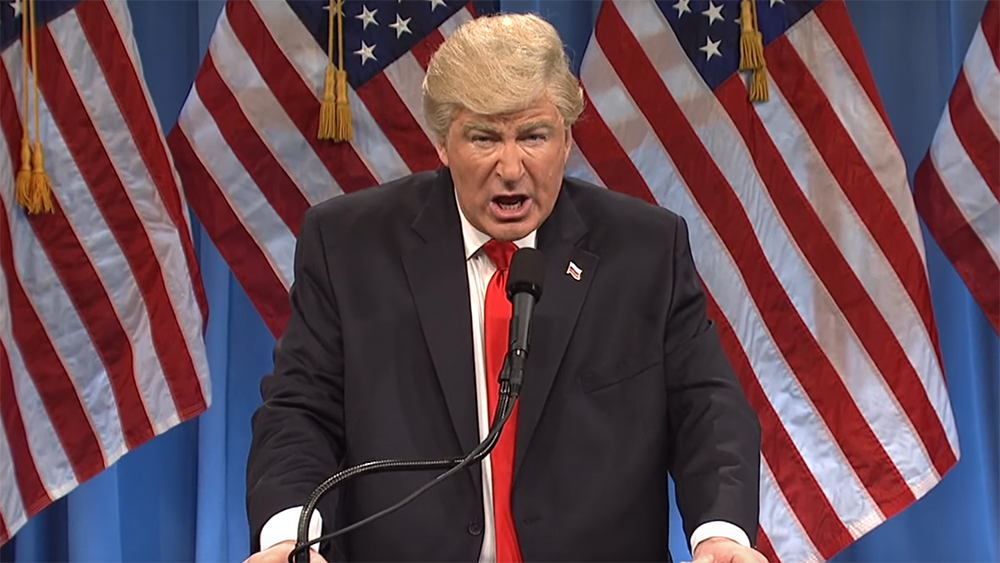
Baldwin initially resisted. He did not want to spend his Saturday nights buried in orange makeup and a blonde wig. Michaels persisted. When Baldwin finally agreed, he made a distinct creative choice. He would not play Trump for lighthearted laughs. He would play him as a menace. Baldwin explicitly engineered his impression to be “mean and nasty.”
The mechanics of Baldwin’s Trump were heavy. He pushed his lower jaw forward. He pursed his lips into a permanent, aggressive pout. He dropped his voice into a raspy, breathy register, emphasizing the sharp consonants. Unlike Carvey’s bouncy, kinetic Bush, Baldwin’s Trump was static. He stood rigidly at the podium, projecting a wall of immovable ego.
The Psychological Toll and the Twitter War
The impact was immediate. Baldwin’s debut as Trump shattered SNL ratings records. The show enjoyed its most-watched season in twenty-three years. Baldwin won a Primetime Emmy Award for Outstanding Supporting Actor in a Comedy Series in 2017. He was paid a nominal fee of $1,400 per episode, but the cultural capital he generated was immeasurable.
However, the affectionate dynamic of the Carvey-Bush era was entirely gone. The real Donald Trump did not invite Baldwin to the White House. Instead, Trump attacked Baldwin on Twitter. The President of the United States routinely criticized the late-night sketch show, calling it unwatchable and biased. Baldwin and Trump entered a bizarre, real-time feud.
Baldwin later admitted the psychological toll of the role. Playing a figure he fundamentally opposed, week after week, became exhausting. The comedy felt less like a pressure valve and more like trench warfare. The “mean and nasty” approach was highly effective, but it was also heavy armor to wear on live television.
The Joe Biden Puzzle: Finding the Hook in 2024
The conversation between the two comedians naturally drifted to the current occupant of the Oval Office. Joe Biden presents a unique challenge for late-night mimics. Over the years, several actors have attempted to capture Biden on SNL. Jason Sudeikis played him as a grinning, aviator-wearing uncle. Woody Harrelson played him with a manic, toothy energy. Jim Carrey played him with aggressive, almost unhinged intensity.
Dana Carvey’s approach to Biden is entirely mechanical. He views the current president as a man operating with two distinct, malfunctioning gears. Carvey breaks the impression down into a sudden, jarring contrast of volume.
The Whisper and the Shout
First, Carvey establishes the whisper. He leans into the microphone, drops his voice to a raspy, intimate level, and delivers nonsensical, folksy anecdotes. He squints his eyes. He projects an image of fragile, quiet contemplation. Then, without warning, Carvey violently shifts gears. He snaps his head back, opens his eyes wide, and shouts a completely unrelated phrase. “No joke!” “Come on, man!”
This aggressive oscillation between the whisper and the shout is the core of Carvey’s Biden. It captures the public’s perception of a politician struggling to maintain a consistent narrative rhythm. It is less mean-spirited than Baldwin’s Trump, but more pointed than Carvey’s own Bush. It sits precisely in the middle of the modern satirical spectrum.
When Satire Becomes the Political Record
The exchange between Baldwin and Carvey underscores a massive shift in American media. Late-night television is no longer just a reflection of the political news cycle. It is an active participant in it. Millions of voters consume their political reality through the filter of Studio 8H. The caricatures built by comedians often become more recognizable than the politicians themselves.
When Carvey created George H.W. Bush, he was building a cartoon. When Baldwin created Donald Trump, he was building an indictment. The mechanics of the impersonation changed because the mechanics of American politics changed. The stakes are higher. The audience is fractured. The comedians are forced to adapt.
The wigs are styled. The prosthetics are applied. The cue cards are written. The cameras roll. The audience laughs. The politicians react. The comedians reset.
History.
Next in the Series: The Economics of Late-Night Politics
We will examine the exact financial windfall NBC experienced during the 2016 election cycle, detailing the ad revenue surges tied directly to Alec Baldwin’s political cold opens.