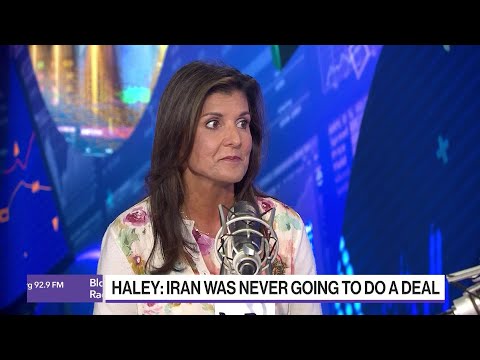
Former UN Ambassador Nikki Haley stated on Bloomberg Television that Iran never intended to finalize a renewed nuclear deal, using diplomatic negotiations primarily as a stalling tactic to advance uranium enrichment and fund proxy networks. The illusion of a renewed Joint Comprehensive Plan of Action (JCPOA) has anchored Western foreign policy for years. But the reality on the ground tells a different story.
Haley’s assessment cuts through the diplomatic optimism that characterized the early years of the Biden administration. Negotiations in Vienna stretched on for months. Envoys exchanged drafts. European intermediaries carried messages back and forth. All the while, Tehran’s centrifuges kept spinning.
The premise of the talks was a return to the 2015 framework. The United States would lift economic sanctions. In exchange, Iran would dismantle advanced centrifuges and ship out enriched uranium. It was a transactional equation. Haley argues the equation was fundamentally flawed because one side was never doing the math.
The Bloomberg Television Declaration
Speaking directly to the global markets and political observers on Bloomberg Television, Haley dismissed the notion of Iranian diplomatic sincerity. Her stance reflects a growing consensus among national security hawks and intelligence analysts.
The regime in Tehran, led by Supreme Leader Ayatollah Ali Khamenei, views the West with fundamental hostility. A diplomatic signature was never the end goal. The end goal was survival, regional hegemony, and nuclear threshold status.
“They were never going to do a deal. It was always a stalling tactic to get exactly what they wanted., Nikki Haley, speaking on Bloomberg Television.
This perspective reframes the last three years of international relations. If Iran was never going to sign a deal, the negotiations were not a failure of diplomacy. They were a successful Iranian intelligence operation.
The Architecture of an Illusion
To understand Haley’s position, one must look back to the original 2015 Joint Comprehensive Plan of Action. Brokered by the Obama administration alongside the P5+1 nations, the deal offered Tehran billions of dollars in sanctions relief.
The theory of change in 2015 was straightforward. Economic integration would moderate Iranian behavior. A wealthier Iran would become a more responsible stakeholder in the Middle East. The nuclear threat would be boxed in for a decade or more.
That theory collapsed almost immediately. The financial windfall from unfrozen assets did not build hospitals or schools in Tehran. It flowed directly to the Islamic Revolutionary Guard Corps (IRGC). It funded the Quds Force. It armed proxy militias across the Levant.
The Fatal Flaws of the JCPOA
Critics of the 2015 agreement, including Haley during her tenure at the United Nations, pointed to specific structural failures in the text.
- Sunset Clauses: Key restrictions on uranium enrichment and centrifuge manufacturing were designed to expire after 10 to 15 years.
- Ballistic Missiles: The agreement completely ignored Iran’s development of intercontinental ballistic missiles, the exact delivery systems required for a nuclear payload.
- Inspection Limits: The International Atomic Energy Agency (IAEA) faced significant hurdles in accessing undeclared military sites where illicit nuclear work was suspected.
These omissions provided Tehran with a legal pathway to a massive nuclear infrastructure, provided they simply waited out the clock.
The 2018 Pivot and Maximum Pressure
In May 2018, the Trump administration officially withdrew the United States from the JCPOA. Nikki Haley served as the U.S. Ambassador to the United Nations during this critical pivot.
The withdrawal initiated the “Maximum Pressure” campaign. The U.S. Treasury Department reimposed crippling secondary sanctions on the Iranian oil and banking sectors. The goal was to force Tehran back to the table for a broader, more comprehensive treaty.
Iran responded with strategic patience. The regime absorbed the economic blow, betting that a future U.S. administration would reverse course. When the political winds in Washington shifted in 2021, Tehran was ready to play the diplomatic game again.
Buying Time in Vienna
When efforts to revive the deal began in early 2021, the venue was the Hotel Coburg in Vienna. U.S. Special Envoy Robert Malley led the American delegation, though Iranian diplomats refused to meet face-to-face with Americans. European diplomats shuttled between rooms.
The talks dragged on for over eighteen months. Every time a finalized text appeared imminent, Iranian negotiators introduced new, extraneous demands.
First, they demanded a guarantee that no future U.S. president could withdraw from the deal. Then, they demanded the Biden administration remove the IRGC from the State Department’s Foreign Terrorist Organization (FTO) list. Finally, they demanded the IAEA close its ongoing investigations into unexplained uranium particles found at undeclared sites.
Haley points to this exact sequence of events. The shifting goalposts were not a sign of tough negotiation. They were a sign of intentional sabotage. Tehran needed time, and Vienna provided the cover.
The Centrifuges Never Stopped
While diplomats argued over bracketed text in Austrian hotels, Iranian scientists worked quietly at the Natanz and Fordow nuclear facilities. The diplomatic cover allowed them to breach every limit set by the original 2015 agreement.
IAEA Director General Rafael Grossi repeatedly warned the international community. Iranian technicians disconnected IAEA surveillance cameras. They denied inspectors access to key facilities. Most alarmingly, they installed cascades of advanced IR-6 centrifuges.
The 60 Percent Threshold
By late 2022, the IAEA confirmed that Iran was enriching uranium to 60 percent purity. This is a massive technical leap. In the complex physics of uranium enrichment, reaching 60 percent requires the vast majority of the effort. Going from 60 percent to the 90 percent required for weapons-grade material is a short, rapid step.
Experts now estimate Iran’s “breakout time”, the time required to produce enough weapons-grade uranium for a single nuclear bomb, has shrunk from a year under the JCPOA to a matter of weeks, if not days.
This is the reality Haley highlights. The regime achieved nuclear threshold status while the West was distracted by the promise of a signature.
The Shadow Economy and the Proxy War
The stalling tactic did more than just protect the nuclear program. It allowed Iran to rebuild its economy through illicit means. The enforcement of U.S. sanctions softened during the negotiation period, as Western powers sought to maintain goodwill with Tehran.
Iran capitalized on this hesitation. A massive “shadow fleet” of aging oil tankers began transporting millions of barrels of crude oil to independent refineries in China. The revenue from these illicit sales stabilized the regime’s currency and refilled the coffers of the IRGC.
That money was immediately deployed across the Middle East. The results of this funding became violently apparent in the latter half of 2023 and into 2024.
- Hamas in Gaza: Tehran provided millions in funding, training, and smuggled weaponry to Hamas, enabling the October 7 attacks against Israel.
- Hezbollah in Lebanon: The IRGC continued to supply precision-guided munitions to Hezbollah, creating a massive strategic threat on Israel’s northern border.
- The Houthis in Yemen: Iranian intelligence ships and weapons transfers empowered Houthi militants to effectively shut down commercial shipping in the Red Sea, directly challenging the global economy.
None of this would have been possible without the financial breathing room afforded by the prolonged, illusory negotiations in Vienna.
The Death of the Deal and a Strategic Shift
Today, the prospect of a revived JCPOA is effectively dead. The Biden administration has publicly stated that the deal is no longer on the agenda. The bipartisan consensus in Washington has shifted significantly toward Haley’s stated position.
The realization that Iran was never going to do a deal forces a total recalculation of Western strategy. Diplomacy, in the traditional sense, has failed. The focus must now shift to deterrence, regional security architecture, and economic containment.
The Abraham Accords, which normalized relations between Israel and several Arab nations, represent the future of Middle Eastern security. A unified coalition of nations threatened by Iranian expansionism is the only viable counterweight to Tehran’s ambitions.
The era of trusting the process is over. The international community spent years chasing a mirage in Vienna. The regime in Tehran used that time exactly as they intended. They enriched uranium. They armed their proxies. They sold their oil.
Diplomats drafted frameworks. Inspectors monitored cameras. Politicians debated terms. The deal was an illusion. Tehran.