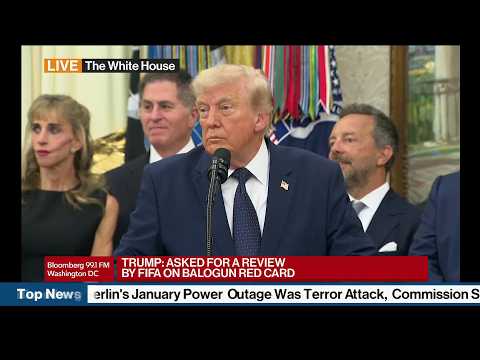
President Trump has entered the public debate surrounding a recent red card incident involving a United States soccer player. His commentary connected the on-field decision to broader discussions of patriotism and American values. This intervention has generated significant public discussion, illustrating the interwoven nature of sports, politics, and national sentiment.
The specific soccer match and the player involved were not detailed in initial reports. However, the nature of the President’s remarks suggests a perceived injustice or a moment that could be framed within a narrative of national pride. Such engagements by political leaders often elevate sports events beyond mere competition.
The Intersection of Sports and Politics
The involvement of high-profile political figures in sports discussions is a recurring phenomenon. Sports often serve as a microcosm of national identity, providing a platform for expressing collective pride or addressing perceived slights. President Trump’s history includes numerous instances where he has commented on athletic events, individual athletes, or sports organizations.
These comments frequently resonate with specific segments of the population. They can galvanize support for particular viewpoints or draw attention to issues that extend beyond the playing field. The blend of celebrity and political office amplifies the impact of such statements.
Previous Presidential Engagements with Sports
Historically, American presidents have often engaged with sports. This engagement typically aims to foster national unity or celebrate athletic achievement. For example, presidents frequently host championship-winning teams at the White House.
President Trump’s approach has often been more direct and opinionated. His comments have sometimes challenged established sports narratives or criticized athletes for their actions or political stances. This distinguishes his engagement from more traditional, ceremonial presidential interactions with sports.
One notable instance occurred in 2017, when President Trump publicly criticized NFL players who knelt during the national anthem. He described these actions as disrespectful to the flag and the country. This sparked a nationwide debate on freedom of speech, patriotism, and racial justice within professional sports.
Another example involved his commentary on specific athletes. He has often used social media platforms to express his views, reaching a wide audience instantly. These direct communications bypass traditional media filters, delivering his message unfiltered to his supporters.
The Red Card Incident: A Catalyst for Discussion
The recent red card incident in US soccer provided another opportunity for presidential commentary. While the specifics of the match and player remain unconfirmed, the President’s decision to weigh in suggests the event held significant symbolic weight. A red card, by its nature, is a punitive action that removes a player from the field, often seen as a moment of disgrace or unfairness depending on one’s perspective.
In the context of international competition, such an incident can quickly become a point of national contention. Fans often perceive decisions against their national team as biased or unjust. A political leader’s endorsement of this sentiment can intensify public reaction.
Public Reaction and Media Coverage
News outlets, including Bloomberg Television, quickly picked up on President Trump’s statements. The coverage often highlighted the polarizing nature of his remarks. Some commentators praised his defense of American athletes, while others criticized what they perceived as an unnecessary politicization of sports.
Social media platforms became immediate arenas for debate. Supporters lauded the President for standing up for the country and its athletes. Critics accused him of distracting from more pressing issues or inflaming divisions.
The discussion extended beyond the immediate incident. It touched upon broader questions about the role of patriotism in sports. It also questioned the responsibilities of athletes as public figures.
Patriotism and Sportsmanship
President Trump’s comments often frame sports controversies within a narrative of patriotism. This approach suggests that actions on the field, or reactions to them, reflect on national character. It implies that athletes carry a responsibility to uphold national honor, even in competitive moments.
However, the concept of patriotism in sports is complex. For some, it means unwavering support for one’s national team, regardless of individual actions. For others, it involves adherence to principles of fair play and sportsmanship, even when it means accepting unfavorable outcomes.
The red card incident, therefore, became a flashpoint for these differing interpretations. Was the player’s action, which led to the red card, an act of passion or a lapse in judgment? Did the referee’s decision reflect fairness or bias? The answers often depended on one’s existing political and national allegiances.
The Role of National Symbols in Sports
National anthems, flags, and team colors are powerful symbols in sports. They evoke strong emotional responses and connect individual athletes to a broader national identity. When these symbols are perceived to be disrespected, or when national pride is challenged, political figures often step in.
President Trump’s past comments on national symbols in sports indicate a consistent emphasis on traditional displays of respect. His recent remarks on the soccer red card align with this pattern. He frames such incidents as opportunities to reinforce his vision of American identity and values.
The Blending of Celebrity, Sports, and Politics
The contemporary landscape sees an increasing convergence of celebrity, sports, and politics. Athletes are often highly visible public figures, and their actions both on and off the field are scrutinized. Political leaders, in turn, recognize the power of these platforms to reach and influence large audiences.
President Trump, a figure who has long operated at the intersection of celebrity and politics, often leverages this overlap. His commentary on the soccer red card is a tactical move. It allows him to engage with a popular cultural event while simultaneously reinforcing his political message.
The Impact on Public Discourse
This blending affects public discourse in several ways. It can make political issues feel more immediate and personal to sports fans. It can also introduce political divisions into spaces traditionally seen as unifying.
For some, this politicization of sports is unwelcome. They argue that sports should remain an escape from political strife. For others, it is an inevitable reflection of a society where few areas remain untouched by political debate.
The President’s remarks ensure that the red card incident will be remembered not just as a moment in a soccer match, but as a point of political discussion. It transforms a referee’s call into a national talking point, debated in living rooms and on news channels alike.
Athletes find themselves under increased pressure. Their on-field performance is subject to athletic review. Their off-field conduct and even their political views can become national news. The line between athlete and political figure blurs.
The sports world becomes another arena for ideological battles. Fans, commentators, and politicians all stake claims. Debates rage over loyalty. Debates rage over conduct. Debates rage over what it means to be an American athlete.
President Trump intervenes. He frames the narrative. He sparks the conversation. He connects the dots between a red card and national pride. The sports world reacts. The political world reacts. The public reacts. A simple game decision becomes a national event.