
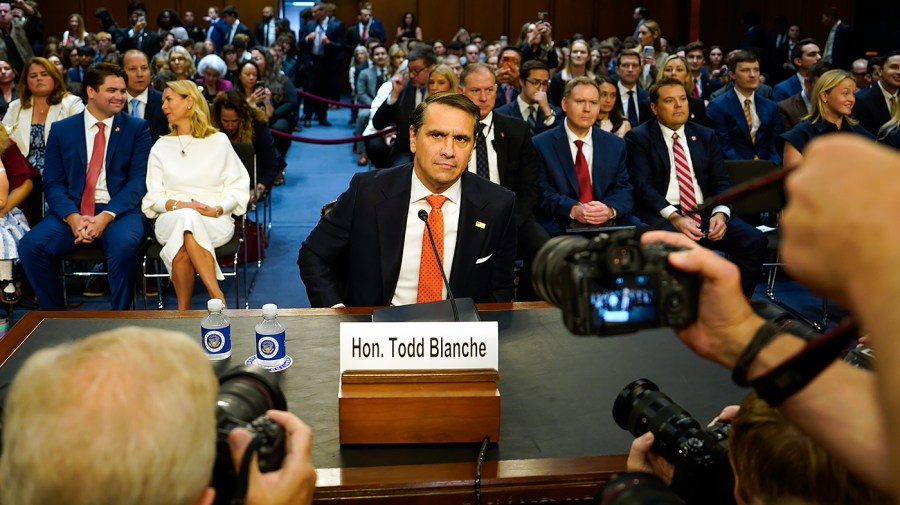
President Donald Trump has indicated a potential move to withdraw Todd Blanche’s nomination for Attorney General. This nomination has been stalled in the United States Senate since its submission in April 2026. The suggestion points to ongoing political maneuvering and growing frustration within Washington D.C. regarding executive appointments, particularly judicial ones. The potential withdrawal highlights the persistent challenges of judicial confirmations in the current political climate.
The Eleventh Circuit covers Alabama, Florida, and Georgia. It handles a significant caseload. A vacant seat can strain the court’s resources and impact the pace of justice.
The Stalled Nomination of Judge Blanche
Todd Blanche’s nomination has faced an unusually protracted delay. The nomination was submitted by President Trump in April 2026. It has remained in what is commonly referred to as ‘Senate limbo’ since that time.
Typically, judicial nominations move through the Senate Judiciary Committee within a few months. Blanche’s nomination has yet to receive a committee hearing. It has also not received a vote from the committee or the full Senate.
Judge Blanche is a sitting federal district judge. The individual was nominated to fill a vacancy on the influential Eleventh Circuit. This court is critical for legal precedent in the southeastern United States.
The specific details of the Senate’s hesitation have not been publicly disclosed. The lack of public explanation contributes to the perception of a stalled process. This delay prevents the administration from filling a critical judicial vacancy.
Understanding Senate Confirmation Process
The Senate confirmation process for presidential nominees is a critical aspect of American governance. It requires a majority vote in the Senate for most executive branch appointments. This includes cabinet secretaries, ambassadors, and federal judges.
Nominations can face delays due to various factors. Partisan opposition is one common reason. Procedural hurdles can also cause slowdowns. A lack of legislative priority for a specific nomination can also contribute to delays.
When a nomination remains in ‘limbo,’ it typically means one of two things. Either it has been referred to a Senate committee but has not yet received a hearing or a vote. Or, it has cleared committee but awaits a full Senate vote.
Such delays can last for weeks or even months. They prevent the administration from filling key positions. This can impact government functionality and the efficiency of the judicial system.
The process is designed to provide a check on executive power. It ensures that nominees are thoroughly vetted. However, it can also become a tool for political obstruction. This is especially true in periods of narrow partisan majorities.
Historical Context of Judicial Nominations
Judicial nominations have historically been contentious. The balance of power on federal courts is a significant political prize. Presidents often seek to appoint judges who align with their judicial philosophy.
The Senate, in turn, scrutinizes these nominees. Senators consider qualifications, temperament, and judicial ideology. The process has become increasingly politicized over recent decades.
Major shifts in court composition often follow presidential elections. The stakes are particularly high for lifetime appointments to federal appellate courts and the Supreme Court. The Eleventh Circuit is one of the busiest federal appellate courts.
Past administrations have faced similar challenges. President George W. Bush encountered significant resistance to some judicial nominees. President Barack Obama also saw many of his nominees delayed or blocked.
The current environment in 2026 continues this trend. The Senate’s narrow majority amplifies the impact of partisan divisions. Every vote becomes critical in the confirmation process.
Implications of a Potential Withdrawal
A presidential decision to withdraw a nomination is not unprecedented. It can occur for several reasons. A nominee’s inability to secure sufficient support is one common cause. The discovery of new information about the nominee can also lead to withdrawal.
A shift in the administration’s policy objectives might also prompt such a move. In 2023, former President Joe Biden withdrew several judicial nominees. This occurred after prolonged Senate inaction on those nominations.
In this instance, President Trump’s suggestion of a potential withdrawal holds multiple interpretations. It could be a tactic to pressure the Senate into action. The implication is that if the Senate does not act, they risk losing the opportunity to confirm this specific nominee.
It might also be a prelude to nominating an alternative candidate. Such a candidate might be perceived as more likely to garner quicker approval. This move underscores the power dynamics between the executive branch and the legislative branch in the appointment process.
A withdrawal could also signal a strategic recalibration by the White House. They might aim to conserve political capital. This capital could then be used for other legislative priorities or future nominations.
Impact on Judicial Vacancies
The continued vacancy on the Eleventh Circuit has practical consequences. It can increase the workload for the remaining judges. This can lead to delays in case processing. It can also impact the consistency of legal rulings.
The Eleventh Circuit covers a vast geographic area. It addresses a wide range of complex legal issues. These include civil rights, environmental law, and business disputes.
Filling judicial vacancies is a priority for any administration. It ensures the efficient functioning of the federal judiciary. Prolonged vacancies can create backlogs and undermine public confidence in the justice system.
President Trump’s administration seeks to shape the federal judiciary. This involves appointing judges who interpret the Constitution in a specific manner. Delays like Blanche’s nomination impede this objective.
Political Context in 2026
The political landscape in 2026 continues to present challenges for presidential administrations. Filling key roles remains a complex endeavor. The Senate, currently with a narrow majority, faces increasing partisan divisions. These divisions significantly affect the confirmation process.
This environment often leads to extended vetting periods. It also creates potential roadblocks for appointments. This applies even to nominations that might otherwise be considered routine.
The current situation with Judge Blanche’s nomination highlights these ongoing tensions. Delays and potential withdrawals are becoming more common. This reflects the complexities of navigating legislative approval. This occurs particularly in a highly polarized political environment.
The White House faces pressure to ensure its judicial appointments are confirmed efficiently. This is crucial for shaping the federal judiciary according to its vision. The executive branch must balance its desires with the realities of Senate procedure.
Future of Judicial Appointments
The trend of contentious judicial appointments is likely to continue. Both parties view judicial appointments as critical. They are seen as a means to influence legal and social policy for decades.
Presidents will continue to seek nominees who align with their ideologies. The Senate will continue to exercise its constitutional role of advice and consent. This dynamic often results in prolonged battles over judicial seats.
The possibility of a presidential withdrawal adds another layer to this dynamic. It can be a powerful negotiating tool. It can also signal a willingness to pivot to new strategies.
The outcome for Judge Blanche’s nomination will set a precedent. It will illustrate the current state of play between the White House and the Senate. It will also show the limits of executive power in a divided government.
The Broader Implications for Governance
The challenges in confirming judicial nominees extend beyond individual appointments. They reflect broader issues in American governance. The ability of the government to function effectively depends on filling key positions.
When the confirmation process becomes overly politicized, it can hinder governmental operations. This can affect the judiciary, the executive branch, and even the legislative agenda.
The interaction between the President and the Senate is a foundational aspect of the U.S. system of checks and balances. When this interaction is strained, it impacts the entire system. The current situation with Judge Blanche is a microcosm of these larger tensions.
The resolution of this specific nomination will be observed closely. It will offer insights into the strategies employed by both the White House and the Senate in 2026. It will also indicate the potential for future cooperation or continued gridlock.
The President suggested. The Senate stalled. The judiciary waited. The nation watched.