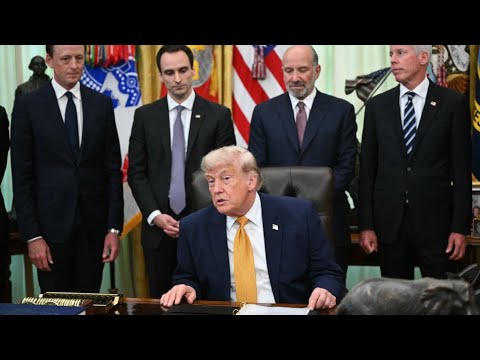
Donald Trump explicitly stated he does not want to inherit an economic collapse, comparing the scenario directly to the presidency of Herbert Hoover. The former president made the historical comparison during an appearance on Bloomberg Television, stating his preference that any impending market crash occur before he potentially assumes office. This statement frames the 2026 economic debate around Federal Reserve policy, the lag effect of interest rates, and the historical precedent of first-term recessions. Presidents do not control the business cycle, but they absorb the political consequences. Trump’s invocation of the 31st president relies on this exact dynamic. Herbert Hoover took office in March 1929. Seven months later, the stock market crashed, permanently defining his legacy.
The Bloomberg interview clip circulated immediately across financial terminals and social media platforms. Within two hours, it generated millions of impressions on X and LinkedIn, drawing formal responses from macroeconomic analysts at JPMorgan Chase and Morgan Stanley. The reaction underscored the heightened anxiety surrounding the U.S. economy in June 2026.
The Bloomberg Television Interview Strategy
Institutional Audience Context
Bloomberg Television operates as a primary information network for institutional investors, fund managers, and central bank policymakers. The broadcast reaches trading floors in Manhattan, London, and Tokyo. The platform demands a specific rhetorical approach, separated from traditional campaign trail messaging. When Trump invoked Herbert Hoover on this network, he spoke directly to market makers. These professionals track the M2 money supply, the inverted yield curve, and corporate default rates. They understand the structural risks embedded in the post-pandemic economy.
The U.S. national debt surpassed $34 trillion in early 2024 and continued its upward trajectory into 2026. Debt servicing costs now consume a historic percentage of federal tax revenue. By addressing these realities on Bloomberg, Trump signaled an awareness of the metrics driving institutional capital allocation.
The Rhetoric of Macroeconomics
“I don’t want to be Herbert Hoover.”
The declaration removes the standard political promise of universal economic control. Most political candidates insist their policies will immediately trigger prosperity. Trump pointed to the structural danger of entering office at the peak of a market cycle. He acknowledged that taking the oath of office right before a speculative bubble bursts guarantees political ruin. The statement functions as expectation management. It forces financial journalists and economic historians to acknowledge the preexisting conditions of the 2026 economy. If a recession occurs, the narrative framework is already established on the record.
The Herbert Hoover Precedent of 1929
The 1928 Election and Economic Optimism
Herbert Hoover entered the White House with an impeccable administrative resume. He served as Secretary of Commerce under Presidents Warren G. Harding and Calvin Coolidge. He orchestrated massive European relief efforts during World War I. He won the 1928 presidential election in a landslide, securing 444 electoral votes against Democrat Al Smith’s 87.
Hoover took the oath of office on March 4, 1929. The American economy appeared invincible. The Dow Jones Industrial Average had climbed steadily throughout the 1920s, driven by mass production and consumer credit. Retail investors borrowed heavily to buy equities, focusing on high-growth companies like Radio Corporation of America (RCA) and General Motors. Margin trading became a national phenomenon. The Federal Reserve maintained loose credit conditions throughout the decade before attempting to tighten policy in 1928.
Black Tuesday and the Margin Crisis
The stock market peaked on September 3, 1929, with the Dow Jones closing at 381.17. The collapse began in late October. Black Thursday on October 24 triggered mass panic. Black Tuesday on October 29 wiped out billions of dollars in paper wealth. Banks called in margin loans. Investors defaulted en masse. The banking system froze as depositors rushed to withdraw funds.
The Great Depression began exactly 239 days after Hoover’s inauguration. The Dow Jones eventually bottomed out at 41.22 in July 1932, representing an 89 percent decline from its peak.
The Policy Failures and the Smoot-Hawley Tariff
Hoover did not engineer the speculative bubble. The macroeconomic conditions formed under the Coolidge administration. Yet, Hoover occupied the Oval Office when the collapse occurred. His subsequent policy decisions compounded the disaster. He signed the Smoot-Hawley Tariff Act in June 1930, raising import duties on over 20,000 foreign goods to protect domestic farmers. The legislation triggered retaliatory tariffs from international trading partners, crushing global trade.
The American public assigned him full responsibility for the domestic suffering. Homeless encampments became known as “Hoovervilles.” Newspapers used for warmth were labeled “Hoover blankets.” Franklin D. Roosevelt defeated Hoover in the 1932 election by a massive margin of 472 to 59 electoral votes.
The Post-Pandemic Inflation Spike
Fiscal Stimulus and the M2 Money Supply
The structural vulnerabilities of the 2026 economy originated in the fiscal response to the 2020 global pandemic. The federal government injected trillions of dollars directly into the economy through the CARES Act and the American Rescue Plan. The M2 money supply expanded at a historically unprecedented rate. This massive influx of liquidity preserved consumer spending during global lockdowns, but it fundamentally distorted the valuation of equities, real estate, and consumer goods.
The Peak of the Consumer Price Index
Inflation began accelerating in early 2021. The Consumer Price Index peaked at 9.1 percent in June 2022, the highest level recorded since November 1981. The cost of shelter, food, and energy outpaced wage growth. The Federal Reserve initially labeled the inflation as “transitory,” attributing the price increases to temporary supply chain bottlenecks. When the inflation proved structural, the central bank was forced into the aggressive tightening cycle that defines the current economic landscape. Trump’s Hoover comparison directly targets the delayed consequences of this specific inflationary period.
The Mechanics of a Modern Market Crash
Algorithmic Trading and Circuit Breakers
A market crash in 2026 operates on entirely different mechanics than the 1929 collapse. Modern equity markets rely on high-frequency trading algorithms. These computer models execute millions of trades per second based on quantitative signals. When support levels break, algorithms automatically trigger sell orders, accelerating the downward momentum.
The Securities and Exchange Commission utilizes market-wide circuit breakers to prevent a total freefall. If the S&P 500 drops 7 percent, trading halts for 15 minutes. A 20 percent drop halts trading for the remainder of the day. These mechanisms prevent a modern equivalent of Black Tuesday, but they do not stop a prolonged bear market.
Federal Reserve Liquidity Facilities
The modern Federal Reserve possesses tools unavailable to the central bank in 1929. During the March 2023 regional banking crisis, the Federal Reserve established the Bank Term Funding Program (BTFP). This facility allowed banks to pledge U.S. Treasuries at par value in exchange for immediate liquidity. These interventions prevent systemic bank runs. However, they also expand the central bank’s balance sheet and complicate the fight against inflation. A president inheriting an economic crisis in 2026 must navigate this complex relationship with the Federal Reserve. The executive branch cannot unilaterally inject liquidity into the banking sector.
The Speed of Panic in the Digital Era
The 1929 Physical Bank Run
When panic struck in 1929, the mechanics of a bank run were physical and slow. Depositors lined up outside financial institutions on Wall Street and Main Street. They demanded physical currency. The speed of the collapse was limited by the physical constraints of geography, transportation, and human teller operations. News traveled through newspapers, radio broadcasts, and telegraph wires.
The 2026 Digital Bank Run
The modern financial system operates at the speed of fiber-optic cables. The collapse of Silicon Valley Bank in March 2023 demonstrated the mechanics of a digital bank run. Venture capitalists and institutional depositors coordinated withdrawals via group chats on WhatsApp and public posts on X. They moved $42 billion out of the bank in a single day using digital wire transfers. A president facing an economic crisis in 2026 must manage panic that compounds exponentially on social media. The traditional tools of presidential communication move too slowly to intercept a digital liquidity crisis.
The 2026 Macroeconomic Landscape
Interest Rate Lags and Jerome Powell
The current economic environment mirrors the late 1920s in specific structural ways. The Federal Reserve, operating under Chairman Jerome Powell, spent 2022 and 2023 executing the fastest series of interest rate hikes in four decades. The federal funds rate moved from near zero to a target range of 5.25% to 5.50%, holding steady through 2024 and 2025.
Monetary policy operates with a widely documented lag effect. The impact of a rate hike takes between 12 and 24 months to fully restrict corporate borrowing and consumer spending. By June 2026, the cumulative weight of these hikes continues to pressure the financial system.
Commercial Real Estate and Regional Banks
Regional banks face ongoing stress from commercial real estate portfolios. The shift to remote work permanently altered office occupancy rates in major metropolitan areas like San Francisco, Chicago, and New York. Trillions of dollars in commercial real estate debt mature between 2024 and 2027. Property owners must refinance these loans at significantly higher interest rates while generating lower rental income. This dynamic threatens the balance sheets of mid-sized regional banks, which hold the majority of commercial real estate loans in the United States.
Consumer Debt and Treasury Yields
Consumer data in mid-2026 shows distinct signs of strain. Total credit card debt exceeds $1.1 trillion. Auto loan delinquencies have surpassed pre-pandemic levels. The yield curve on U.S. Treasuries experienced a prolonged inversion, with short-term rates exceeding long-term rates. An inverted yield curve serves as a traditional leading indicator of a recession. The stock market’s performance, heavily concentrated in a few mega-cap technology and artificial intelligence companies like Nvidia and Microsoft, masks broader economic weakness. Trump’s reference to Hoover signals an awareness of these specific vulnerabilities.
Presidential Control vs. Economic Reality
Inheriting the Previous Administration’s Baseline
The American electorate routinely holds the executive branch responsible for global macroeconomic shifts. This dynamic forces political campaigns to navigate events entirely outside their jurisdiction. Supply chain disruptions, international conflicts, and global energy market fluctuations dictate domestic pricing.
Every president inherits a baseline. Barack Obama inherited the 2008 financial crisis from George W. Bush. Ronald Reagan inherited double-digit inflation from Jimmy Carter. The timing of an economic downturn determines the political narrative.
Historical Examples of First-Term Recessions
If a recession begins in the fourth year of a term, the incumbent faces the backlash. If it begins in the first year, the new president risks the Hoover designation. George H.W. Bush faced a mild recession in 1990, midway through his term. It contributed heavily to his 1992 defeat by Bill Clinton. Jimmy Carter dealt with an energy crisis and stagflation, leading to his 1980 loss. The historical data confirms Trump’s underlying premise. Economic contractions destroy presidencies.
The Electoral Calculus of Preemptive Blame
Catching a Falling Knife
Wall Street uses the phrase “catching a falling knife” to describe the act of buying an asset while its price is rapidly declining. Taking the presidency during a market correction presents the exact same risk. The executive branch must deploy political capital to pass stimulus measures. They must navigate rising unemployment. They must manage public panic. By stating his preference that a crash happen before he takes office, Trump acknowledges the impossibility of catching the knife without bleeding.
Setting the 2026 Narrative
The strategy relies on preemptive narrative construction. If the market crashes shortly after the next inauguration, the incoming administration has already placed the warning on the record. The blame is shifted backward to the monetary policy of the preceding four years. This approach abandons the traditional political optimism that defined campaigns in the late 20th century. It replaces it with a stark macroeconomic realism tailored for an electorate conditioned by inflation and market volatility.
The macroeconomic data points remain fixed. The Federal Reserve sets the rates. The bond market dictates the yields. The consumer holds the debt. The historical precedent stands unchallenged. Candidates make the promises. Presidents take the oath. Presidents take the fall. Hoover.