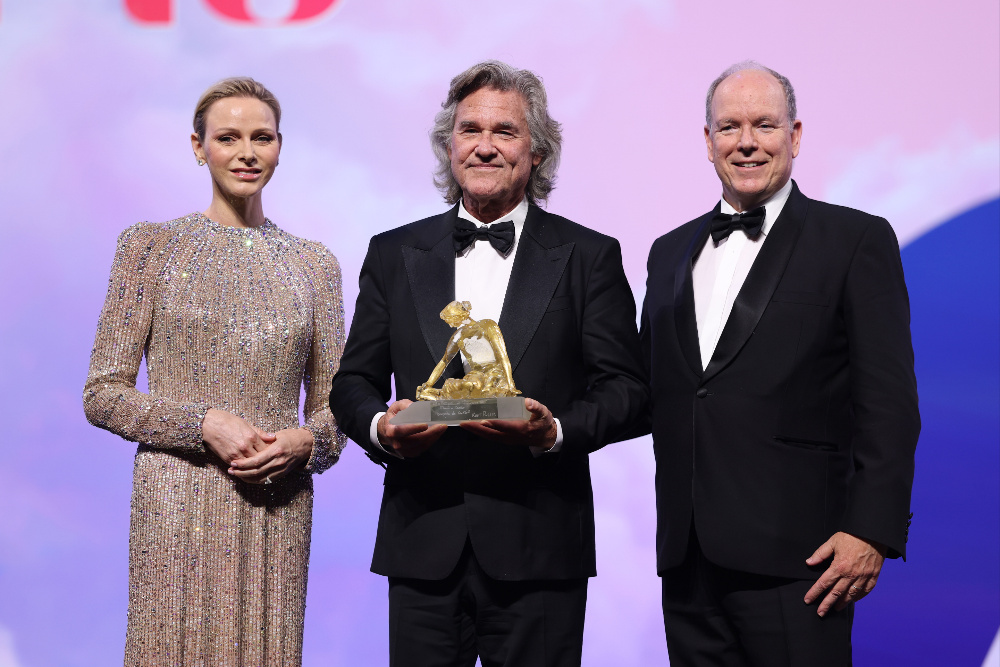
Kurt Russell received the prestigious Crystal Nymph Award from Princess Charlene of Monaco at the 2026 Monte-Carlo Television Festival. The ceremony, held inside the Grimaldi Forum on the Mediterranean coast, formally recognized the American actor’s six-decade contribution to global entertainment. The award stands as the festival’s highest honor for lifetime achievement, bridging the gap between classic Hollywood stardom and the modern international television landscape.
The moment brought Hollywood royalty face-to-face with European statehood. Russell, at 75 years old, stood under the festival lights to accept a trophy historically reserved for the medium’s most transformative figures. Princess Charlene, representing the House of Grimaldi, handed over the crystal statuette to thunderous applause from the international press corps and assembled industry executives.
In many ways, the award represents a full-circle moment. What looks to the general public like a purely cinematic legacy actually began on the small screen. The Monte-Carlo honor recontextualizes a career that started in the black-and-white era of network broadcasting and has now anchored itself in the multi-billion-dollar streaming wars.
The Grimaldi Forum and the Weight of the Crystal Nymph
The Monte-Carlo Television Festival is not a new invention. Prince Rainier III established the event in 1961. His goal was specific: to recognize television as an art form equal to cinema, a radical notion at the time. Over the decades, the festival has operated under the honorary presidency of Prince Albert II, maintaining its status as a critical European gathering for global media executives, showrunners, and actors.
The festival’s standard competitive awards are the Golden Nymphs. These are handed out annually for best series, best actor, and best documentary. The Crystal Nymph operates on a different tier entirely. It is not awarded for a single season of television. It is awarded for a lifetime of sustained excellence and cultural impact.
When Russell walked onto the stage at the Grimaldi Forum, he joined a highly exclusive list of global icons. The physical award itself is a masterwork of design. It is a crystal replica of the Salmacis nymph, originally sculpted by François Joseph Bosio. Bosio, famously, was the chief court sculptor to King Louis XVIII. The trophy carries the physical weight of European history, handed to an actor famous for portraying the rugged American frontier.
A Career Forged in the Fires of Early Television
Modern audiences associate Kurt Russell with the wide-screen theatrical experience. They picture MacReady in the snows of Antarctica or Wyatt Earp walking down the dusty streets of Tombstone. Yet, the Monte-Carlo Television Festival recognized the foundation of his career: episodic television.
Russell’s professional life began as a child actor on the small screen. In 1963, he landed the lead role in the ABC western series The Travels of Jaimie McPheeters. He was twelve years old. He shared the screen with Charles Bronson and Dan O’Herlihy, learning the brutal, fast-paced mechanics of television production. He appeared in episodes of Gunsmoke, The Fugitive, and The Virginian. He became a fixture in the living rooms of mid-century America long before he became a box-office draw.
His most critical television milestone arrived in 1979. Director John Carpenter cast Russell as Elvis Presley in the made-for-television movie Elvis, which aired on ABC. The performance was a revelation. It stripped away the caricature of the rock-and-roll king and delivered a grounded, deeply human portrayal. The role earned Russell an Emmy nomination for Outstanding Lead Actor in a Miniseries or a Movie. More importantly, it forged his lifelong creative partnership with Carpenter, a collaboration that would define the next decade of genre cinema.
The Theatrical Decades and Global Stardom
Following the success of Elvis, Russell transitioned out of television and into a dominant run of theatrical releases. Throughout the 1980s and 1990s, he became an archetype of the American anti-hero.
He played Snake Plissken in Escape from New York in 1981. He played R.J. MacReady in The Thing in 1982. He played Jack Burton in Big Trouble in Little China in 1986. These films did more than generate box office revenue. They created a distinct cultural footprint. Russell’s characters were cynical, highly capable, and deeply reluctant to save the day. It was a stark contrast to the muscle-bound, invincible action stars dominating the era.
His versatility kept him employed across genres. He anchored the romantic comedy Overboard with Goldie Hawn in 1987. He led the blockbuster ensemble of Backdraft in 1991. He delivered a definitive portrayal of Wyatt Earp in 1993’s Tombstone. Through it all, Russell maintained a reputation as a working professional. He did not chase the Hollywood social scene. He clocked in, hit his marks, delivered the performance, and went home.
The Streaming Renaissance: A Return to the Small Screen
The Crystal Nymph Award in 2026 was not merely a nostalgic look backward. It was an acknowledgment of Russell’s potent return to television in the modern streaming era.
In 2023, Russell signed on to star in Monarch: Legacy of Monsters for Apple TV+. The series, part of Legendary Entertainment’s MonsterVerse, represented a massive investment in serialized storytelling. Russell took on the role of Lee Shaw, a former Army officer entangled with the secretive Monarch organization. In a unique casting maneuver, the younger version of the character was played by Russell’s real-life son, Wyatt Russell.
The show proved that Russell’s screen presence translated perfectly to the prestige television format. He brought cinematic gravity to an episodic structure. The success of Monarch demonstrated that the actor who had mastered network television in the 1960s could seamlessly adapt to the algorithmic, global streaming landscape of the 2020s. This ongoing relevance is precisely what the Monte-Carlo Television Festival seeks to honor with the Crystal Nymph.
Princess Charlene and the Optics of the Presentation
The visual contrast of the award presentation was striking. On one side of the stage stood Princess Charlene of Monaco. Born in Zimbabwe and raised in South Africa, the former Olympic swimmer married into the House of Grimaldi in 2011. She represents modern European royalty, carrying the philanthropic and cultural duties of the principality.
On the other side stood Russell. Born in Springfield, Massachusetts, and raised in the Hollywood studio system, he represents a specific brand of American resilience. He wore a tailored dark suit, his signature hair swept back, looking every bit the elder statesman of the entertainment industry.
When Princess Charlene handed the heavy crystal statuette to Russell, the cameras captured the intersection of two distinct worlds. Her brief remarks highlighted his enduring appeal across international borders. Russell’s acceptance speech was characteristically grounded. He thanked his family. He thanked the crews who had built the sets and lit the scenes over his sixty-year career. He did not offer a sweeping political manifesto. He offered the quiet gratitude of a man who simply loves the work.
The Architecture of a Lasting Legacy
The entertainment industry is littered with cautionary tales. Child stars rarely survive the transition to adult roles. Action stars rarely age into prestige television. Marriages in the public eye rarely last.
Kurt Russell defied all the statistical probabilities of his profession. He survived the Disney contract-player system of his youth. He survived the shifting tastes of the theatrical box office. He built a forty-year relationship with Goldie Hawn that remains one of Hollywood’s most enduring partnerships. He managed his career without the aid of relentless self-promotion or manufactured scandals.
The Crystal Nymph Award is an acknowledgment of this rare trajectory. It is an award for survival as much as it is for talent. It recognizes the sheer stamina required to remain relevant, compelling, and employed at the highest levels of global media from the Kennedy administration through the 2020s.
The festival concluded. The international press filed their stories. The executives returned to their networks. The actor held the crystal nymph. Monaco.