
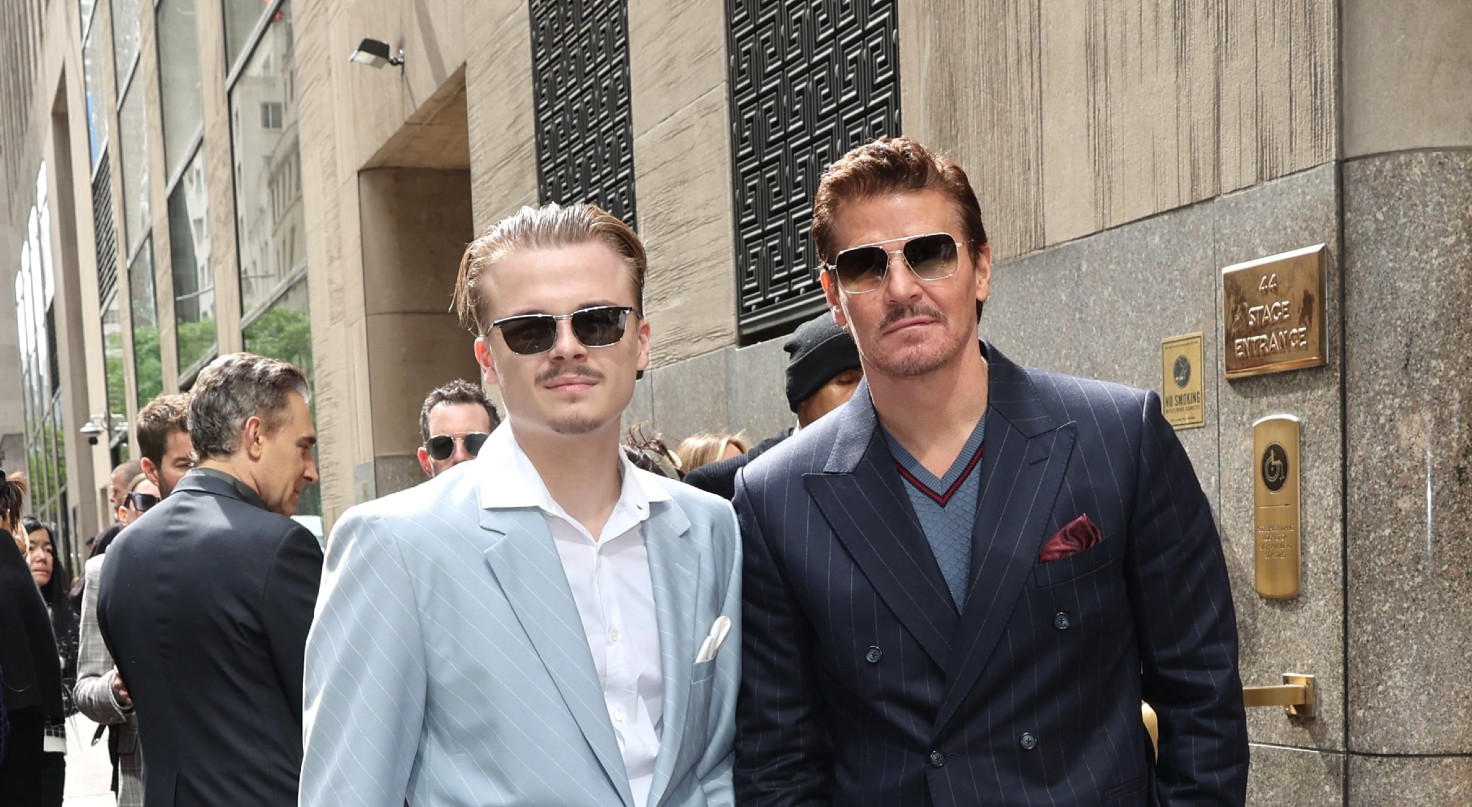
When David Boreanaz’s son, Jaden, secured a role in the pilot for a reboot of The Rockford Files, the moment represented a collision of television generations. The original series, anchored by the legendary James Garner, defined the 1970s private investigator genre. But the story took a deeper, more personal turn behind the scenes. During the production process, Gigi Garner, daughter of the late James Garner, reached out to David Boreanaz. She presented him with a specific keepsake that belonged to her father, a tangible passing of the torch from one era of television leading men to another.
The gesture was not merely a polite Hollywood exchange. It was an acknowledgment of legacy. James Garner’s portrayal of Jim Rockford left an indelible mark on television history. For the Boreanaz family, stepping into that orbit carried significant weight.
This is how television history is preserved. Not just in archives or streaming catalogs, but in quiet moments off-camera. The artifacts matter. The lineage matters.
The Long Shadow of Jim Rockford
The Rockford Files premiered on NBC on September 13, 1974. It ran for six seasons, concluding on January 10, 1980. The show was a stark departure from the polished, infallible detectives of previous decades. Jim Rockford lived in a dilapidated mobile home parked at 29 Cove Road in Malibu, California. He drove a gold Pontiac Firebird Esprit. He often found himself on the losing end of a fistfight.
James Garner built the character with a specific, weary charm. Rockford was an ex-convict, pardoned after serving time in San Quentin for a crime he didn’t commit. He charged $200 a day plus expenses. He kept a gun in a cookie jar but rarely used it.
The series, created by Roy Huggins and Stephen J. Cannell, earned Garner an Emmy Award for Outstanding Lead Actor in a Drama Series in 1977. It established a template for the reluctant hero that influenced decades of television.
When Hollywood attempts to revive a property with that level of cultural footprint, the stakes are inherently high. The casting of Jaden Boreanaz in the pilot signaled a fresh attempt to capture the essence of the original while introducing it to a new demographic.
The Boreanaz Television Lineage
David Boreanaz understands the demands of long-running television. He has been a fixture on network and cable television for nearly three decades. His career trajectory is a study in sustained leading-man status.
He first gained prominence as the brooding vampire Angel on Buffy the Vampire Slayer (1997–1999), before anchoring his own successful spin-off, Angel (1999–2004). He immediately transitioned to the Fox procedural Bones, playing FBI Special Agent Seeley Booth for 12 seasons (2005–2017). Following Bones, he stepped into the role of Jason Hayes on the CBS/Paramount+ military drama SEAL Team.
This sustained success requires a specific type of work ethic and an understanding of the medium. Boreanaz has navigated the shifting landscape of television from the late-90s boom through the streaming era.
For his son, Jaden, to enter the industry via a project connected to The Rockford Files creates a fascinating parallel. Jaden is stepping into an arena where his father has long been established, but doing so within the framework of a classic property.
The Keepsake: A Tangible Connection
The most compelling element of this narrative is the interaction between the Garner family and the Boreanaz family. Gigi Garner has been fiercely protective of her father’s legacy since his passing on July 19, 2014, at the age of 86.
When news of the reboot pilot circulated, Gigi Garner initiated contact. The presentation of a keepsake, an item directly connected to James Garner, to David Boreanaz was a significant gesture. It moved the reboot from a corporate intellectual property exercise to a personal handover.
Items belonging to iconic actors carry a distinct provenance. They are artifacts of a specific era of production. Whether it was a piece of wardrobe, a script, or a personal item Garner kept in his trailer, the gift serves as an anchor. It reminds the current production of the human element that made the original series resonate.
David Boreanaz, having spent decades on sets, recognizes the value of such artifacts. They provide a grounding force. They are a reminder of the standard set by those who previously occupied the space.
The Challenge of the Reboot Era
The attempt to revive The Rockford Files is part of a broader industry trend. Networks and streaming platforms frequently mine existing intellectual property. The strategy is built on the premise of built-in audience awareness.
However, the execution is often fraught with difficulty. A successful reboot must balance nostalgia with contemporary storytelling. It must honor the original without becoming a mere imitation.
Previous attempts to revive the Rockford character have faced significant hurdles. In 2010, NBC ordered a pilot for a reboot starring Dermot Mulroney as Jim Rockford, with Peter Berg directing. Despite the high-profile talent involved, the project did not move forward to series.
The character of Jim Rockford is intricately tied to James Garner’s specific persona. Garner’s effortless charisma, his comedic timing, and his ability to project a world-weary cynicism were unique. Replicating that alchemy is a formidable challenge for any actor or production team.
The Mechanics of a Pilot Production
A television pilot is essentially a prototype. It is a costly experiment designed to test a concept, the chemistry of the cast, and the viability of the narrative engine.
The casting process for a pilot is rigorous. Network executives, studio heads, showrunners, and casting directors scrutinize every decision. The inclusion of Jaden Boreanaz in the ensemble indicates that he navigated this gauntlet.
During pilot production, the atmosphere is a mix of high anxiety and creative energy. Every scene is calibrated to hook the viewer and convince the network to order a full season. The presence of a legacy property like The Rockford Files amplifies the pressure. The production is not just competing against other pilots; it is competing against the memory of the original series.
The Cultural Footprint of the 1970s Detective
To understand the significance of The Rockford Files, one must examine the context of 1970s television. The decade was defined by a specific breed of detective shows. Kojak, Columbo, Baretta, and The Streets of San Francisco dominated the ratings.
These shows reflected a post-Watergate, post-Vietnam cynicism. The protagonists were often flawed, operating outside the strict confines of the establishment. Jim Rockford was the epitome of this archetype. He was a man who had been wronged by the system, yet he continued to seek justice for those who could afford his $200-a-day fee.
The aesthetic of the show, the sun-drenched streets of Los Angeles, the specific fashion, the iconic Mike Post and Pete Carpenter theme song, became ingrained in the cultural consciousness. The theme song alone, featuring a prominent Moog synthesizer and a bluesy harmonica, reached number 10 on the Billboard Hot 100 in 1975.
Reviving The Rockford Files requires navigating this cultural footprint. It requires deciding which elements to retain and which to update for a modern audience.
The Enduring Appeal of the Reluctant Hero
The core of The Rockford Files’ appeal lies in the character of the reluctant hero. Rockford didn’t want to be involved in dangerous situations. He wanted to go fishing. He wanted to avoid his father, Joseph “Rocky” Rockford (played by Noah Beery Jr.), who constantly urged him to find a safer profession.
This reluctance made him relatable. He wasn’t a superhero. He was a guy trying to make a living, often getting punched in the face in the process. He relied on his wits, his network of contacts (including the perpetually exasperated LAPD Sergeant Dennis Becker, played by Joe Santos), and his ability to talk his way out of trouble.
This archetype remains potent. Audiences continue to respond to characters who are flawed, pragmatic, and ultimately decent. If the new iteration of The Rockford Files can capture this dynamic, it has a chance to succeed.
The Intersection of Hollywood Families
The story of the Boreanaz family and the Garner family intersecting highlights the insular nature of the entertainment industry. Hollywood is a company town. Lineages and connections often span generations.
David Boreanaz’s own father, Dave Roberts, was a prominent television presence as a weatherman for WPVI-TV in Philadelphia. The understanding of the medium has been passed down.
When Gigi Garner presented the keepsake to David Boreanaz, she was acknowledging this shared experience. She was recognizing the unique pressures and responsibilities that come with being part of a television legacy. It was a gesture of solidarity between families who understand the specific demands of the industry.
The Future of the Franchise
The fate of the new Rockford Files pilot remains to be seen. The television landscape is vastly different from the 1970s. The proliferation of streaming services, the fragmentation of audiences, and the shift in viewing habits present significant challenges.
However, the core elements of the original series, a compelling protagonist, sharp dialogue, and engaging mysteries, are timeless. If the new production can harness these elements while establishing its own identity, it may find an audience.
Regardless of the pilot’s outcome, the exchange between Gigi Garner and David Boreanaz remains a poignant moment. It serves as a reminder that behind the corporate strategies and intellectual property management, there are human connections. There are individuals who care deeply about the legacy of the work.
The artifacts remain. The stories continue. The lineage holds.
A pilot was shot. A keepsake was given. A legacy was honored.
Hollywood.