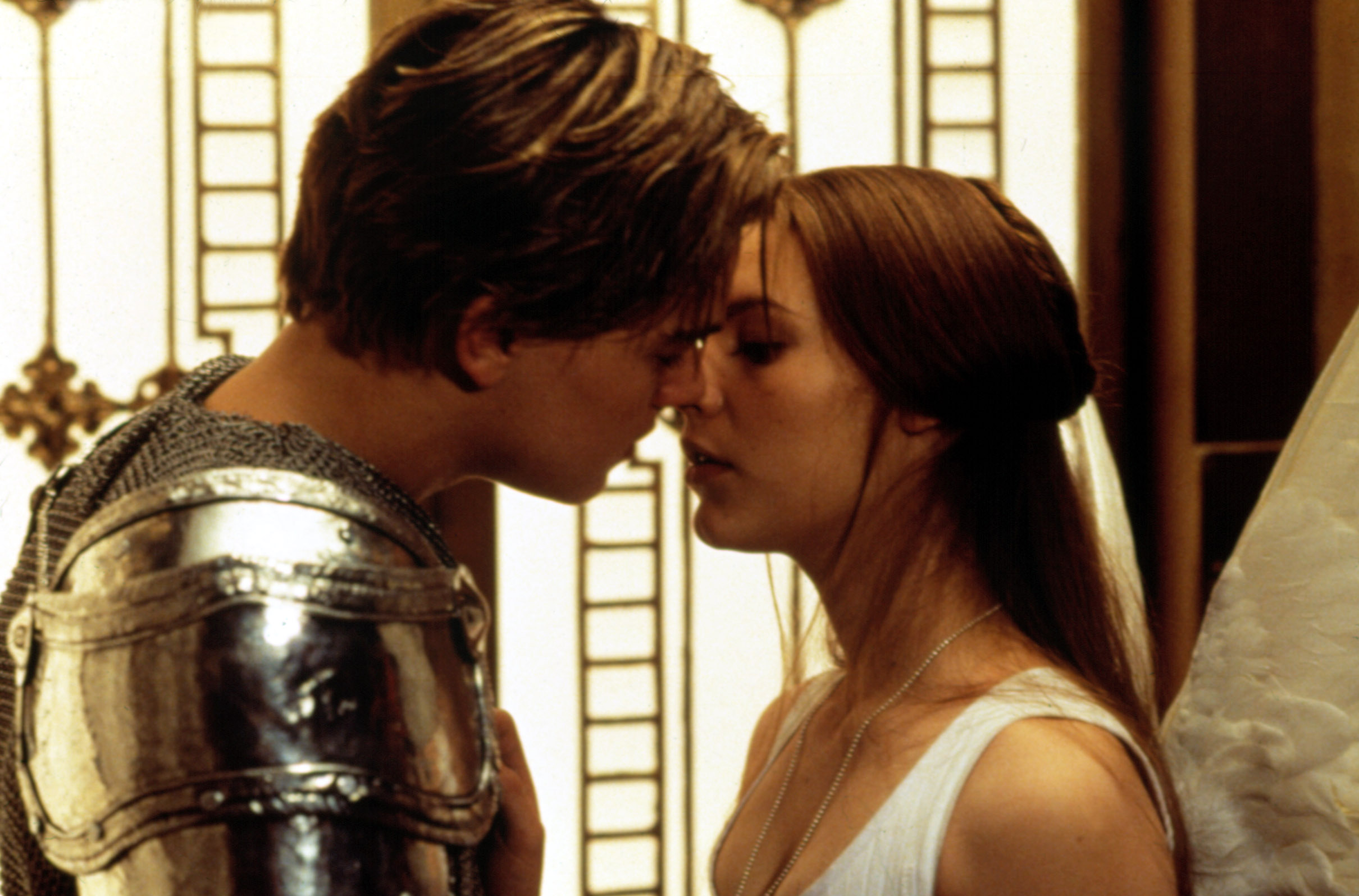
In 1996, during the chaotic filming of Baz Luhrmann’s William Shakespeare’s Romeo + Juliet, a 21-year-old Leonardo DiCaprio explicitly warned his 16-year-old co-star Claire Danes not to play with the production’s prop firearms. Danes had picked up one of the custom-engraved handguns used in the film and began twirling it on her finger. DiCaprio immediately stepped in. He looked at the young actress and delivered a firm directive: “Claire, we don’t do that.” The moment was brief. The lesson was permanent. The exchange highlights the stark reality of Hollywood production sets, where the line between a plastic toy and a lethal weapon is defined entirely by strict protocol.
The story of that warning does not exist in a vacuum. It belongs to a specific era of Hollywood history. It belongs to a production that redefined the modern blockbuster. And it belongs to a cinematic landscape that had recently learned a devastating lesson about the dangers of prop weaponry.
The Arsenal of Verona Beach
Baz Luhrmann did not want swords. The Australian director envisioned a hyper-kinetic, neon-drenched modernization of Shakespeare’s classic tragedy. Set in the fictional, Miami-esque metropolis of Verona Beach, the film required a visual language that felt both ancient and immediate. To achieve this, production designer Catherine Martin and property master Justin Dix transformed the traditional weaponry of the Elizabethan stage into modern firearms.
The text remained unchanged. The actors still spoke of “swords” and “longswords.” But the weapons they drew were custom-modified semi-automatic pistols. The Capulet family wielded sleek, silver weapons with ornate religious iconography. The Montague family carried rugged, tactical black firearms. The weapons were branded with names matching their Shakespearean counterparts. A “Sword” was a modified Para-Ordnance P-14.45 or a Taurus PT99 9mm. A “Dagger” was a compact Beretta.
These were not cheap plastic molds. They were heavy, metallic, functioning prop guns. They featured custom grips adorned with the Holy Mary. They featured family crests stamped into the barrels. They required armorers. They required safety briefings. They required a level of respect that a 16-year-old Claire Danes, fresh off the television set of My So-Called Life, had not yet internalized. When she absentmindedly spun the weapon, DiCaprio recognized the breach in protocol. His intervention was not an act of arrogance. It was an act of preservation.
The Shadow of The Crow
DiCaprio’s strict adherence to set safety in 1996 was not an accident. The entire film industry was operating under a heavy, lingering shadow. Just three years earlier, on March 31, 1993, 28-year-old actor Brandon Lee was killed on the Wilmington, North Carolina, set of The Crow. A prop gun, improperly checked by the crew, fired a real projectile into Lee’s abdomen. The tragedy forced Hollywood to rewrite its safety manuals.
By the time 20th Century Fox greenlit Romeo + Juliet, the rules had changed. Prop weapons were no longer viewed as harmless stage dressing. Armorers held absolute authority on set. Actors were trained to treat every weapon, loaded or unloaded, blank or dummy, as a lethal instrument. DiCaprio, who had been working steadily in Hollywood since the early 1990s in films like This Boy’s Life and What’s Eating Gilbert Grape, understood the stakes. He had absorbed the industry’s collective trauma.
Danes, five years his junior and navigating her first massive studio feature, was still adjusting to the scale of the machinery around her. DiCaprio’s warning, “Claire, we don’t do that”, was a generational transfer of industry knowledge. It was a reminder that the fantasy of Verona Beach ended at the edge of the camera lens. The metal in her hand was governed by the laws of the real world.
Chaos in Mexico City
The need for strict discipline on the set of Romeo + Juliet was amplified by the sheer chaos of the production itself. Luhrmann chose to shoot the film in and around Mexico City and the coastal state of Veracruz. The locations provided the perfect blend of decaying grandeur and vibrant street culture. They also provided immense logistical nightmares.
The production was a crucible. The cast and crew faced intense heat, severe illness, and staggering security threats. While filming in the coastal town of Boca del Río, the production was struck by Hurricane Dolly. Luhrmann famously kept the cameras rolling, capturing the actual storm for the dramatic scene where Mercutio, played by Harold Perrineau, is killed by Tybalt, played by John Leguizamo. The wind tearing through the Sycamore Grove was not a special effect. It was a Category 1 hurricane.
The danger extended beyond the weather. Security was a constant concern. In a now-infamous incident, the film’s key hair and makeup artist, Aldo Signoretti, was kidnapped by armed men in Mexico City. The kidnappers demanded a ransom of $300,000. Luhrmann and the production team scrambled to secure the funds, eventually negotiating his release for a lower sum. Signoretti returned to the set the next day, physically unharmed but deeply shaken. He went on to earn an Academy Award nomination for his work on the film.
In an environment where natural disasters and armed kidnappings were active threats, controlling the controllable became paramount. The prop guns were one of the few elements the production could entirely manage. DiCaprio’s insistence on prop discipline was a small anchor of order in a sea of operational chaos.
The Casting of Star-Crossed Lovers
The dynamic between DiCaprio and Danes was central to the film’s success, but it was not the original plan. 20th Century Fox had initially cast a 14-year-old Natalie Portman in the role of Juliet. DiCaprio, already a rising heartthrob, was secured as Romeo. However, during early screen tests, the age gap between the 21-year-old DiCaprio and the 14-year-old Portman proved visually jarring. The studio and the director agreed that the pairing felt inappropriate. Portman exited the project amicably.
The search for a new Juliet was exhaustive. Luhrmann needed an actress who possessed both the innocence of youth and the emotional gravity to anchor a tragedy. Claire Danes, then 16, auditioned alongside DiCaprio. The chemistry was immediate. She did not treat DiCaprio with the reverence of a fan. She looked him directly in the eye. She held her ground. Luhrmann knew he had found his Juliet.
That equal footing translated to the screen, but behind the scenes, the age and experience gap remained. DiCaprio was the seasoned professional guiding the production. Danes was the prodigy learning the ropes. The prop gun incident was a microcosm of their working relationship. He corrected her. She listened. They built the performance together.
A Cultural Reset
When William Shakespeare’s Romeo + Juliet opened in theaters on November 1, 1996, it defied all industry expectations. Shakespeare adaptations were historically difficult to market to teenage audiences. Luhrmann’s frenetic editing, the modern setting, and the explosive soundtrack changed the formula entirely.
The film grossed $147.5 million at the worldwide box office against a modest budget of $14.5 million. It transformed DiCaprio into a global superstar, perfectly positioning him for his role in James Cameron’s Titanic the following year. It established Danes as a leading cinematic force. It sold millions of soundtrack albums, introducing bands like Radiohead, Garbage, and The Cardigans to a massive mainstream audience.
The visual iconography of the film became deeply embedded in 1990s pop culture. The Hawaiian shirts. The neon crosses. The silver, engraved 9mm handguns. The weapons themselves became famous. Replicas of the “Sword 9mm” are still sought after by collectors today. The aesthetic choices made by Catherine Martin and Baz Luhrmann proved revolutionary.
The Weight of the Metal
Today, the anecdote about DiCaprio and Danes carries a renewed weight. The film industry is once again grappling with the reality of prop weaponry following the tragic 2021 death of cinematographer Halyna Hutchins on the set of the film Rust. The conversation around set safety, armorer protocols, and the handling of firearms by actors is louder than ever.
Looking back at a 21-year-old Leonardo DiCaprio stopping a 16-year-old Claire Danes from spinning a prop gun reveals a quiet moment of professional responsibility. It was not a scene in the script. It was not captured on film. It was simply a working actor ensuring the safety of his environment. The production was wild. The locations were dangerous. The schedule was punishing. But the rules of the metal remained absolute.
The sets were struck. The props were boxed. The film endured. Verona.