Netflix released the first trailer for its highly anticipated Little House on the Prairie reboot on June 4, 2026, signaling a dramatic shift from the sunny 1970s television adaptation to a grounded, survival-focused retelling of the Ingalls family’s 1870s western migration. The two-minute preview, titled “A Fresh Start,” confirms a November 12, 2026, global premiere date and positions the series as a prestige historical drama. Audiences seeking nostalgia will find the familiar characters of Charles, Caroline, Mary, and Laura Ingalls, but placed against a harsher, historically accurate American frontier.
The announcement immediately dominated social media algorithms. Deadline reported the trailer capitalizes on a deep cultural longing for simpler times. But the footage reveals that “simpler” does not mean easier. The reboot strips away the golden-hour gloss of previous adaptations. It replaces it with mud, freezing rain, and the vast, indifferent landscape of the American Midwest.
What looks like a sudden pivot to historical nostalgia is actually a calculated multi-million-dollar bet. The streaming platform is banking on the idea that an exhausted, hyper-connected modern audience wants to watch a family survive on nothing but timber, wheat, and sheer will.
The 2026 Trailer: Mud, Wind, and a Fresh Start
The trailer opens without music. Only the sound of prairie wind and the creak of wooden wagon wheels. A title card appears in a stark, serif font: A Fresh Start.
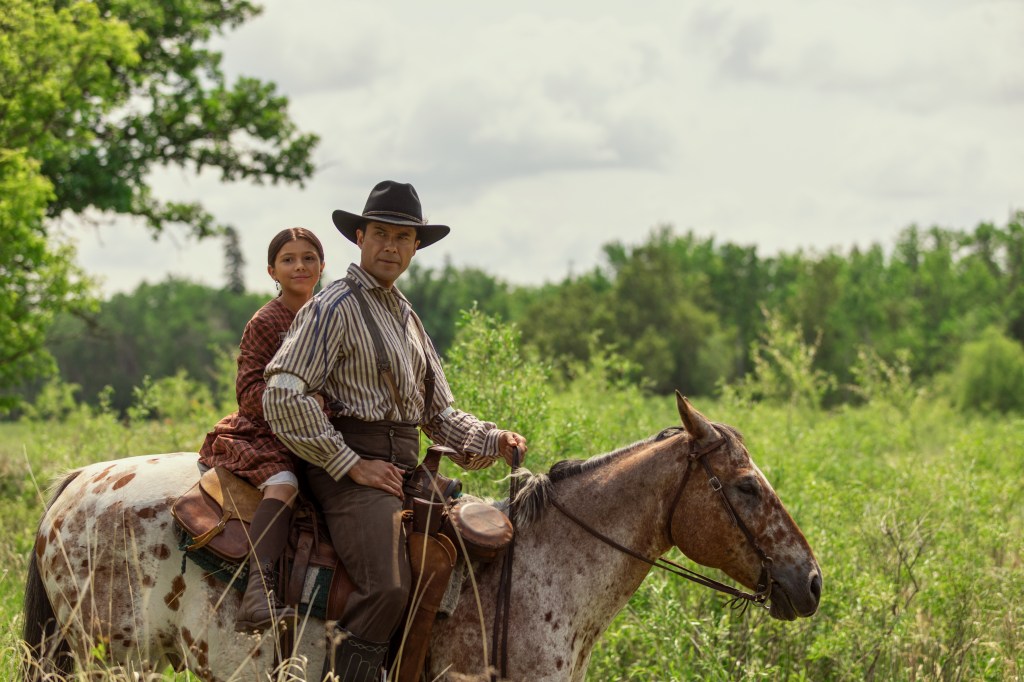
Within two minutes and fourteen seconds, the visual language of the new series is established. Charles Ingalls, played with quiet intensity by Garrett Hedlund, is shown driving a covered wagon across a swollen, dangerous river. Caroline Ingalls, portrayed by Lily Rabe, stares across an endless expanse of tallgrass prairie. The camera work is handheld. The lighting relies heavily on practical firelight and overcast skies.
There are no pristine calico dresses. The wardrobe is frayed. The dirt is permanent. The trailer culminates in a sweeping drone shot of a tiny wooden cabin dwarfed by the massive, unforgiving landscape of Plum Creek.
This is not the Walnut Grove of 1974. This is the Walnut Grove of 1874. The stakes are not localized town drama. The stakes are starvation, weather, and survival.
The Economics of Frontier Nostalgia
Nostalgia is a lucrative commodity. Netflix recognized this when it greenlit the project in October 2024. Co-produced with Paramount Television Studios, the first season carries a reported production budget of $85 million. This averages to over $10 million per episode for the eight-episode run.
The investment reflects a broader industry trend. Following the massive, sustained success of the Yellowstone franchise, networks and streamers realized the American West still holds immense commercial power. But while Yellowstone offers modern soap-opera violence, Little House on the Prairie offers historical endurance.
The target demographic is uniquely broad. Netflix aims to capture the older generation who grew up watching the original series in syndication, while simultaneously hooking younger viewers drawn to prestige, high-budget survival narratives. The longing for “simpler times” is actually a longing for tangibility. In an era defined by artificial intelligence and digital screens, chopping wood and planting wheat offer a psychological anchor.
Reclaiming Laura Ingalls Wilder’s Text
To understand the 2026 reboot, one must look past the television screen and back to the printed page. Laura Ingalls Wilder published Little House in the Big Woods in 1932. She was 65 years old. Over the next decade, with heavy editorial assistance from her daughter, Rose Wilder Lane, she released eight more books chronicling her childhood.
The books are stark. They are written for children, but they do not hide the brutality of the era. Wilder wrote about a sky blackened by millions of Rocky Mountain locusts in 1874. She wrote about the devastating blizzards of the Long Winter in 1880, where the family survived for months on nothing but ground seed wheat and twisted hay for fuel.
The new series showrunner, Margaret Vance, has publicly stated her intention to adapt the original text, not the 1974 television show. The scripts draw heavily from historical records, land deeds, and Wilder’s original, unedited manuscript, Pioneer Girl, which was finally published in 2014. The goal is historical fidelity. The Ingalls family were not wealthy farmers. They were perpetual migrants, driven by the promises of the Homestead Act of 1862, constantly chasing the edge of the frontier.
The 1974 Legacy of Michael Landon
It is impossible to launch a property named Little House on the Prairie without confronting the ghost of Michael Landon. In 1974, Landon and producer Ed Friendly brought the Ingalls family to NBC. The show ran for nine seasons, producing 204 episodes.
Landon’s vision was distinct. He served as the executive producer, frequent director, and the patriarchal star. His Charles Ingalls was a moral pillar, always ready with a gentle lesson and a perfectly timed tear. The series was filmed primarily at the Big Sky Movie Ranch in Simi Valley, California. The California sun gave the show a perpetual, golden-hour warmth that looked nothing like the harsh reality of the Dakota Territory.
The NBC series was a massive hit. Airing on Monday nights at 8:00 PM, it became a staple of American family viewing. It launched the career of Melissa Gilbert, who became the definitive face of Laura Ingalls for half a century. But Landon’s version often strayed far from historical fact, inventing adopted children, town villains, and melodramatic storylines to satisfy the demands of weekly episodic television.
The 2026 reboot deliberately distances itself from this legacy. It respects the 1970s iteration as a cultural touchstone, but treats it as a separate entity entirely.
Casting the Frontier
Casting a reboot of this magnitude requires precision. The actors must carry the historical weight of the 19th century without feeling like modern transplants in costume.
- Garrett Hedlund as Charles Ingalls: Hedlund brings a weathered, physical presence to “Pa.” He looks like a man who can actually swing an axe. His portrayal leans less on moralizing speeches and more on the silent, desperate weight of keeping a family alive.
- Lily Rabe as Caroline Ingalls: Rabe anchors the family as “Ma.” Historical accounts paint Caroline as a deeply resilient woman who managed the homestead alone for weeks while Charles sought labor. Rabe’s casting signals a more complex, central role for the matriarch.
- Eliana Jones as Laura Ingalls: The 11-year-old newcomer faces the steepest challenge. She must embody the wild, observant spirit of the author. The trailer shows her running through tall grass, capturing the untamed energy that defines the character.
- Clara Bowden as Mary Ingalls: Playing the older, more obedient sister, Bowden’s role carries the tragic foresight of Mary’s eventual blindness, a storyline the producers have confirmed will be handled with strict medical and historical accuracy.
Production: Leaving California for Alberta
To capture the true menace of the Midwestern climate, production could not remain in Southern California. The 2026 series moved its base of operations to Calgary, Alberta. Filming commenced in August 2025 and ran through the bitter cold of February 2026.
The Canadian province offered the vast, unbroken plains necessary to replicate 1870s Minnesota and the Dakota Territory. The production crew built a fully functioning 19th-century mill. They constructed the iconic sod house and the Plum Creek dugout using historically accurate techniques. There was no drywall. There were no hidden generators on set.
This commitment to practical effects extends to the environment. When the script called for a blizzard, the crew filmed in sub-zero Albertan weather. The breath leaving the actors’ mouths in the trailer is real. The shivering is not acting. This physical discomfort translates directly to the screen, adding a layer of tension that CGI cannot replicate.
The Historical Reality of Walnut Grove
The central hub of the trailer is Walnut Grove, Minnesota. In reality, the Ingalls family lived on a farm situated on the banks of Plum Creek, roughly one and a half miles north of the town.
In 1874, Charles Ingalls paid $500 for the rights to the 160-acre farm. The family initially lived in a dugout carved directly into the bank of the creek. It was a home made of dirt, roots, and prairie grass. The reality of dugout living was claustrophobic and damp. The trailer briefly shows this cramped, subterranean existence, a stark contrast to the spacious wooden cabin featured in the 1970s series.
The financial reality of the era was brutal. Wheat was the cash crop. When the Rocky Mountain locusts descended in the summer of 1874, they did not just eat the crops; they ate the family’s financial future. The insects consumed the wheat, the vegetable garden, and even the clothing on the clothesline. Charles was forced to walk two hundred miles east to find work harvesting crops that had been spared. The 2026 series promises to dedicate an entire episode to the psychological horror of the locust swarm.
Why “A Fresh Start” Resonates Today
The tagline “A Fresh Start” operates on two levels. Narratively, it refers to the Ingalls family leaving the Big Woods of Wisconsin to claim land in the West. Culturally, it speaks directly to the modern viewer.
The 2020s have been defined by global instability, technological saturation, and a pervasive sense of burnout. The allure of the 1870s frontier is not that it was easy. The allure is that the problems were physical, not existential. If you were cold, you chopped wood. If you were hungry, you hunted or harvested. The cause and effect of daily survival were immediate and visible.
This psychological phenomenon is often called anemoia, nostalgia for a time you never experienced. The Netflix reboot taps directly into this vein. It offers a brutal, beautiful escape into a world where the rules of survival were dictated by the seasons, not by the screen.
The trailer ends with a simple shot. A lantern is blown out. The screen goes black. The premiere date appears. The digital age prepares to look backward.
The wagons rolled west. The cameras stopped rolling. The algorithms captured the longing.
Walnut Grove.