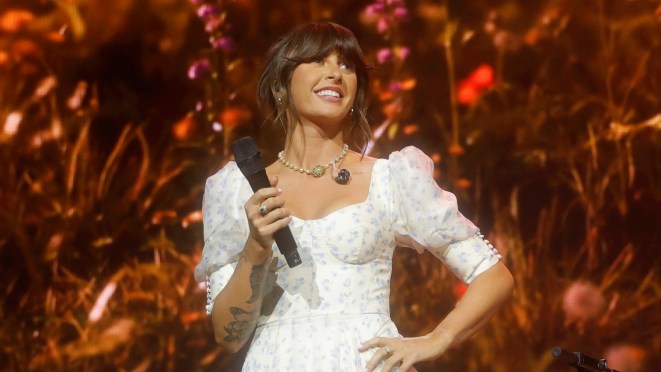
Ella Langley navigated her massive 2024 breakout in country music by explicitly rejecting the pressure of perfection, telling American Songwriter that acknowledging her flaws and admitting she doesn’t have all the answers is her primary strategy for maintaining her sanity. The sudden transition from regional working musician to nationally recognized country star requires a psychological anchor. For Langley, that anchor is radical transparency.
Fame in the modern music industry does not arrive slowly. It hits like a freight train. One month, an artist is playing to half-empty rooms on a Tuesday night. The next, a song catches fire on TikTok, the streaming numbers cross into the tens of millions, and the tour bus is pulling into a sixty-thousand-seat stadium. The human brain is rarely prepared for the whiplash.
Langley is currently living inside that whiplash. Her trajectory over the past year has been nothing short of explosive. But instead of projecting an image of total control, she is choosing a different route. She is admitting that the ride is chaotic.
The Anatomy of a Breakout Year
The timeline of Langley’s rise is quantifiable. On August 2, 2024, she released her debut full-length album, hungover. The project arrived via Columbia Records Nashville and immediately cemented her as a formidable force in the neotraditional country space.
Before the album even dropped, the momentum was building. She secured opening slots on some of the highest-grossing tours in the genre. She shared stages with Morgan Wallen on his massive One Night at a Time stadium tour. She went on the road with Dierks Bentley. She opened for HARDY. She toured with Riley Green.
Each of these tours placed her in front of tens of thousands of new fans every single night. The exposure was unprecedented for an artist who had only moved to Nashville a few years prior. The physical demands of playing that many shows, in that many cities, across a single calendar year are staggering.
But the live shows were only half of the equation. The digital metrics were climbing at an equally aggressive pace.
Viral Fame and the TikTok Engine
In the current era of Music Row, a career can be made by a single algorithm. Langley experienced this firsthand with the release of “you look like you love me,” a duet featuring Riley Green. The track blends spoken-word verses with a soaring, traditional country chorus.
It was a stylistic risk. It paid off immediately.
The song became a viral phenomenon on TikTok. Users created hundreds of thousands of videos using the audio. This digital virality translated directly into tangible Billboard chart success and massive streaming numbers on platforms like Spotify and Apple Music. Suddenly, Langley was not just an opening act. She was the voice behind one of the most inescapable country songs of the summer.
This level of sudden visibility brings a specific type of pressure. The internet demands constant content. Record labels demand follow-up hits. Fans demand access. The machine expects the artist to be a perfectly polished product, ready for consumption at all hours of the day.
The Weight of the Platform
This is where Langley’s comments to American Songwriter become critical. When asked about managing the sheer velocity of her career, she did not offer a polished PR response.
“I’m not a perfect person, and I don’t know the answer.”
That single sentence dismantles the traditional country music playbook. For decades, the Nashville machine was built on cultivating flawless personas. The hats were perfectly shaped. The smiles were practiced. The public image was fiercely guarded by managers and publicists. Flaws were hidden. Exhaustion was masked.
Langley is operating in a different era. By leading with her imperfections, she removes the weapon from the hands of her critics. If an artist admits they are figuring it out in real-time, the public is far more likely to grant them the grace to make mistakes.
Staying “sane” in the music industry often requires setting boundaries. Acknowledging a lack of perfection is a boundary. It tells the audience, the label, and the media that the human being behind the microphone has limits.
The Hope Hull Anchor
To understand Langley’s grounded approach to sudden fame, one must look at her origins. She was raised in Hope Hull, Alabama. It is an unincorporated community in Montgomery County. It is the kind of place where pretense is quickly identified and rejected.
She did not grow up in the entertainment industry. She grew up playing local gigs, writing songs in her bedroom, and absorbing the sounds of classic country and southern rock. When she finally made the move to Nashville in 2019, she did not arrive with a massive financial backing or a guaranteed record deal.
She spent years grinding. She played the bars on Lower Broadway. She took co-writing sessions with anyone who would sit in a room with her. She built a catalog of songs the hard way.
That five-year period between arriving in Nashville and releasing hungover serves as her foundation. When the stadium lights turn on and the screaming starts, she is still the songwriter from Hope Hull. The Alabama roots act as a ballast against the turbulence of the music industry.
Collaborations as Accelerants
Langley’s rise was not a solitary effort. She strategically aligned herself with artists who share her gritty, unapologetic approach to country music. These collaborations served as massive accelerants for her career.
- Riley Green: Their work on “you look like you love me” provided a massive crossover hit. Green’s established fanbase provided a direct pipeline to Langley’s catalog.
- Koe Wetzel: Langley featured on Wetzel’s track “That’s Why We Fight.” The collaboration introduced her to the Texas country and southern rock audience, a demographic that values raw, unfiltered performances.
- Morgan Wallen: Opening for Wallen exposed Langley to the largest possible audience in modern country music, testing her ability to command a stadium-sized crowd.
Working alongside these established artists provided Langley with a front-row seat to the realities of massive fame. She watched how they handled the pressure. She saw the toll the road takes on a person. This proximity likely informed her own strategy for maintaining her mental health.
A Shifting Industry Standard
Langley’s candid admission about staying sane is part of a larger, necessary conversation happening within the music industry. The conversation around mental health is finally being forced into the open.
In recent years, the facade has begun to crack. Artists across all genres are canceling tours due to mental exhaustion. Pop stars are speaking out about the terrifying reality of parasocial relationships. Country artists are taking vocal rests and stepping away from the spotlight to address their physical and psychological well-being.
The grueling nature of a 100-date tour schedule is no longer being romanticized as a badge of honor. It is being recognized as a fast track to burnout.
By stating plainly that she is not perfect and does not have the answers, Langley is contributing to this cultural shift. She is giving herself permission to be a human being first and a product second. She is signaling to her fans that it is acceptable to be overwhelmed by the circumstances of one’s own life.
The Reality of the Road
The physical reality of Langley’s 2024 is exhausting to simply read on paper. The logistics of touring at her current level involve constant motion.
Wake up on a bus. Load into a new venue. Soundcheck in an empty arena. Do press interviews. Meet and greets. Perform a high-energy set. Load out. Sleep on the highway. Repeat.
There is very little silence. There is very little stillness. The adrenaline spikes are massive, and the subsequent crashes are inevitable. Navigating this cycle requires a deliberate effort to protect one’s peace.
For Langley, protecting that peace means letting go of the illusion of control. It means accepting that some nights the voice will be tired. Some nights the crowd will be tough. Some interviews will be awkward. The pursuit of perfection in that environment is a losing game. The pursuit of survival is the only logical path.
The Next Phase of the Journey
As 2024 transitions into 2025, Langley faces a new set of challenges. The breakout phase is ending. The establishment phase is beginning.
She is transitioning from a supporting act to a headliner. Her own Hungover tour puts her name at the top of the marquee. The ticket sales rely entirely on her draw. The pressure shifts from winning over someone else’s crowd to satisfying her own.
The spotlight will only get brighter. The demands on her time will only increase. The expectations for her sophomore album will be significantly higher than they were for her debut.
The machine will continue to demand perfection. The algorithm will continue to demand content. The industry will continue to demand hits.
But the foundation has been set. The expectations have been managed. The boundary has been drawn. She has already told the world exactly who she is, and more importantly, who she is not.
The tour bus rolls into the next city. The crew unloads the gear. The lights go down. The crowd roars. The guitar is tuned. Langley steps up to the microphone.