President Donald Trump issued a pointed warning to the Houthi movement on July 26, 2026, indicating that continued attacks on commercial shipping in the Red Sea could trigger significant U.S. actions targeting Iran. This statement reflects a heightened level of concern within the U.S. administration regarding the stability of global maritime trade and the broader regional security landscape. The President’s remarks were made during a press briefing at the White House, emphasizing the gravity with which Washington views the ongoing Houthi aggression.
The Houthi movement, officially known as Ansar Allah, has been launching missile and drone attacks on vessels traversing the Bab al-Mandab Strait and the Red Sea since late 2023. These actions, which the Houthis claim are in solidarity with Palestinians amid the ongoing conflict in Gaza, have severely impacted international shipping, rerouting supply chains and increasing transit costs. The United States and its allies have consistently identified Iran as the principal state sponsor providing military and financial support to the Houthis.
The Escalation of Red Sea Tensions
The Red Sea crisis began to intensify significantly in October and November 2023. Following the October 7, 2023, attacks in Israel and the subsequent conflict in Gaza, the Houthis declared their support for Hamas and began targeting ships they asserted had links to Israel or were bound for Israeli ports. This initial targeting soon expanded to include a wider range of commercial vessels, regardless of their direct affiliation, creating a volatile and dangerous shipping environment.
Major shipping companies, including Maersk and Hapag-Lloyd, began diverting their vessels away from the Suez Canal route, opting for the longer, more expensive journey around the Cape of Good Hope. This rerouting adds approximately 10 to 14 days to transit times between Asia and Europe, significantly increasing fuel consumption, insurance premiums, and operational costs. The economic impact has been felt globally, affecting supply chains for goods ranging from consumer electronics to energy resources.
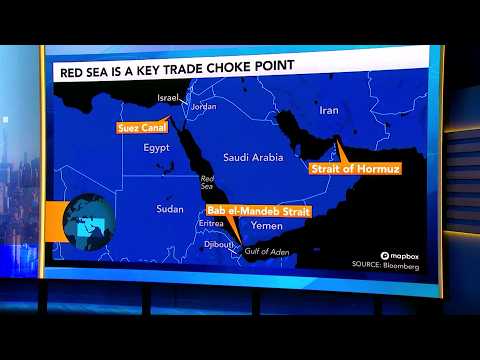
The Bab al-Mandab Strait, a narrow waterway connecting the Red Sea to the Gulf of Aden, is one of the world’s most critical maritime chokepoints. An estimated 12% of global trade and 30% of global container traffic passes through this route annually. Disruptions here have immediate and far-reaching consequences for global commerce and energy markets.
International Response: Operation Prosperity Guardian
In response to the escalating Houthi attacks, the United States initiated Operation Prosperity Guardian in December 2023. This multinational maritime security initiative aims to protect commercial shipping in the Red Sea and Gulf of Aden. The operation involves naval forces from several countries, including the United Kingdom, France, Germany, Canada, Australia, and others.
The primary objective of Operation Prosperity Guardian is to provide a defensive shield for commercial vessels and to deter further Houthi aggression. Warships involved in the operation have intercepted numerous Houthi missiles and drones targeting merchant ships and naval assets. These defensive actions have prevented many potential attacks from reaching their targets, but have not fully stopped the Houthi campaign.
Despite the presence of international naval forces, the Houthis have demonstrated a continued capability and willingness to launch attacks. Their arsenal includes anti-ship ballistic missiles, cruise missiles, and unmanned aerial vehicles (UAVs). Many of these weapons systems are believed to be supplied or facilitated by Iran, a claim consistently denied by Tehran but supported by U.S. intelligence assessments.
Allied Contributions and Challenges
The United Kingdom has been a key partner in Operation Prosperity Guardian, with Royal Navy vessels actively participating in defensive operations and joint strikes against Houthi military sites in Yemen. Other nations have contributed in various capacities, including intelligence sharing, logistical support, and the deployment of naval assets to the region.
One of the primary challenges for the coalition has been the difficulty in completely neutralizing the Houthi threat without risking a broader regional conflict. Houthi launch sites are often mobile or located in civilian areas, complicating targeting efforts. Furthermore, the Houthis operate within a complex Yemeni civil war context, where their actions are intertwined with internal political dynamics.
President Trump’s Direct Warning
President Trump’s warning on July 26, 2026, marks a significant rhetorical escalation. His statement directly links the Houthis’ actions to Iran and suggests that the U.S. is prepared to move beyond defensive measures against the Houthis themselves. The President’s language indicated that if the Red Sea attacks do not cease, the United States would consider “major moves” against Iran.
This phrasing implies a range of potential responses, from intensified sanctions on Iran’s oil exports and financial institutions to more direct military pressure. The U.S. has maintained a robust sanctions regime against Iran for years, particularly after the Trump administration withdrew from the Joint Comprehensive Plan of Action (JCPOA) in May 2018. Any new measures would likely build upon or significantly expand these existing economic pressures.
The U.S. administration’s position is that Iran provides the Houthis with the training, intelligence, and advanced weaponry necessary to carry out their sophisticated attacks. By targeting Iran, the U.S. aims to cut off the source of this support and compel Tehran to exert control over its proxy forces in the region. This strategy aligns with a long-standing U.S. foreign policy approach of holding state sponsors accountable for the actions of non-state actors they support.
Historical Precedents and Future Implications
The U.S. has a history of responding to threats from Iranian-backed groups. In the early 2020s, there were several instances of U.S. military action against Iranian-backed militias in Iraq and Syria in response to attacks on U.S. personnel or interests. These actions, while localized, demonstrated a willingness to use force to deter and punish hostile acts orchestrated by Tehran or its allies.
A major move against Iran could have wide-ranging implications for global energy markets, regional stability, and international diplomacy. The Strait of Hormuz, another critical chokepoint through which much of the world’s oil transits, could become a flashpoint. Any significant escalation could also draw in other regional powers, potentially leading to a broader conflict in the Middle East.
Diplomatic efforts to de-escalate tensions have been ongoing but have yielded limited success in curbing Houthi attacks. Various international bodies and individual nations have called for a cessation of hostilities and a return to diplomatic solutions for the Yemeni conflict, which has been ongoing since 2014. The Houthi movement’s current actions are deeply intertwined with their broader political objectives within Yemen and their regional alignment.
The Houthi Perspective and Regional Dynamics
From the Houthi perspective, their actions in the Red Sea are a legitimate response to what they perceive as Western and Israeli aggression. They frame their attacks as a defense of Palestinian rights and an assertion of their growing regional influence. The Houthis have demonstrated resilience throughout the Yemeni civil war, maintaining control over significant portions of northern Yemen, including the capital Sana’a.
Their military capabilities have been enhanced significantly over the past decade, with a focus on asymmetric warfare tactics, including drone and missile technology. The support from Iran has been crucial in developing these capabilities, allowing the Houthis to project power far beyond Yemen’s borders, notably into key international shipping lanes.
The broader regional dynamics also play a role. Saudi Arabia, a long-time adversary of the Houthis, has been engaged in a protracted conflict in Yemen. While there have been recent attempts at de-escalation between Saudi Arabia and Iran, the Red Sea crisis complicates these efforts and keeps regional tensions high. The U.S. warning to Iran could be interpreted by some regional actors as a reaffirmation of U.S. commitment to countering Iranian influence.
Economic and Geopolitical Impact
The prolonged disruption of Red Sea shipping has already led to increased costs for consumers through higher freight rates and extended delivery times. Insurance costs for vessels transiting the region have soared, sometimes by hundreds of percentage points. This economic pressure adds to inflationary concerns in many economies already grappling with post-pandemic recovery and other geopolitical shocks.
Geopolitically, the crisis highlights the vulnerability of global trade routes to non-state actors armed with advanced weaponry. It also tests the resolve of international coalitions to protect shared economic interests. President Trump’s strong stance signals a potential shift in strategy, suggesting that the U.S. may be prepared to take more assertive action to safeguard these interests, even if it risks further regional destabilization.
The coming weeks will likely see intense diplomatic activity and possibly further military maneuvers. The U.S. administration will weigh the risks and benefits of any escalated action against Iran, considering potential retaliatory measures and the impact on broader U.S. foreign policy objectives in the Middle East. The precise nature of the “major moves” remains unspecified, keeping all parties in a state of anticipation.
Governments gathered. Shipping executives gathered. Military strategists gathered. Washington.