Tag: travel

  • Trump Lifts Direct US Flight Ban to Lebanon – A Shift in Diplomacy

    Trump Lifts Direct US Flight Ban to Lebanon – A Shift in Diplomacy

    President Donald Trump lifted the ban on direct flights between the United States and Lebanon on 2026-07-22. This action reverses a long-standing policy that prohibited direct air travel between the two nations, a measure originally instituted due to significant security concerns. The decision follows a period of reassessment by the Trump administration regarding regional security and diplomatic engagement in the Middle East.

    The policy change is anticipated to have immediate effects on travel and commerce. It promises to simplify transit for the substantial Lebanese diaspora residing in the United States. Furthermore, it opens avenues for enhanced economic and cultural exchanges between the two countries. The announcement from the White House underscores a strategic shift in US foreign policy, indicating a renewed approach to Lebanese relations.

    The Historical Context of the Flight Ban

    The prohibition on direct flights between the United States and Lebanon dates back to a period of heightened instability in the Middle East. Security concerns were paramount during the 1980s. The region experienced a series of geopolitical upheavals.

    In 1985, TWA Flight 847, en route from Athens to Rome, was hijacked by Hezbollah members. This incident led to a 17-day ordeal and the death of one American passenger, US Navy diver Robert Stethem. The hijacking brought international attention to the security risks associated with air travel in the region.

    Following this and other incidents, the US government implemented strict travel advisories and eventually the direct flight ban. The primary aim was to protect American citizens and interests. The ban reflected the perceived inability of Lebanese authorities to guarantee the security of international flights originating from Beirut Rafic Hariri International Airport.

    Over the decades, the ban became a symbol of the complex and often strained relationship between the US and Lebanon. It impacted generations of Lebanese-Americans. They often faced longer, multi-leg journeys to visit family or conduct business.

    The security landscape in Lebanon has evolved significantly since the 1980s. Beirut’s airport has undergone substantial upgrades. International security standards have been implemented. These improvements have been a crucial factor in the recent policy reconsideration.

    Security Assessments and Diplomatic Efforts

    The decision to lift the ban was not made in isolation. It followed a comprehensive review of security protocols at Beirut Rafic Hariri International Airport. US aviation security experts conducted detailed assessments. These evaluations focused on passenger screening, baggage handling, and overall airport perimeter security.

    Reports from the Department of Homeland Security and the Federal Aviation Administration (FAA) played a critical role. These reports indicated that significant improvements had been made. Lebanon’s commitment to international aviation security standards was a key finding.

    Diplomatic channels were also highly active. For several years, Lebanese government officials have advocated for the lifting of the ban. They consistently highlighted their efforts to enhance airport security. Discussions involved high-level meetings between US and Lebanese representatives. President Trump engaged directly with Lebanese counterparts on this matter.

    The US Department of State also contributed to the review process. They analyzed the broader security environment in Lebanon. Their assessment considered regional stability and the effectiveness of Lebanese security forces. The conclusion was that the risks associated with direct flights had diminished to an acceptable level.

    "The lifting of this ban reflects a renewed confidence in Lebanon’s commitment to global aviation security standards and a strengthened bilateral relationship," stated a White House spokesperson on 2026-07-22.

    This diplomatic push culminated in President Trump’s announcement. It signifies a trust in Lebanon’s ability to manage its airport security effectively. It also indicates a willingness to engage more directly with the Lebanese government.

    Economic and Social Implications

    The lifting of the direct flight ban carries substantial economic benefits for both the United States and Lebanon. For Lebanon, the immediate impact is expected to be a boost to its tourism sector. Direct flights will make the country more accessible to American tourists and business travelers. This influx of visitors can stimulate local economies, supporting hotels, restaurants, and other service industries.

    Trade relations are also poised for improvement. Easier travel facilitates face-to-face business meetings and investments. Lebanese businesses may find it simpler to connect with American partners. Conversely, US companies might explore new opportunities in the Lebanese market.

    The Lebanese diaspora in the United States is a significant demographic. Estimates place the Lebanese-American population at over half a million. Many have maintained strong ties to their homeland. The ban had complicated family visits and cultural exchanges. Direct flights will reduce travel times and costs, making it easier for families to reunite.

    This policy change also holds social and cultural significance. It can foster greater understanding and connection between the two nations. Increased travel often leads to enhanced cultural dialogue and educational exchanges. Universities and cultural institutions in both countries could see renewed interest in partnerships.

    Aviation industries in both countries stand to gain. American carriers may consider routes to Beirut. Middle Eastern airlines, including Lebanon’s Middle East Airlines (MEA), could expand their services to US cities. This competition could lead to more affordable travel options for consumers.

    The announcement has been met with enthusiasm within the Lebanese-American community. Organizations representing this group have long advocated for the ban’s removal. They view it as a step towards normalizing relations and supporting their community’s connections.

    Regional Geopolitical Impact

    President Trump’s decision to lift the flight ban has broader geopolitical implications for the Middle East. It signals a nuanced approach to US engagement in a complex region. Lebanon borders Israel and Syria, two countries central to Middle Eastern stability.

    The move could be interpreted as a gesture of support for the Lebanese state. It might empower moderate factions within Lebanon. It could also provide a counterweight to regional influences, such as those from Iran. The US has historically sought to bolster Lebanon’s sovereignty and independence.

    However, the region remains volatile. The presence of Hezbollah, a powerful political and militant group, continues to be a factor in Lebanese politics. The US government maintains sanctions against Hezbollah. The lifting of the flight ban does not alter this stance. The decision reflects a distinction between the Lebanese government and non-state actors.

    Analysts suggest that this policy could be part of a broader strategy. The Trump administration has focused on recalibrating alliances and challenging existing paradigms. Engaging directly with Lebanon, a nation often caught between regional powers, aligns with this approach.

    Other regional actors will be observing this development closely. Saudi Arabia, the United Arab Emirates, and other Gulf states maintain significant interests in Lebanon. Their reactions could influence future diplomatic alignments. Israel also monitors developments in Lebanon due to ongoing security concerns along its northern border.

    The lifting of the ban could facilitate increased intelligence sharing and cooperation on counterterrorism efforts. A more stable and economically viable Lebanon serves US interests in combating extremism. The move is a calculated risk, balancing security concerns with diplomatic objectives.

    Future Outlook and Challenges

    While the lifting of the direct flight ban marks a significant step, future challenges remain. The stability of Lebanon is subject to internal political dynamics and regional tensions. Economic reforms are still critical for the country’s long-term prosperity. The US will likely continue to monitor these developments.

    The implementation of new flight routes will require coordination between aviation authorities. Airlines will need to assess the commercial viability of direct services. This process could take several months. It involves regulatory approvals, slot allocations, and marketing strategies.

    Security measures at Beirut Rafic Hariri International Airport will remain under scrutiny. US authorities will likely conduct ongoing audits and assessments. Maintaining high security standards will be crucial for the sustainability of direct flights.

    The political landscape in Lebanon is often fragmented. The government faces challenges in implementing consistent policies. Regional conflicts, particularly the ongoing situation in Syria, continue to affect Lebanon’s internal stability. The US policy aims to support a sovereign and stable Lebanon, but external factors are influential.

    The decision could open doors for further diplomatic initiatives. It might encourage broader regional dialogue. The Trump administration’s foreign policy approach prioritizes direct engagement. This move with Lebanon exemplifies that strategy. It suggests a willingness to adjust long-standing policies in response to evolving realities.

    Ultimately, the success of this policy shift depends on several factors. These include sustained security cooperation, continued diplomatic efforts, and Lebanon’s internal stability. The lifting of the ban is a beginning, not an end, to a renewed chapter in US-Lebanon relations.

    Immediate Reactions and Political Context

    The announcement from President Trump has generated immediate reactions from various stakeholders. Lebanese officials have welcomed the decision as a testament to their efforts to improve security and strengthen bilateral ties. Many view it as a long-overdue rectification of a punitive measure.

    In the United States, responses have been mixed, largely falling along partisan lines. Supporters of President Trump have lauded the move as a demonstration of effective diplomacy and a pragmatic approach to foreign policy. They emphasize the economic benefits and the support for the Lebanese-American community.

    Critics, however, have raised concerns about potential security risks. They question whether the improvements at Beirut Airport are sufficient to guarantee the safety of direct flights. Some also express apprehension about the broader implications for US policy towards Hezbollah, despite assurances from the administration.

    The decision comes within President Trump’s second term, a period marked by continued focus on re-evaluating US commitments and engagements globally. His administration has often prioritized direct negotiations and transactional diplomacy. This approach contrasts with more traditional multilateral foreign policy strategies.

    The timing of the announcement may also be strategic. It could aim to project an image of active and effective foreign policy ahead of future diplomatic initiatives. It also serves as a concrete achievement in a region where US policy is often scrutinized.

    The media coverage of this event, particularly from outlets like Bloomberg Television, highlights the significant global interest. The focus is on how this action shapes perceptions of President Trump’s leadership and US influence. It taps into broader discussions about national interest and international relations.

    This policy shift represents a tangible outcome of sustained diplomatic and security efforts. It also reflects the dynamic nature of international relations under the current US administration. The world watches to see the full impact of this change.

    A long-standing restriction lifted. New avenues for travel and commerce. A shift in diplomatic strategy.

    Engagement.

    Why Was the US Flight Ban to Lebanon Imposed?

    The US flight ban to Lebanon was primarily imposed due to severe security concerns during the 1980s. This period saw significant instability in the Middle East, including the 1985 hijacking of TWA Flight 847 by Hezbollah, which resulted in the death of an American citizen. The US government enacted the ban to protect American lives and interests, citing insufficient security measures at Beirut’s airport at the time.

    What are the Main Benefits of Lifting the Ban?

    Lifting the ban is expected to bring several key benefits. Economically, it should boost Lebanon’s tourism sector and facilitate trade between the two countries. Socially, it will ease travel for the large Lebanese-American diaspora, enabling easier family visits and cultural exchanges. Diplomatically, it signals renewed US confidence in Lebanon’s security capabilities and strengthens bilateral relations.

    How Did Lebanon Improve its Airport Security?

    Lebanon undertook substantial efforts to improve security at Beirut Rafic Hariri International Airport. These improvements included upgrading passenger screening technologies, enhancing baggage inspection systems, and bolstering overall perimeter security. US aviation security experts, including those from the Department of Homeland Security and the FAA, conducted multiple assessments and confirmed that these measures meet international standards.

    What are the Geopolitical Implications of This Decision?

    The geopolitical implications are significant. The decision signals US support for the Lebanese state, potentially strengthening moderate elements and countering regional influences. It could also facilitate increased intelligence sharing and cooperation on counterterrorism. While Hezbollah remains a concern, the move distinguishes between the Lebanese government and non-state actors, aiming to foster stability in a volatile region.

    When Will Direct Flights Between the US and Lebanon Resume?

    While the ban has been lifted, the resumption of direct flights will not be immediate. Airlines will need time to assess the commercial viability of new routes, secure regulatory approvals, allocate slots, and implement operational logistics. This process typically takes several months, so direct flights are expected to resume gradually in the coming months following the 2026-07-22 announcement.



  • State Department Issues Worldwide Caution Amid Rising Middle East Tensions

    State Department Issues Worldwide Caution Amid Rising Middle East Tensions

    The United States State Department issued a worldwide caution alert on 2026-07-18, advising U.S. citizens traveling or residing abroad to exercise increased vigilance. This advisory stems from escalating tensions in the Middle East, prompting a broad recommendation for enhanced situational awareness.

    Such alerts are standard protocols. They serve to inform and protect American citizens in an unpredictable global environment. The current caution reflects a perceived elevation of risk across various regions.

    Understanding Worldwide Caution Alerts

    A worldwide caution alert is a comprehensive travel advisory. It is issued by the U.S. Department of State. Its purpose is to inform U.S. citizens about global events or trends that could affect their safety and security abroad.

    These alerts differ from country-specific travel advisories. While country-specific advisories focus on particular nations or regions, a worldwide caution indicates a more generalized, elevated threat landscape.

    The State Department regularly assesses global security conditions. This assessment includes geopolitical developments, potential for civil unrest, and specific threats from various actors. The current alert is a direct outcome of these ongoing evaluations.

    What Triggers a Worldwide Caution?

    Worldwide cautions are typically triggered by significant geopolitical shifts. They can also be prompted by broad patterns of extremist activity or large-scale humanitarian crises. The current situation in the Middle East is cited as the primary driver.

    Escalations in regional conflicts, increases in terrorist threats, or widespread demonstrations can all contribute to such an issuance. The goal is to provide a proactive warning to American travelers and residents.

    These alerts are not meant to deter all international travel. Instead, they encourage informed decision-making and heightened personal security measures. They are a tool for risk mitigation.

    The Current Middle East Landscape

    Tensions in the Middle East have been a consistent feature of international relations. Recent developments have led to a re-evaluation of the risk profile for U.S. citizens in the region and globally.

    Specific incidents are not detailed in the general alert. However, the cumulative effect of various ongoing situations contributes to the overall assessment of increased risk. This includes political instability, potential for conflict expansion, and extremist group activities.

    Regional dynamics involve multiple state and non-state actors. The interactions among these entities can quickly escalate. This creates an environment of uncertainty that necessitates caution.

    Implications for Travel and Residency

    For U.S. citizens abroad, the worldwide caution means a need for increased vigilance. This includes being aware of surroundings, avoiding large gatherings, and monitoring local news.

    The State Department advises enrolling in the Smart Traveler Enrollment Program (STEP). This free service allows U.S. citizens to receive important information from the Embassy or Consulate about safety conditions in their destination country.

    STEP also makes it easier for the U.S. Embassy or Consulate to contact citizens in an emergency. This can include natural disasters, civil unrest, or family emergencies.

    Previous Worldwide Caution Alerts

    Worldwide caution alerts are not unprecedented. The U.S. State Department has issued similar advisories in response to various global events throughout history.

    For instance, significant alerts were issued following major terrorist attacks or during periods of widespread geopolitical instability. Each alert is tailored to the specific circumstances of the time.

    Reviewing past alerts reveals a pattern of responsiveness. The State Department aims to keep its citizens informed of evolving threats. This historical context underscores the gravity of the current advisory.

    Historical Context of U.S. Travel Advisories

    The system of travel advisories has evolved over decades. It began with simpler warnings and has grown into a multi-tiered system. This system includes four levels of advisories, from ‘Exercise Normal Precautions’ to ‘Do Not Travel.’

    Worldwide cautions fit into this framework as a special type of alert. They signal a broad, rather than localized, concern. This distinguishes them from country-specific warnings.

    The modern system prioritizes clarity and actionable advice. It provides granular information whenever possible. This helps travelers and residents make informed decisions about their safety.

    Official Guidance and Resources

    The State Department’s official website is the primary source for current travel advisories. It provides detailed information and updates for every country. U.S. citizens are encouraged to consult this resource regularly.

    Travelers should also review the country-specific travel advisories for their planned destinations. These may contain more specific guidance relevant to their exact location.

    Consular services remain available for U.S. citizens in need. Embassies and consulates provide assistance with emergencies, passport services, and general welfare inquiries.

    Personal Security Planning

    Developing a personal security plan is crucial in response to such alerts. This involves identifying safe areas, understanding local emergency procedures, and maintaining communication with family and friends.

    Travelers should also keep copies of important documents. These include passports, visas, and identification. Digital copies stored securely are also recommended.

    Maintaining a low profile and avoiding predictable routines can also enhance personal safety. These are general recommendations applicable in any elevated risk environment.

    The Role of National Security

    The issuance of a worldwide caution alert highlights the broader concerns of national security. The safety of U.S. citizens abroad is a paramount concern for the government.

    These advisories are part of a larger strategy. This strategy involves intelligence gathering, diplomatic efforts, and, when necessary, security operations. The goal is to protect American interests and lives globally.

    The alert also serves as a signal to other government agencies. It prompts them to review their own protocols and preparedness. This ensures a coordinated response to global threats.

    Government Response to Global Tensions

    President Donald Trump’s administration continually monitors international developments. The State Department, under its current leadership, is responsible for issuing these public advisories.

    The Vice President, JD Vance, also plays a role in national security discussions. These discussions inform the decisions made regarding travel advisories and broader foreign policy.

    Diplomatic efforts are ongoing to de-escalate tensions in the Middle East. These efforts involve engaging with regional partners and international organizations. The aim is to find peaceful resolutions to conflicts.

    Public and Media Reaction

    News of a worldwide caution alert typically generates significant media attention. Outlets like Fox News amplify these advisories, reaching a broad audience.

    The public reaction often involves heightened concern and discussions about national security. Social media platforms become forums for sharing information and personal perspectives.

    Such alerts often prompt individuals to re-evaluate travel plans. They also encourage greater awareness of global events. The impact extends beyond those directly affected by international travel.

    Disinformation and Misinformation

    In times of heightened tension, the spread of disinformation and misinformation can increase. It is crucial for citizens to rely on official sources for accurate information.

    The State Department’s website and official social media channels are reliable. These platforms provide verified updates and guidance. Misinformation can create unnecessary panic or lead to unsafe decisions.

    Citizens are advised to cross-reference information from multiple credible sources. This practice helps to filter out inaccurate or misleading content.

    Looking Ahead

    The worldwide caution alert will remain in effect until rescinded or updated. The State Department will continue to monitor the global security environment closely.

    Updates will be provided as circumstances evolve. U.S. citizens abroad should regularly check official channels for the latest information.

    The focus remains on ensuring the safety and security of American citizens. This is a constant priority in a complex and interconnected world.

    Governments conferred. Diplomats dialogued. Citizens cautioned.

    Vigilance.

  • Trevor Donovan Cast as Time-Traveling Cowboy in ‘The Devil’s Train’

    Trevor Donovan Cast as Time-Traveling Cowboy in ‘The Devil’s Train’

    Trevor Donovan has been cast as a time-traveling cowboy in the upcoming film ‘The Devil’s Train.’ The project, announced by Deadline on June 11, 2026, will see Donovan navigate a narrative that fuses classic Western aesthetics with the complex mechanics of temporal displacement. This unique premise aims to deliver a fresh take on established genres, appealing to viewers who value both tradition and imaginative storytelling.

    The film’s core concept involves a cowboy from a bygone era transported to an unfamiliar time. This displacement creates dramatic tension and opportunities for exploring cultural clashes and enduring human values. Donovan’s involvement signals a production keen on connecting with audiences who appreciate a blend of historical context and speculative adventure.

    Donovan Embodies the Frontier Spirit

    Trevor Donovan has built a career portraying characters often defined by integrity and a strong moral compass. His roles across various film and television projects have frequently showcased an earnest and principled demeanor, resonating with a demographic that values traditional heroic archetypes.

    His selection for ‘The Devil’s Train’ aligns with this established public persona. The cowboy figure, iconic in American mythology, embodies independence, resilience, and a straightforward sense of justice. Donovan’s casting leverages his ability to convey these qualities authentically.

    This role offers Donovan a unique opportunity to expand his artistic range. He will interpret a character rooted in historical ideals, yet forced to confront the challenges of an anachronistic setting. The physical and emotional demands of such a performance are substantial, requiring both grit and adaptability.

    The Western genre itself has experienced consistent periods of cultural relevance. These revivals often reflect a societal yearning for foundational narratives and clear-cut moral frameworks. Donovan’s participation positions him at the forefront of this enduring cinematic tradition, infused with a modern twist.

    The Allure of Time Travel Narratives

    Time travel serves as a powerful narrative device, offering filmmakers extensive creative freedom. It allows for compelling juxtapositions of past and present, generating both humor and profound commentary on societal evolution.

    When combined with the Western genre, time travel introduces a wealth of storytelling possibilities. A cowboy displaced through time could encounter advanced technology, grapple with altered social norms, or bring his unique skillset to a future in need of his particular brand of justice.

    This narrative fusion can explore themes of identity, belonging, and the impact of progress. It allows for an examination of how core human values endure or transform across different historical epochs. The dramatic potential arises from the character’s struggle to adapt while remaining true to their origins.

    Audiences are consistently drawn to stories that bend the rules of reality. Time travel narratives provide an imaginative escape, grounding fantastical elements in relatable human experiences and emotional stakes. ‘The Devil’s Train’ capitalizes on this inherent appeal, promising a journey across time and cultural divides.

    ‘The Devil’s Train’: A Bold Genre Fusion

    The title ‘The Devil’s Train’ itself evokes a potent blend of traditional and supernatural elements. ‘The Devil’ suggests a force of chaos, temptation, or perhaps a malevolent entity driving the narrative. ‘Train’ conjures images of classic Western travel, industrial advancement, and relentless forward momentum.

    This combination hints at a story that is both grounded in historical imagery and propelled by a fantastical, perhaps even sinister, mechanism. The train could be a literal vehicle for temporal displacement, or a metaphorical journey through a landscape fraught with peril and moral ambiguity.

    While specific plot details remain closely guarded, the core concept promises a high-stakes adventure. The time-traveling cowboy must navigate an unfamiliar world, relying on his inherent character and frontier skills to overcome obstacles that span centuries.

    Genre fusion projects like ‘The Devil’s Train’ aim to broaden their audience by combining familiar elements in unexpected ways. They offer novelty within established frameworks, creating a fresh cinematic experience that defies easy categorization.

    The Enduring Appeal of the Western

    The Western genre has been a foundational pillar of American cinema for over a century. It reflects narratives of expansion, conflict, and the forging of a national identity. The archetypal figures – the lone rider, the steadfast lawman, the resilient pioneer – resonate deeply within the cultural consciousness.

    Contemporary interpretations of the Western often deconstruct or recontextualize these classic themes. They might introduce diverse perspectives, challenge historical assumptions, or infuse the genre with elements from other narrative traditions. ‘The Devil’s Train’ exemplifies this modern approach, taking a classic figure and placing him in an anachronistic setting.

    This innovative strategy allows for both homage and forward-thinking storytelling. It respects the genre’s rich history while pushing its boundaries into new, unexplored territories. The film can leverage the inherent drama of the American frontier while simultaneously exploring universal themes through the lens of science fiction.

    The cowboy figure, in particular, remains an iconic symbol globally. He represents independence, a deep connection to the land, and a rugged individualism that transcends specific historical periods. A time-traveling cowboy can carry these archetypal traits into any era, making them relevant to new contexts and challenges.

    Donovan’s Resonance with Traditional Audiences

    Trevor Donovan has cultivated a significant and loyal following throughout his career. His public image often aligns with family-friendly content and an emphasis on traditional values. This audience appreciates narratives that uphold themes of honor, courage, and self-reliance.

    His casting in ‘The Devil’s Train’ is strategically advantageous, as the Western genre itself is deeply associated with these same virtues. The film’s potential to resonate with those who appreciate traditional Western themes is a key aspect of its market appeal. It taps into a desire for narratives that reinforce certain cultural perspectives and enduring moral principles.

    This strategic casting decision could significantly expand the film’s reach. It connects a popular actor, known for his principled roles, with a genre that holds profound and enduring significance for a specific demographic. Donovan’s presence lends an air of authenticity and familiarity to a concept that is otherwise quite fantastical.

    The film aims to provide entertainment that is both thrilling and grounded in recognizable values. It seeks to tell a story where a hero, despite being displaced from his own time, can still embody the virtues that define a classic Western protagonist.

    Production Outlook and Industry Expectations

    Following the initial casting announcement from Deadline, specific production timelines and additional cast members for ‘The Devil’s Train’ are eagerly awaited. The development of a film with such a high-concept premise requires meticulous planning, including script finalization, director selection, and securing appropriate filming locations.

    The success of this project will likely hinge on its ability to expertly balance its disparate elements. The seamless integration of Western grit with time-travel intricacies will be crucial for both critical acclaim and commercial viability. The visual storytelling will need to convey both historical accuracy and speculative wonder.

    Expectations are building within the entertainment industry for ‘The Devil’s Train.’ The unique premise, coupled with Trevor Donovan’s involvement, has generated considerable early interest. This combination suggests a film that could capture the imagination of a broad audience, from Western aficionados to science fiction enthusiasts.

    The project represents a bold venture into genre-bending cinema. Its execution will determine if it becomes a memorable entry in both the Western and time-travel canons. The creative team faces the challenge of delivering a narrative that is both innovative and deeply satisfying.

    The Cultural Impact of Genre Blending in Cinema

    Genre blending has become an increasingly prevalent and celebrated trend in contemporary cinema. This approach allows for immense creative freedom, enabling filmmakers to produce unexpected and often groundbreaking results. It challenges conventional storytelling boundaries and offers audiences novel experiences.

    Films that successfully merge disparate genres often achieve both critical acclaim and significant commercial success. They provide something fresh and innovative while retaining familiar narrative hooks and character archetypes. This fusion caters to a diverse audience, bridging gaps between different fan bases.

    While the combination of Western and science fiction is not entirely unprecedented, ‘The Devil’s Train’ appears poised to offer a distinct and compelling take. It leverages the inherent drama of a hero displaced from his natural environment, forcing him to adapt and redefine his purpose in a new reality.

    This innovative approach reflects a broader evolution in storytelling across various media. Creators are continuously seeking ways to innovate within established narrative traditions, pushing the boundaries of what is possible and engaging audiences with fresh perspectives on classic themes. The film has the potential to contribute significantly to this ongoing cultural conversation.

    Trevor Donovan’s Career Trajectory

    For Trevor Donovan, ‘The Devil’s Train’ represents a significant milestone in his career. It places him at the center of a high-concept project with considerable potential for audience engagement and critical attention. This role is a testament to his growing stature in the industry and his ability to tackle diverse characters.

    The film will allow Donovan to showcase his versatility as an actor, requiring him to convey the complexities of a character living across different timelines and cultural contexts. He will need to embody the stoicism of a cowboy while reacting authentically to the wonders and dangers of an unfamiliar future or past.

    The visibility afforded by a film like ‘The Devil’s Train’ could elevate Donovan’s profile considerably. It offers a platform for him to deliver a memorable performance that combines action, drama, and perhaps even a touch of fish-out-of-water humor. The role presents a substantial opportunity for him to leave a lasting mark on both the Western and science fiction genres.

    His commitment to projects that align with a certain set of values will likely continue to endear him to his established fanbase. This new role, however, also presents a chance to attract a broader audience, drawn in by the intriguing premise and the promise of a compelling performance.

    A cowboy out of time. A journey across eras. A fight for what is right.

    Trevor Donovan.

  • President Trump Confirms White House South Lawn Helipad Construction

    President Trump Confirms White House South Lawn Helipad Construction

    President Trump Confirms White House Helipad Construction

    President Donald Trump confirmed on July 7, 2026, that construction would begin on a new, dedicated helipad on the White House South Lawn. This project is designed to enhance logistical efficiency and security for presidential air travel. The announcement signals a move to formalize and upgrade the existing landing procedures for Marine One, the presidential helicopter.

    For decades, Marine One has utilized the South Lawn as its primary landing and takeoff point for the President of the United States. However, this has often occurred without a permanently reinforced, purpose-built helipad structure. The new construction will address these long-standing operational considerations.

    The Rationale Behind the Upgrade

    The decision to construct a dedicated helipad stems from multiple factors. Primary among these are security enhancements and logistical improvements for presidential movements. Current procedures often require temporary arrangements or rely on the lawn’s natural surface, which can be susceptible to weather conditions and wear.

    A permanent helipad will provide a stable, engineered surface capable of withstanding the weight and exhaust of presidential helicopters. This reduces potential hazards and ensures consistent operational readiness. The upgrade also aims to minimize disruption to the White House grounds, which are frequently used for public events and ceremonial functions.

    President Trump has emphasized a focus on efficiency and modernized infrastructure throughout his administration. This project aligns with that broader objective, seeking to optimize the functional aspects of the Executive Residence.

    Historical Context of White House Air Travel

    Presidential air travel from the White House has a rich history, evolving significantly since its inception. The first presidential helicopter flight from the White House lawn occurred on July 12, 1957, with President Dwight D. Eisenhower. He used a Bell H-13J Sioux helicopter, taking off from the South Lawn to Camp David.

    Before dedicated helicopter services, presidential travel involved motorcades to nearby airfields. The convenience of direct air access from the White House quickly became apparent. The South Lawn became the unofficial, and then official, landing zone for what would become known as Marine One.

    Over the years, the fleet of presidential helicopters has grown and modernized. Aircraft such as the Sikorsky VH-3D Sea King and the newer VH-60N White Hawk have served the presidential transport mission. These aircraft are significantly heavier and more technologically advanced than their predecessors, placing greater demands on landing infrastructure.

    Technical Specifications and Design Considerations

    The new helipad project involves extensive engineering and construction. The design must accommodate the specific requirements of the Marine One fleet, which includes several large and heavy helicopters.

    • Weight Bearing Capacity: The helipad must support aircraft weighing tens of thousands of pounds. This requires significant subsurface reinforcement, likely involving concrete or specialized paving materials.
    • Heat Resistance: Helicopter exhaust can generate intense heat. The surface material must be resistant to thermal stress and degradation.
    • Drainage Systems: Proper drainage is crucial to prevent water accumulation, which can affect operations and structural integrity.
    • Lighting and Navigation Aids: Advanced lighting systems and navigational markers will be integrated for safe operations during all weather conditions and at night.
    • Security Integration: The helipad’s design will incorporate state-of-the-art security features, including perimeter protection and surveillance systems, consistent with presidential security protocols.

    The precise location on the South Lawn will be chosen to balance operational needs with aesthetic and historical preservation concerns. The White House grounds are a National Historic Landmark, requiring careful planning for any new construction.

    Impact on White House Operations and Security

    The construction of a dedicated helipad is expected to have several positive impacts on White House operations. It will reduce the setup time for presidential departures and arrivals, offering a more streamlined process compared to current arrangements.

    Security perimeters can be more consistently established and maintained around a fixed structure. This minimizes variables associated with temporary landing zones. The Secret Service, responsible for presidential protection, has likely been a key proponent of this infrastructure upgrade.

    The project also signals a long-term commitment to maintaining the White House as a fully functional and secure operational hub for the President. It reflects an understanding that modern presidential responsibilities demand robust and reliable transport capabilities.

    Previous White House Modernization Efforts

    The White House has undergone numerous modernization and renovation projects throughout its history. These efforts often aim to adapt the historic building and its grounds to contemporary needs while preserving its heritage.

    “The White House, as both a symbol of democracy and a working office, must continuously evolve to meet the demands of the modern presidency.”

    Past projects have included upgrades to communications systems, energy efficiency improvements, and accessibility enhancements. The construction of a dedicated helipad falls within this tradition of adapting the White House infrastructure to serve the presidency effectively.

    In 2025, the White House initiated several infrastructure reviews. These reviews identified areas where technological and physical upgrades could enhance both operational security and efficiency. The helipad project is a direct outcome of these strategic assessments.

    Public and Political Reception

    The announcement of the helipad construction has generated discussion. Supporters highlight the practical benefits of enhanced security and efficiency for the President. They view it as a necessary investment in national security infrastructure.

    Critics may raise questions regarding cost, environmental impact, or the aesthetics of a new structure on the historic South Lawn. However, the operational necessities for presidential travel often outweigh such concerns in the long term.

    The current administration emphasizes the functional and strategic importance of such upgrades. The project is framed as a pragmatic improvement rather than a purely symbolic one. It is presented as a necessary step for the efficiency of the presidency.

    The Role of Marine One

    Marine One is not a single helicopter but refers to any United States Marine Corps aircraft carrying the President of the United States. The fleet is operated by Marine Helicopter Squadron One (HMX-1), based in Quantico, Virginia.

    HMX-1’s mission is to provide safe, reliable, and timely helicopter transportation for the President, Vice President, Cabinet members, and other VIPs. The squadron maintains a rigorous operational schedule and requires robust infrastructure support at all key locations, including the White House.

    The new helipad will serve as a critical component of the national infrastructure supporting these vital operations. It ensures that the President can travel securely and efficiently, whether for domestic engagements or international departures from Joint Base Andrews.

    Construction Timeline and Future Use

    Details regarding the precise construction timeline and budget are expected to be released as the project progresses. Such projects typically involve multiple phases, from initial site preparation to final commissioning.

    Once completed, the helipad will serve as a permanent fixture on the South Lawn. It will be utilized for all presidential helicopter movements, providing a consistent and secure platform for arrivals and departures. This will include travel to Camp David, Joint Base Andrews for Air Force One connections, and other regional destinations.

    The new infrastructure will support the current President, Donald Trump, and all future Presidents of the United States. It represents a lasting investment in the operational capabilities of the Executive Branch.

    Presidents have adapted the White House to meet the demands of their office. They have modernized its technology. They have reinforced its security. They have streamlined its logistics. The construction of a dedicated helipad on the South Lawn is the latest chapter in this ongoing evolution.

    Security. Efficiency. Modernization. Washington.

    FAQ Section

    What is the purpose of constructing a new helipad on the White House South Lawn?
    The new helipad aims to enhance logistical efficiency and security for presidential air travel. It provides a dedicated, reinforced landing zone for Marine One, improving operational reliability and safety compared to relying on the natural lawn surface.

    When was the helipad construction confirmed?
    President Donald Trump confirmed the construction of the new helipad on the White House South Lawn on July 7, 2026.

    What are the key technical requirements for the new helipad?
    The helipad must have a high weight-bearing capacity for presidential helicopters, be resistant to intense heat from exhaust, incorporate efficient drainage systems, and integrate advanced lighting and navigation aids for all-weather operation.

    Has the White House had a dedicated helipad before?
    While Marine One has regularly used the South Lawn for landings since 1957, it has typically operated without a permanently reinforced, purpose-built helipad structure. This new construction will create such a dedicated facility.

    How will the helipad impact White House security?
    A permanent helipad allows for more consistent security perimeters and protocols, reducing variables associated with temporary landing zones. This enhances the overall security posture for presidential movements from the White House.

  • Patti LuPone Reacts to LGBTQ+ Cruise Ban from Turkish Ports

    Patti LuPone Reacts to LGBTQ+ Cruise Ban from Turkish Ports

    Patti LuPone’s Reaction to the Turkish Port Ban

    Patti LuPone, the acclaimed Broadway star, voiced her strong disapproval, describing herself as “furious” after an LGBTQ+ themed cruise ship was reportedly denied entry into Turkish ports. This unexpected decision by Turkish authorities disrupted the cruise’s itinerary, leading to the cancellation of planned stops and scheduled performances by LuPone and other artists aboard the vessel.

    The incident quickly garnered attention, reflecting broader discussions about LGBTQ+ rights and the complexities of international travel. It brought into focus the challenges that can arise for travel operators and communities specifically catering to LGBTQ+ clientele in various global regions.

    The Cruise Itinerary and Its Disruption

    The cruise, organized by an LGBTQ+-focused travel company, had planned to visit several ports in Turkey. Among these were prominent destinations like Istanbul and Kusadasi. These stops were integral to the cruise’s advertised experience, offering passengers opportunities to explore historical sites and cultural landmarks.

    The denial of port access necessitated an immediate rerouting of the ship. Alternative destinations were sought to accommodate the passengers and maintain the integrity of the voyage, albeit with significant changes to the original plan. This logistical shift impacted hundreds of travelers and the various entertainment staff.

    Patti LuPone’s Scheduled Performances

    Patti LuPone was a featured performer on the cruise, with several concerts and appearances scheduled for the duration of the voyage. Her involvement was a major draw for many passengers, promising high-caliber entertainment as part of their travel experience.

    Upon learning of the port ban, LuPone publicly expressed her frustration. Her statement, “I am ready to perform,” underscored her commitment to her audience and her disappointment over the unforeseen circumstances that prevented her from doing so in the intended locations. The cancellations were a direct consequence of the rerouted itinerary.

    Broader Implications for LGBTQ+ Travel

    The incident involving the LGBTQ+ cruise and Turkish ports highlights a recurring issue within the travel industry. Cruise lines and tour operators specializing in LGBTQ+ travel often navigate a complex geopolitical landscape, where local laws and cultural norms can vary significantly.

    Such bans can lead to financial losses for organizers, reputational damage, and disappointment for travelers. They also serve as a reminder for tour operators to conduct thorough due diligence regarding the political and social climate of their chosen destinations.

    The Role of Cultural Diplomacy in Tourism

    Tourism frequently acts as a bridge for cultural exchange and understanding. However, when political or social stances clash, as seen in this port ban, the potential for such exchange can be curtailed. The incident raises questions about the intersection of tourism, human rights, and national sovereignty.

    For many, travel is not just about visiting new places but also about feeling safe and accepted. The denial of port access to an LGBTQ+-specific cruise can be interpreted as a direct message regarding the perceived acceptance of the community within that nation’s borders.

    Responses from the Travel Industry

    Following the ban, the cruise company involved issued statements to its passengers, detailing the changes to the itinerary and expressing regret for the inconvenience. Efforts were made to provide alternative experiences and mitigate the disruption to the passengers’ vacations.

    The broader travel industry often monitors such events closely. They inform decisions regarding future itineraries and the selection of destinations for specialized cruises. The incident may prompt other LGBTQ+-focused travel companies to re-evaluate their risk assessments for certain regions.

    Historical Precedents and Ongoing Challenges

    This is not an isolated incident in the history of LGBTQ+ travel. There have been previous instances where LGBTQ+-themed events or groups have faced restrictions or outright bans in various countries. These situations often spark debates about human rights, freedom of expression, and international relations.

    The challenges persist for the LGBTQ+ community in many parts of the world, impacting not only travel but also daily life. Activists and organizations continue to advocate for greater acceptance and legal protections globally, making events like this port ban a focal point for discussion.

    The Economic Impact of Tourism Decisions

    Decisions by national governments to deny entry to specific groups can have economic repercussions. Tourism is a significant revenue generator for many countries, supporting local businesses, hotels, and service industries.

    While the immediate impact of one cruise ship’s rerouting may be limited, a pattern of such decisions could deter other tourism operators and travelers, potentially affecting a country’s overall tourism economy. The balance between national policy and economic benefit is often a delicate one.

    Looking Ahead: Future of LGBTQ+ Cruises

    The incident with the Turkish ports will likely influence future planning for LGBTQ+ cruise lines. Operators may increasingly prioritize destinations known for their inclusivity and legal protections for LGBTQ+ individuals. This could lead to a concentration of such cruises in specific, more welcoming regions.

    Moreover, the event might encourage greater transparency from cruise lines regarding potential risks and contingency plans for their passengers. Travelers themselves may become more discerning about the political climate of their chosen destinations.

    Patti LuPone’s Stance on Activism and Art

    Patti LuPone has a long history of advocating for various causes, and her vocal reaction to this ban aligns with her public persona. Artists often use their platforms to draw attention to social and political issues, leveraging their visibility to spark conversation and express solidarity.

    Her willingness to speak out underscores the belief that art and entertainment can play a role in cultural commentary. For LuPone, the stage is not just a place for performance but also a space to assert values and challenge injustices.

    The Voices of the Passengers

    Passengers aboard the rerouted cruise expressed a mix of disappointment and understanding. Many had specifically chosen the LGBTQ+-themed cruise for its inclusive environment and the opportunity to travel with like-minded individuals.

    The change in itinerary, while inconvenient, was often met with resilience. The shared experience of the ban, for some, reinforced the importance of the community and the solidarity among its members, even in the face of external challenges.

    International Law and Port Access

    The legal framework surrounding port access for commercial vessels is complex. While international maritime law governs aspects of navigation and safety, a sovereign nation retains the right to control access to its territorial waters and ports based on its own laws and policies.

    This means that while a cruise ship might operate under the flag of one nation, its ability to dock in another is ultimately subject to the host country’s discretion. These national policies can be influenced by a range of factors, including political, social, and cultural considerations.

    The incident. The fury. The rerouting. The performances.

    Disrupted.

  • Dolly Parton’s New Travel Stop – A Challenge to Buc-ee’s in Tennessee

    Dolly Parton’s New Travel Stop – A Challenge to Buc-ee’s in Tennessee

    Dolly Parton, a figure synonymous with country music and philanthropy, has broadened her entrepreneurial portfolio with the inauguration of a new travel stop in Tennessee. This establishment enters a competitive market, notably challenging the presence of Buc-ee’s, a chain known for its large-scale travel centers. Parton’s public statements during the opening event on June 24, 2026, directly referenced Buc-ee’s, indicating a strategic and good-humored approach to her new business venture. Her remarks, including the quip about not leaving it “to beavers,” quickly garnered media attention and social media engagement.

    The expansion into the travel stop industry represents a significant development for Parton’s diverse business interests. These interests already encompass Dollywood, a theme park in Pigeon Forge, Tennessee, and numerous other entertainment and hospitality enterprises. The new travel stop is designed to offer travelers a distinct experience, reflecting Parton’s personal brand and her connection to the Appalachian region.

    The Strategic Play in the Travel Stop Market

    The decision by Dolly Parton to enter the travel stop sector is a calculated business move. The travel stop industry, particularly in states like Tennessee that serve as major thoroughfares for interstate travel, represents a substantial market. These facilities cater to a wide range of needs, from fuel and food to souvenirs and rest areas.

    Buc-ee’s, a Texas-based chain, has gained considerable popularity for its expansive locations, clean restrooms, and diverse product offerings. Its mascot, a cartoon beaver, is instantly recognizable. Parton’s direct reference to Buc-ee’s during her opening speech was a clear acknowledgment of this competitor. It also served as a branding statement for her own establishment.

    Parton’s travel stop aims to capture a segment of this market. It offers a unique atmosphere that aligns with her persona. This includes elements of Southern hospitality, comfort, and perhaps a touch of the theatrical flair associated with her entertainment career.

    The Location and Its Significance

    While specific details about the travel stop’s exact location were not provided in the original report, its presence in Tennessee is geographically significant. The state is a crossroads for travelers heading to various parts of the Southeastern United States. Major interstates, such as I-40 and I-75, traverse Tennessee, creating high demand for well-appointed travel services.

    Investing in her home state has been a consistent theme throughout Parton’s business career. Dollywood, her flagship attraction, is a major economic driver for Sevier County, Tennessee. The new travel stop extends this commitment, providing employment opportunities and contributing to the local economy. This regional focus helps to root her business ventures within her personal narrative and public image.

    Dolly Parton’s Entrepreneurial Journey

    Dolly Parton’s career extends far beyond music. She has cultivated a reputation as a shrewd businesswoman and a successful entrepreneur. Her ventures demonstrate a keen understanding of branding, market demand, and customer experience.

    Dollywood, which opened in its current form in 1986, started as a small theme park and evolved into a major tourist destination. The park attracts millions of visitors annually, offering rides, shows, and artisan crafts. It has received numerous awards and is a cornerstone of the Pigeon Forge tourism industry.

    Beyond Dollywood, Parton’s enterprises include the Dollywood’s Splash Country water park, the DreamMore Resort and Spa, and the Smoky Mountain Cabins. She also has a production company, film and television projects, and a line of merchandise. Her business empire reflects a diverse portfolio, all managed under the umbrella of Dolly Parton Enterprises.

    Branding and Public Image

    Parton’s business success is intricately linked to her public image. She is widely admired for her down-to-earth demeanor, philanthropic efforts, and enduring optimism. This positive public perception translates directly into brand loyalty and consumer trust.

    The playful challenge to Buc-ee’s is characteristic of Parton’s humor. It allows her to create buzz around her new venture without appearing overly aggressive. Instead, it frames the competition as a friendly, spirited rivalry, consistent with her charming persona. This approach resonates with her fan base and generates positive media coverage.

    The Impact of Celebrity Entrepreneurship

    The involvement of a celebrity of Dolly Parton’s stature in a commercial venture like a travel stop brings immediate visibility. Celebrity endorsement and direct ownership can significantly accelerate brand recognition and consumer interest. This is particularly true for Parton, whose appeal transcends demographic boundaries.

    Her name alone serves as a powerful marketing tool. Consumers are often drawn to products and services associated with figures they admire. In the case of the travel stop, Parton’s reputation for quality and hospitality will likely be a key draw for customers.

    Philanthropic Undertakings

    Parton’s business success often fuels her extensive philanthropic work. The Imagination Library, a book-gifting program, has provided millions of free books to children worldwide since its inception in 1995. Her efforts to support education and literacy are well-documented and widely praised.

    Profits from her commercial ventures often contribute to these charitable initiatives. This creates a positive feedback loop: business success enables philanthropy, which in turn enhances her public image and further supports her business ventures. The travel stop is expected to be another contributor to this cycle.

    The Future of Travel Stops in Tennessee

    The entry of Dolly Parton’s travel stop into the Tennessee market suggests a dynamic future for the industry. It indicates continued investment and innovation in facilities designed for travelers. This competition can lead to improved services and amenities across the board, benefiting consumers.

    Other travel stop operators in the region will likely observe Parton’s model. Her focus on a distinct brand identity and customer experience could influence industry trends. The market may see a shift towards more themed or regionally focused travel centers, moving beyond generic offerings.

    The growth of tourism in Tennessee, driven by attractions like Dollywood and the Great Smoky Mountains National Park, further supports the need for high-quality travel infrastructure. Parton’s investment aligns with these broader economic trends, contributing to the state’s appeal as a tourist destination.

    Consumer Expectations and Experience

    Modern travelers expect more than just fuel and basic amenities from a travel stop. They seek clean facilities, diverse food options, convenience stores, and often unique local products. Parton’s brand is well-positioned to meet these evolving consumer expectations. Her establishments typically emphasize a welcoming atmosphere and attention to detail.

    The “couldn’t leave it to beavers” comment also highlights a competitive spirit focused on delivering a superior experience. It suggests a commitment to outperforming existing standards in the industry. This consumer-centric approach is a hallmark of successful businesses in the hospitality sector.

    A Legacy of Innovation and Charm

    Dolly Parton’s career is marked by a continuous drive for innovation, both in entertainment and business. From her early days in music to her current status as a global icon and entrepreneur, she has consistently reinvented herself and expanded her reach.

    The new travel stop is another chapter in this ongoing narrative. It demonstrates that at 79 years old, Parton remains an active and influential force in the business world. Her ability to blend humor, strategic thinking, and a genuine connection with her audience continues to set her apart.

    The opening event, with its playful jab at a competitor, encapsulates her unique brand of charm and business acumen. It ensures that her new venture receives immediate attention and establishes its place within the competitive landscape.

    Country music fans gathered. Travelers paused. Business observers noted. Parton.

  • The 1,700-Mile Miscalculation – Why Carson Hocevar Drove to MSG for a San Antonio NBA Finals Game

    The 1,700-Mile Miscalculation – Why Carson Hocevar Drove to MSG for a San Antonio NBA Finals Game

    NASCAR Cup Series driver Carson Hocevar drove roughly 100 miles from Pocono Raceway in Pennsylvania to Madison Square Garden in New York City on June 12, 2026, to attend the NBA Finals, only to discover the New York Knicks were playing the Spurs 1,700 miles away in San Antonio, Texas. The Spire Motorsports driver had secured tickets and navigated Manhattan evening traffic before realizing his geographical error. The incident quickly became a viral moment, highlighting the intense, tunnel-vision reality of professional racing schedules.

    The story begins in the Pocono Mountains. The NASCAR Cup Series schedule is unforgiving. It demands constant motion. Drivers move from state to state, track to track, living out of luxury motorhomes and chartered aircraft. The bubble is absolute.

    In mid-June 2026, the circuit arrived at Long Pond, Pennsylvania. Pocono Raceway, known as the Tricky Triangle, sits in a rural stretch of Monroe County. It is a massive, 2.5-mile asphalt track surrounded by dense forests and unpredictable weather patterns. For a professional race car driver, the weekend consists of practice sessions, qualifying runs, sponsor obligations, and engineering debriefs. The outside world largely disappears.

    Carson Hocevar drives the No. 77 Chevrolet Camaro ZL1 for Spire Motorsports. At twenty-three years old, he represents the new generation of NASCAR talent. The demands on his time are relentless. When a rare evening of free time presented itself during the Pocono race weekend, Hocevar looked toward the biggest sporting event happening in the country: the 2026 NBA Finals.

    The Route to Manhattan

    The New York Knicks had secured a spot in the NBA Finals against the San Antonio Spurs. The cultural gravity of the series was immense. Basketball fans across the Northeast were consumed by the matchup.

    Hocevar decided to attend. The logistics seemed straightforward. Pocono Raceway is located approximately 100 miles west of New York City. It is a direct drive. A driver leaves the track, merges onto Interstate 80 East, and follows the highway through the Delaware Water Gap. The route cuts across northern New Jersey, transitioning to Interstate 280, and eventually feeds into the Lincoln Tunnel.

    On the evening of June 12, Hocevar made this exact drive. He left the quiet mountains of Pennsylvania. He navigated the sprawling infrastructure of the New Jersey Turnpike. He sat in the inevitable bottleneck of tunnel traffic beneath the Hudson River. He emerged into the chaotic, neon-lit grid of Midtown Manhattan.

    Driving into Manhattan is an intentional act. It requires patience. It requires navigating one-way streets, aggressive taxi drivers, and exorbitant parking fees. Hocevar committed to the journey. His destination was 4 Pennsylvania Plaza. Madison Square Garden. The Mecca of basketball.

    He arrived. He parked. He prepared to watch the New York Knicks compete for an NBA Championship.

    The Madison Square Garden Realization

    A typical game night at Madison Square Garden is unmistakable. The sidewalks along 7th and 8th Avenues swell with thousands of fans wearing blue and orange. Scalpers work the corners. Police barricades direct the flow of pedestrian traffic. The energy of 19,000 ticket-holders radiates into the surrounding blocks of Penn Station.

    When Hocevar arrived, the environment did not match the occasion. The sidewalks were standard Manhattan busy, but not playoff-basketball busy. The massive digital marquees wrapping the exterior of the arena were not broadcasting live warm-ups.

    The realization set in slowly, then all at once. The New York Knicks were indeed playing in the NBA Finals that night. But they were not in New York.

    The NBA Finals utilize a 2-2-1-1-1 format. The higher-seeded team hosts the first two games. The series then shifts to the lower-seeded team’s arena for the next two games. On this specific night, the series had shifted to Texas.

    The New York Knicks were inside the Frost Bank Center in San Antonio. They were 1,700 miles away. Madison Square Garden was empty.

    The Hyper-Focused Bubble of Professional Racing

    To the average observer, driving two hours to a stadium without checking the location of the game seems impossible. In the context of a modern professional athlete’s schedule, it becomes entirely plausible.

    NASCAR operates on a 38-week schedule. From the Busch Light Clash in early February to the Championship race in November, drivers do not get weekends off. Their lives are managed by public relations representatives, crew chiefs, and team owners. Their schedules are broken down into fifteen-minute increments.

    When an athlete lives inside this highly structured environment, the cognitive load shifts. They focus entirely on tire wear, aerodynamic packages, and track temperatures. The broader details of the outside world fade into the background. Hocevar knew the Knicks were in the Finals. He knew they played at Madison Square Garden. He knew he had a rare evening free in the Northeast. His brain connected the data points and executed the plan.

    He simply forgot to check the venue.

    This phenomenon is not unique to Hocevar. Athletes frequently lose track of days, time zones, and geographic locations. When a charter flight lands, a driver gets into a waiting rental car and drives to a hotel. The next morning, they drive to the track. The city outside the track is often irrelevant to the job at hand. The bubble creates a specific type of blindness.

    The Social Media Aftermath

    The story broke the following day. On June 13, 2026, the country music and lifestyle outlet Whiskey Riff published the details of the mix-up. The headline asked the question directly: Did Carson Hocevar really drive from Pocono to Madison Square Garden without realizing the game was in San Antonio?

    The answer was yes. The NASCAR community quickly seized on the error. Social media platforms lit up with memes and commentary. Rival drivers and team mechanics offered lighthearted jabs.

    Hocevar leaned into the mistake. In the modern media landscape, self-deprecation is the most effective defense mechanism. Acknowledging the absurdity of sitting in Manhattan traffic for an empty arena defuses the criticism. The Spire Motorsports driver owned the error. It humanized him. It transformed a logistical failure into a relatable cultural moment.

    Fans engage with athletes who display vulnerability. A driver navigating a 3,400-pound stock car at 190 miles per hour seems untouchable. A driver realizing he drove to the wrong state for a basketball game is universally understood.

    The Logistical Reality of the Error

    The financial and temporal cost of the mistake is worth examining. Tickets to an NBA Finals game run into the thousands of dollars. While it remains unclear if Hocevar had physical tickets in hand for a future game or simply assumed he could procure them upon arrival, the intent was clear.

    The time investment was equally significant. A two-hour drive into Manhattan is exhausting. A two-hour drive back to the Pocono Mountains in the dark is punishing. Hocevar spent at least four hours on Interstate 80 and the New Jersey Turnpike for an event that did not exist.

    He returned to Long Pond. He slept in his motorhome. The next morning, he strapped into the No. 77 Chevrolet. The engine fired. The spotter came over the radio. The basketball game in Texas was forgotten. The Tricky Triangle demanded his full attention.

    The incident remains a footnote in the 2026 NASCAR season. It is a testament to the strange, isolated reality of professional sports. Athletes move through the world at incredible speeds. Sometimes, the map simply fails to load.

    The engine cooled. The highway emptied. The arena stayed dark.

    San Antonio.

  • The Origins of a Gathering City Part 3 – The Blue and Gray Reunion at Wilson’s Creek

    The Origins of a Gathering City Part 3 – The Blue and Gray Reunion at Wilson’s Creek

    The Veterans Arrive in the Ozarks

    The Veterans Arrive in the Ozarks

    In August of 1883, only a few years after the press convention had introduced Springfield to the state, passenger trains pulling into the city carried a different kind of visitor.

    They were not editors. They were veterans of the Civil War.

    They arrived along the lines of the St. Louis and San Francisco Railway, stepping off at the Springfield depot in steady numbers over several days. Some came from Missouri towns, while others traveled from farther regions, connecting through the expanding rail network that now tied the Ozarks to the rest of the country.

    At the depot they were met with organized receptions marked by the boom of cannon and ringing of bells. Processions were formed and moved through the principal streets of the city before continuing outward toward their accommodations.

    This was not a single arrival but a continuous flow. From the railhead, the movement extended toward Wilson’s Creek as wagon trains carried men and provisions the ten miles southwest of the city, while carriages transported officers, dignitaries, and members of the citizen committees. Others made the journey on foot.

    The route followed the Wire Road, the same corridor that had carried troops and telegraph lines during the war. Over several days, that movement grew into the thousands, with some accounts placing total attendance near 10,000 visitors across the reunion.

    Springfield, which had hosted roughly 150 editors in 1878, was now receiving a volume of visitors it had never managed before.

    A City Preparing for a Larger Gathering

    By 1883 Springfield had developed the infrastructure necessary to receive visitors, but the scale of the reunion quickly pushed those systems to their limits.

    Hotels near the Public Square and along Commercial Street filled beyond capacity, while boarding houses and private residences opened their doors. Overflow was directed into temporary arrangements across the city.

    Transportation became a continuous operation, with wagons and carriages moving constantly between Springfield and Wilson’s Creek, carrying veterans, families, and supplies along the same ten mile route.

    Food required large scale coordination. On the second day of the reunion, a massive tent was erected on the grounds of E. G. Blake, where plates were laid for over six hundred people at once. This mass dining operation became the centerpiece of the day’s logistics and a visible demonstration of the strain placed on a town of Springfield’s size.

    Additional refreshment stands appeared across both the city and the battlefield, extending the food system beyond fixed locations and into temporary structures.

    Springfield was no longer simply hosting visitors. It was managing strain at scale.

    The Blue and Gray Reunion

    The reunion was structured as a three-day event, beginning on August 8 and culminating on August 10, the anniversary of the battle. This allowed for a transition from social and civic activity within the city to a more focused, commemorative movement toward the battlefield.

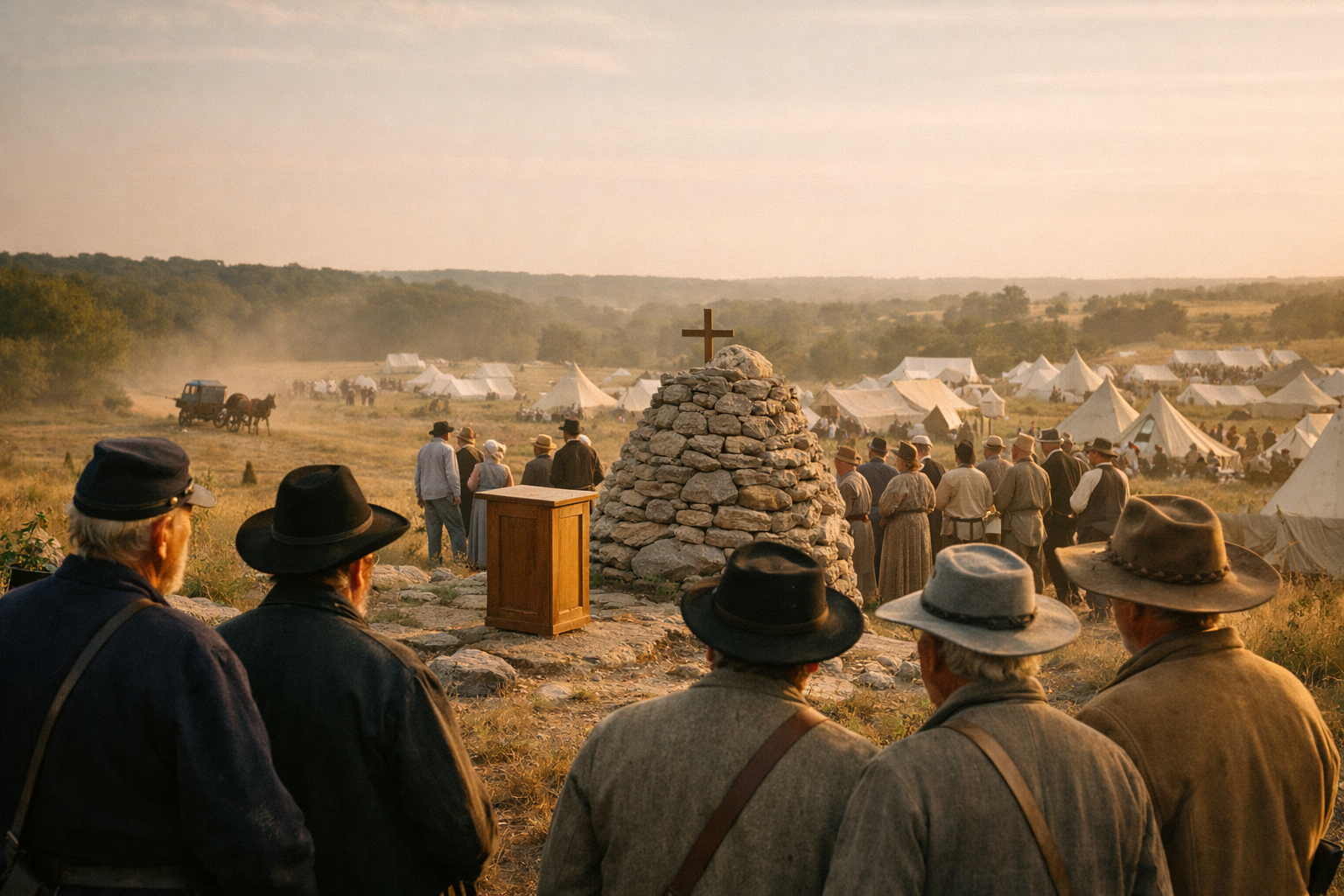
    Veterans from both Union and Confederate forces were invited to return to the ground where they had fought twenty two years earlier. It was one of the first major joint gatherings where former adversaries were encouraged to camp together as though there had never been a difference between them.

    The battlefield itself had changed very little. The hills, Wilson’s Creek, and the dense scrub oak known as blackjacks remained largely as they had been in 1861, allowing veterans to locate positions with a degree of accuracy not possible on more developed landscapes.

    They were not visiting an abstract place. They were walking through the physical structure of the battle itself.

    August 8 The Social Foundation

    The first day focused on arrival and registration. Local posts of the Grand Army of the Republic organized the reception and directed veterans to gathering spaces such as Drummond Hall, which had been decorated with flags and emblems.

    Inside, large tables were arranged with shared provisions, including a pail of prepared tobacco and a basket of pipes. This communal setup created an immediate point of connection, allowing Union and Confederate veterans to sit together, smoke, and talk.

    The act itself became part of the reunion, a quiet but meaningful ritual that allowed former opponents to engage in the ordinary habits of civilian life.

    August 9 Civic Processions and Mass Dining

    On the second day, formal processions moved through Springfield‘s principal streets. A column of approximately four hundred veterans, accompanied by bands, marched through a city decorated with flags, banners, and color displays.

    The movement led to the grounds of E. G. Blake, where the central logistical effort of the day took place. A massive tent had been erected, with plates laid for over six hundred people.

    This was not incidental. It was the centerpiece.

    The scale of the meal reflected both the size of the gathering and the limits of the city’s permanent infrastructure, requiring coordinated temporary solutions beyond what hotels and restaurants could provide.

    August 10 The Battlefield Pilgrimage

    The final day centered on movement. Several thousand people traveled the ten miles from Springfield to Wilson’s Creek along the Wire Road, with wagons, carriages, and foot traffic filling the route continuously as dust rose under constant motion.

    At the battlefield, attention focused on Bloody Hill. A formal stand had been erected near the location where General Nathaniel Lyon had fallen on August 10, 1861, and from this position speakers addressed the crowd while surrounded by the terrain that had shaped the original battle.

    Among those present were local officials, invited guests, and nationally recognized figures.

    The same ground that had once held lines of fire now held an assembled crowd.

    The Battlefield Encampment

    The reunion expanded into a temporary encampment stretching nearly two miles. This tent city housed veterans and visitors who remained on the field, with Sibley tents recreating the physical arrangement of wartime camps and providing a direct sensory connection to earlier experiences.

    Refreshment stands and gathering areas appeared throughout the encampment, and families were present, giving the environment a dual character as both a memorial and a large public gathering.

    At the center stood Bloody Hill, and nearby the location of Lyon’s death was marked by a growing stone cairn built collectively by visitors over time.

    Veterans moved across the battlefield identifying positions they had once held. Some followed routes associated with Sigel’s column, while others stood along ridges where lines had formed and broken.

    In 1861, Lyon had assembled approximately 5,800 men at Springfield to confront a combined Southern force of nearly 12,000 under Sterling Price and Benjamin McCulloch. The struggle on Bloody Hill remained the focal point of their return.

    The terrain itself had not changed.

    The Scale of the Reunion

    Attendance reached into the thousands, with some estimates approaching 10,000 visitors across the three-day event. This represented a significant expansion from earlier gatherings in the city.

    The strain on infrastructure was visible, with overwhelmed hotels, heavily trafficked roads, expanded food systems, and decentralized water and sanitation solutions.

    Despite these pressures, the event remained functional. Springfield demonstrated that it could coordinate movement, resources, and space at a scale it had not previously attempted.

    Interactions on the Field

    Observers noted that interactions between Union and Confederate veterans remained orderly. Men who had once faced each other across the same ground now occupied it together, sharing meals, camps, and movement.

    At locations such as the Lyon cairn, both sides gathered in recognition of the same event from different perspectives.

    The act of gathering itself became the defining feature.

    Contemporary Descriptions and Historical Voices

    The reunion was documented in real time through newspapers and firsthand accounts. Reports described the atmosphere as notably calm, with veterans camping together as though there had never been a difference between them.

    Other accounts captured the contrast between past and present, linking the organized movement of the reunion to the memory of the battle.

    Veterans’ own recollections added further depth, as many revisited positions from both sides and, for the first time, understood how the battle had unfolded from the perspective of their former opponents.

    Logistics Strain and the Local Economy

    The scale of the reunion produced both economic activity and visible strain. Housing reached critical levels, forcing overflow into tent encampments and private residences, while food and water systems expanded through temporary stands and mass dining operations.

    The demand for food led to the establishment of refreshment stands across the battlefield, many operated by local families and businesses. The stand on Bloody Hill served not only as a platform for speeches but also as a central logistical hub.

    This reflected a broader trend, as battlefields were beginning to function as destinations long before formal preservation systems were established.

    The Battlefield Landscape in 1883

    The physical landscape remained largely unchanged from 1861. Wilson’s Creek continued to serve as a water source, while the hills and blackjacks still defined the terrain.

    Vegetation had increased, with dense scrub oak contributing to the same visibility challenges that had shaped the battle. Markers were informal, with the most prominent being the stone cairn marking Lyon’s death.

    Nearby structures such as the Ray House remained visible, and the Wire Road continued as the primary route through the area.

    Relic hunting was already underway, with local families collecting and selling artifacts, reflecting a growing desire among visitors to take a physical piece of the site with them.

    A City Tested by Scale

    The Blue and Gray Reunion of 1883 placed demands on Springfield beyond anything it had previously experienced. The city coordinated transportation, housing, food, and movement across multiple days and distances.

    What had been developed in earlier years was tested under pressure.

    The result was not perfection, but capacity.

    Springfield proved that it could manage a gathering larger than any it had hosted before.

    The Long-Term Significance of the 1883 Gathering

    The 1883 reunion was not an isolated event. It marked an early example of how large scale gatherings could reshape public memory through shared presence rather than conflict, and it also marked the beginning of a longer process of recognition and preservation.

    Future gatherings would expand in size, with later reunions drawing even larger crowds, and interest in the battlefield continued as visitors returned in the years that followed.

    The site began to shift in meaning, moving from a battlefield to a destination and ultimately to a place of memory. By gathering on the same ground where they had once fought, the veterans reshaped how the land was understood, not by changing it, but by returning to it together.

    Next in the Series

    In the years that followed, Springfield would continue to grow as a regional center for commerce, industry, and public gatherings. What had been demonstrated in 1883 would continue to build, as the city moved beyond becoming the Queen City of the Ozarks and began learning how to operate like one.