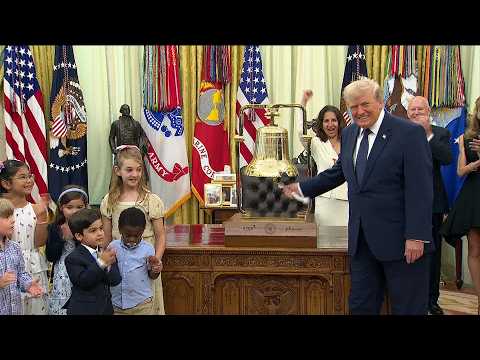
On February 24, 2025, President Donald Trump rang the New York Stock Exchange (NYSE) opening bell directly from the White House. This symbolic gesture marked the first time a sitting U.S. President performed this traditional market ritual from the executive residence. The event aimed to connect national leadership directly with the nation’s economic pulse, reinforcing a patriotic and pro-business sentiment among the American populace.
The televised ceremony served as a visual demonstration of the Trump administration’s commitment to economic growth and stability. By bringing a Wall Street tradition to the seat of government, President Trump sought to bridge the perceived gap between policy-making and market performance. This direct engagement was designed to project confidence in the economic outlook and highlight the administration’s pro-growth agenda.
The Symbolism of the Opening Bell Tradition
The ringing of the opening bell is a long-standing tradition on stock exchanges worldwide. It signifies the start of the trading day, a moment of renewed activity and opportunity for investors. Historically, this ritual has been performed by exchange officials, prominent business leaders, or special guests invited to the trading floor.
When President Trump performed this act from the White House, it elevated the symbolism significantly. It transformed a financial market custom into a national statement of economic intent. The location itself added considerable weight to the message, placing economic activity at the very center of national governance and presidential focus.
This particular bell-ringing event differed fundamentally from those held on a bustling trading floor. It was a carefully curated media moment, designed for maximum public impact and broadcast reach. The President’s direct participation aimed to personalize the connection between government actions and the daily lives of investors, businesses, and American workers.
Origin and Evolution of the Bell Ceremony
The practice of ringing a bell to signify the start and end of trading dates back to the 19th century. Early exchanges used a gong or gavel. The modern brass bell became standard at the NYSE in the late 1800s. It provides a definitive audible signal for the open and close of market operations.
Over time, the bell-ringing evolved from a purely functional signal to a ceremonial event. Inviting guests to ring the bell became a way to honor individuals, celebrate corporate milestones, or bring attention to charitable causes. It served as a public relations opportunity for both the exchanges and their guests.
The NYSE bell, located above the main trading floor, is a powerful visual icon of American capitalism. Its sound is instantly recognizable to financial professionals globally. The President’s engagement with this icon underscored its national economic significance.
Connecting Policy and Prosperity from the White House
The White House serves as the primary stage for presidential communications and policy pronouncements. Utilizing this platform for a market opening bell ceremony sends a clear signal about the administration’s priorities. It suggests that economic prosperity is not merely a consequence of policy, but a direct and central focus of presidential attention and effort.
Such events are meticulously crafted to foster a sense of national unity around economic goals. They attempt to instill confidence in government leadership regarding financial matters and market stability. The visual of the President ringing the bell from the Oval Office or a similar White House setting reinforces this narrative of direct engagement and responsibility.
The Trump administration frequently links its policy successes, such as deregulation and tax cuts, to positive economic indicators like job growth and stock market performance. Events like this bell-ringing ceremony provide a tangible, visual representation of that asserted connection. It is a form of communication designed to resonate with a broad audience, from seasoned investors to everyday citizens concerned with their financial well-being.
Presidential Economic Messaging Strategies
Presidents often employ various strategies to communicate their economic vision and accomplishments. Speeches, economic reports, and press conferences are common tools. The White House bell-ringing added a unique visual and symbolic dimension to this communication toolkit.
This particular event leveraged the inherent authority and symbolism of the presidential office. By directly participating in a market ritual, President Trump aimed to project an image of active leadership over the economy. This contrasts with more traditional approaches that might keep the executive branch at arm’s length from the daily fluctuations of the stock market.
The administration’s messaging emphasized a strong economy as a cornerstone of national strength and global competitiveness. The bell-ringing event served as a public reaffirmation of this commitment. It was a performative act designed to underscore the administration’s focus on fostering a robust economic environment.
Historical Precedent and Modern Adaptations in Presidential Engagement
While presidents have historically commented on economic conditions, delivered economic addresses, and engaged with economic advisors, the direct act of ringing a market bell from the White House represents a modern adaptation of presidential engagement with financial markets. In the digital age, such events are easily disseminated through various media channels, amplifying their reach and impact.
Past presidents have used different methods to signal economic priorities and provide assurances to the public. Franklin D. Roosevelt’s fireside chats addressed economic anxieties during the Great Depression. Ronald Reagan emphasized supply-side economics in his speeches. George W. Bush addressed the nation following the 2008 financial crisis.
The bell-ringing ceremony introduces a new layer of direct, symbolic action that leverages contemporary media capabilities. The advent of televised news and later, online streaming, has transformed how such presidential actions are perceived and consumed by the public. A live broadcast of the President engaging with a market ritual creates an immediate, shared experience for viewers, contributing to the event’s intended impact on public sentiment and market confidence.
The Evolution of Media and Presidential Visibility
Early presidents communicated primarily through written statements and occasional public appearances. The radio era brought presidential voices directly into American homes, enabling a more personal connection during times of crisis or national importance.
Television further enhanced presidential visibility, making visual symbolism a crucial component of political communication. A president’s demeanor, setting, and actions became integral to their message. The White House bell-ringing capitalized on this visual power, transforming an abstract concept like ‘economic policy’ into a concrete, observable act.
Today, social media and 24/7 news cycles ensure that such events are instantly analyzed and widely discussed. The rapid dissemination of images and videos allows a presidential action to reach millions within minutes, shaping immediate public and market reactions. This immediacy is a key factor in the strategic deployment of symbolic gestures like the White House bell-ringing.
The Role of Media in Economic Messaging and Public Perception
Bloomberg Television, a prominent financial news outlet, broadcast this event live. Media platforms play a crucial role in shaping the public’s understanding of economic affairs and government actions. The choice of a major financial news channel for this broadcast underscored its specific economic focus and target audience.
The coverage of such an event by major news organizations, including general news outlets, amplifies its message far beyond financial professionals. It reaches a general audience interested in national news and the overall health of the economy. The framing and interpretation of the event by these outlets can significantly influence public perception and market sentiment.
Media narratives often highlight the interplay between political leadership and economic outcomes. When the President performs an act like ringing the market bell, it provides a compelling visual for these narratives. It becomes a touchstone for discussions about national economic direction, governmental influence on markets, and investor confidence.
Framing the Economic Narrative
News organizations often serve as intermediaries, translating complex economic concepts into understandable narratives for the public. The bell-ringing event offered a clear, simple visual that could be easily integrated into various news stories about the economy.
Editors and anchors would likely discuss the significance of the White House setting, the President’s message, and potential implications for investors. This media interpretation helps to solidify the intended message or, conversely, introduce alternative perspectives on the event’s meaning and efficacy.
The consistent portrayal of presidential involvement in economic rituals reinforces the idea that the executive branch plays a direct and active role in shaping market conditions. This perception, whether fully accurate or not, can influence both public and investor behavior.
Impact on Investor and Public Sentiment
Investor sentiment is a critical, often psychological, factor in market performance. Positive sentiment can encourage investment, drive up asset prices, and fuel economic growth. Conversely, negative sentiment can lead to caution, sell-offs, and economic contraction. Symbolic actions by national leaders can play a significant role in shaping this crucial sentiment.
The act of President Trump ringing the bell from the White House aimed to project stability, confidence, and a strong pro-business stance. For investors, this could signal a supportive regulatory and fiscal environment for businesses and capital markets, encouraging further investment. For the general public, it might reinforce a belief in the nation’s economic strength and the administration’s competence in managing it.
Public perception of the economy can influence consumer spending, business expansion plans, and overall economic activity. By fostering a sense of connection and optimism through such presidential gestures, the administration sought to create a positive feedback loop. This encourages both investment and consumption, driving economic momentum and reinforcing the perception of prosperity.
Behavioral Economics and Presidential Signals
Behavioral economics recognizes that human psychology heavily influences financial decisions. Investors do not always act purely rationally; emotions, biases, and public sentiment play significant roles. Presidential actions, especially highly visible ones, can tap into these psychological factors.
A presidential bell-ringing can act as a powerful ‘nudge’ for market participants. It suggests that the highest office in the land is actively endorsing and promoting economic activity. This implicit endorsement can reduce perceived risk and increase confidence, potentially leading to more aggressive investment strategies or increased consumer spending.
The event also serves to consolidate a common narrative about economic health. When leaders project confidence, it can become a self-fulfilling prophecy, as collective belief translates into real economic activity. This makes such symbolic acts valuable tools in an administration’s economic communication strategy.
The White House as an Economic Stage and Symbol of Authority
The White House is not merely a residence or an office building; it is a powerful symbol of national authority, stability, and governance. When economic events are staged there, they gain a particular gravitas and official sanction. This transforms the political space into an economic one, at least for the duration of the event, blurring the lines between policy and market operations.
The backdrop of the White House lends an air of official endorsement and national priority to the financial markets. It suggests that the highest levels of government are not only aware of but actively engaged with and supportive of the mechanisms of capitalism. This can be a powerful message to both domestic and international observers, signaling a stable and predictable economic environment.
The deliberate choice of location for this bell-ringing ceremony highlights a strategic use of presidential power and symbolism. It positions the administration as a direct participant in, and guardian of, the nation’s economic health and market integrity. This reinforces the idea that national leadership is inextricably linked to the economy’s performance, and that the President is personally invested in its success.
Global Implications of White House Economic Displays
The global financial community closely watches signals from the U.S. President and the White House. A bell-ringing event from this iconic location is not just for a domestic audience; it sends a message to international investors, trading partners, and geopolitical rivals.
Such an event can be interpreted as a demonstration of American economic strength and leadership on the world stage. It suggests a government that is stable, focused on economic growth, and supportive of free markets. This can influence foreign direct investment, currency valuations, and international trade relations.
By bringing a Wall Street ritual to the White House, the Trump administration projected an image of robust economic stewardship. This was a calculated move to reinforce confidence in the U.S. economy as a reliable engine of global prosperity, even amidst international trade tensions or geopolitical uncertainties.
Presidents speak. Markets listen. The White House acts. Investors watch. The economy responds.
Confidence.