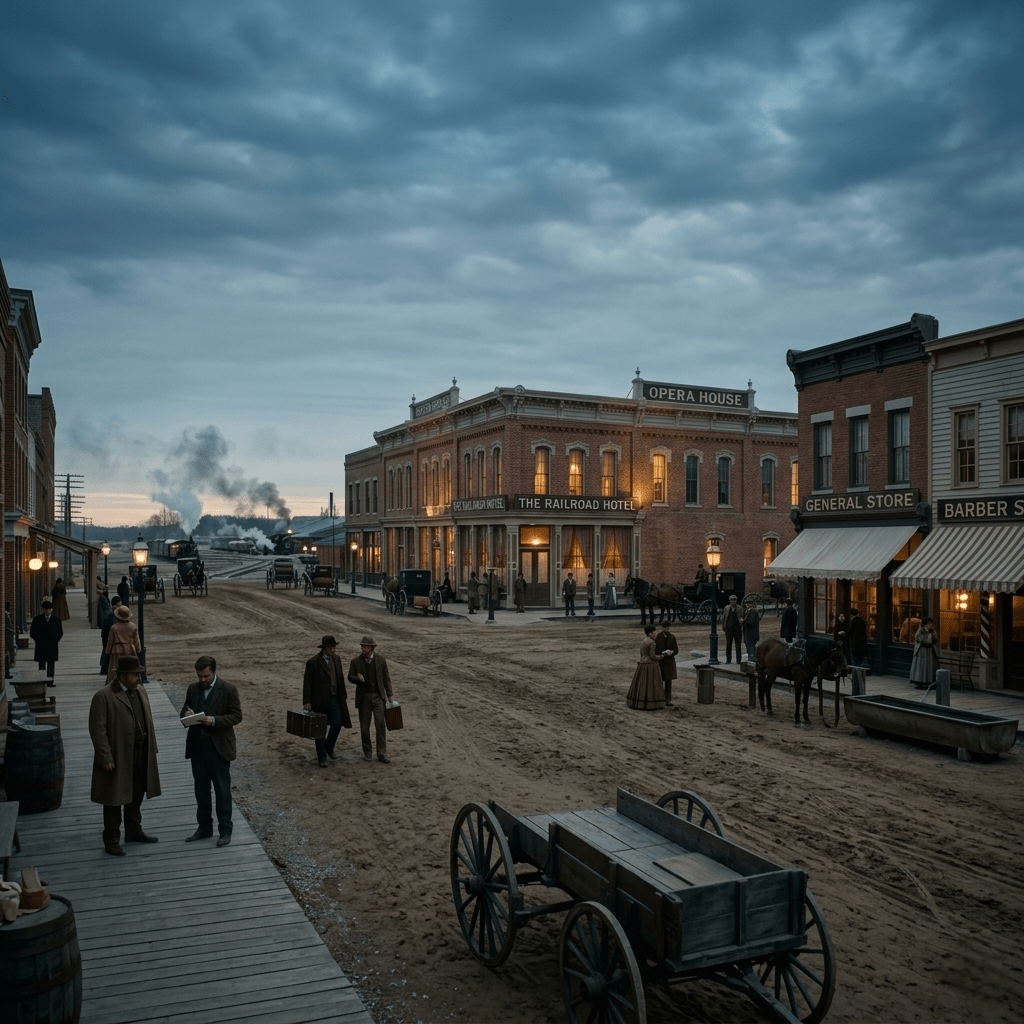
How Springfield Began Becoming the Queen City of the Ozarks
The debate over Springfield’s future usually sounds like a modern argument. Convention centers. Tourism. Downtown development. What kind of city Springfield wants to be.
But that conversation didn’t begin in our lifetime. It didn’t begin in the 1980s either.
In many ways, Springfield started moving in that direction more than a century ago.
Long before anyone debated convention centers or tourism districts, Springfield was already learning how to bring people together. The foundations of the city’s identity as a regional gathering place began forming in the nineteenth century, shaped by geography, war, railroads, and a few pivotal civic decisions that slowly transformed a frontier settlement into what would eventually be called the Queen City of the Ozarks.
Understanding where Springfield is going requires understanding how that identity first formed.
The Land Before the City
The land that would eventually become Springfield sits on the Springfield Plateau, a broad stretch of limestone terrain in the northern Ozarks. Natural springs, creeks, and fertile soil made the area attractive long before the city existed.
For generations the region was part of the territory used by the Osage Nation. Later, as displacement pushed Native communities westward, groups such as the Kickapoo and Lenape moved into the area.
Around 1812, a Kickapoo village of roughly one hundred wigwams stood near what is now Madison and Grand Streets. Long before streets or buildings were surveyed, the location already functioned as a gathering place because of its access to water and natural resources.
Permanent European American settlement began in 1829 when John Polk Campbell established a homestead near a spring along Jordan Creek. The water source made the location viable for a permanent settlement.
In 1833 Greene County was organized and Springfield was designated as the county seat. Campbell donated roughly fifty acres of land for the creation of a public square, establishing the center of commerce and government that still anchors the city today.
For decades the square served as the primary gathering point for farmers, merchants, and travelers throughout the Ozarks.
War Turns the Town Into a Strategic Hub
By the start of the Civil War Springfield had grown into an important regional town with a population of roughly two thousand residents.
Missouri was a divided border state, and Springfield quickly became a strategic military objective.
On August 10, 1861 the Battle of Wilson’s Creek was fought just southwest of the city. It was the first major Civil War battle west of the Mississippi River.
During the war Springfield changed hands multiple times. Thousands of troops passed through the area and the town became a logistical center for supplies, communications, and transportation.
Telegraph lines were installed, freight moved through the region, and Springfield learned how to handle the movement of large groups of people and resources.
Although the war brought destruction, it also reinforced Springfield’s role as a regional crossroads.
The Railroad Changes Everything
A decade later Springfield’s trajectory changed permanently.
On May 3, 1870 the Atlantic and Pacific Railroad reached the city. The arrival of the railroad was celebrated with speeches, cannon fire, and large crowds who understood what the iron rails meant for the future.
Springfield was no longer isolated in the Ozarks.
But the railroad introduced an unexpected twist. The tracks were built roughly one mile north of the existing town center. Around the depot a new settlement quickly emerged.
Within a year that community incorporated itself as a separate municipality known as North Springfield.
A Tale of Two Cities
For nearly two decades the region operated as two competing towns.
Springfield, centered around the Public Square, remained the legal and administrative hub. Lawyers, merchants, and county officials operated there, and the square continued to serve as the traditional commercial center.
North Springfield, centered along Commercial Street, developed around the railroad. Rail yards, repair shops, mills, and warehouses filled the district. Hotels and boarding houses served passengers arriving by train.
The dividing line between the two towns became Division Street.
What began as a geographic boundary soon symbolized an economic rivalry. Businesses competed for customers, infrastructure was duplicated, and each town attempted to position itself as the dominant center of the region.
The competition also pushed both communities to develop rapidly.
The Rise of Hospitality and Gathering Spaces
To compete with the railroad driven growth of North Springfield, leaders in the original town invested in hospitality and gathering spaces.
One of the most important projects was the Metropolitan Hotel, which opened in 1870 near the Public Square. It was considered one of the finest hotels in southwest Missouri and featured large dining halls, reception spaces, and meeting rooms suitable for hosting visitors.
Opera houses and lecture halls also appeared during this period. Baldwin’s Opera House and later the Springfield Opera House provided large indoor venues for performances, lectures, and civic meetings.
These buildings functioned as the conference halls of the nineteenth century.
The city also invested in modern infrastructure. By the mid 1870s the Springfield Gaslight Company provided street lighting and indoor gas service, helping the city project an image of safety and progress to visiting travelers.
The 1878 Press Convention
Springfield’s ability to host large gatherings was put to the test in May of 1878.
That year the Missouri Press Association selected Springfield as the location for its annual convention. Approximately 150 newspaper editors from across the state traveled to the city for the event.
At a time when newspapers were the primary source of public information, these editors were some of the most influential voices in Missouri. Their impressions of Springfield would be printed in papers across the state.
The city treated the convention as an opportunity to showcase itself. Delegates stayed in local hotels, attended sessions in meeting halls, and toured Springfield’s businesses and industries.
The event was widely viewed as a success.
Visiting editors wrote positively about the city, and many accounts referred to Springfield as the Queen City of the Ozarks. The phrase would become the city’s most enduring nickname.
For the first time, Springfield saw how hosting a gathering of influential visitors could shape how the rest of the state saw the city.
Proving the City Could Host Large Events
Just a few years later Springfield faced another large test.
In 1883 the city hosted a massive reunion of Union and Confederate veterans who had fought at the nearby Battle of Wilson’s Creek. Thousands attended ceremonies and battlefield visits commemorating the conflict.
Managing the logistics of such a large gathering demonstrated once again that Springfield could successfully host major regional events.
The 1887 Merger
Meanwhile the rivalry between Springfield and North Springfield continued.
Both towns had built their own schools, utilities, and civic institutions. Maintaining two separate municipal governments only a mile apart increasingly seemed inefficient.
By the mid 1880s civic leaders began pushing for consolidation.
On April 4, 1887 residents voted to merge the two municipalities into a single city. Celebrations followed the vote as crowds gathered in the Public Square to mark the occasion.
There was even a proposal to rename Division Street to Union Street as a symbol of reconciliation. Although the name never changed, the divide between the two towns had finally been bridged.
The merger transformed the region overnight. What had once been rival communities became one larger city with unified infrastructure and resources.
The Beginning of the Queen City
The consolidation of 1887 gave Springfield the scale it needed to act as a true regional center.
The railroad district and the original town were no longer competitors. Instead they became complementary parts of the same city.
Commercial Street continued as a rail and industrial corridor, while the Public Square remained the administrative and mercantile heart of the community.
Together they formed the foundation of what would become the Queen City of the Ozarks.
By the end of the nineteenth century Springfield had already proven something that would shape its future for generations.
It was not simply a crossroads town.
It was a place where people gathered.
Farmers gathered to trade goods. Soldiers gathered during wartime. Railroad passengers gathered as the Ozarks opened to the rest of the country. Editors gathered to shape public opinion. Veterans gathered to commemorate history.
And after the merger of 1887, the city finally had the unified infrastructure to host those gatherings under one name.
Springfield.
Next in the Series
In the next installment, we will look at how Springfield moved from railroad era gatherings into a new phase of industrial conventions and regional conferences that further established the city as the economic and professional hub of the Ozarks.
 Bytesizenetwork