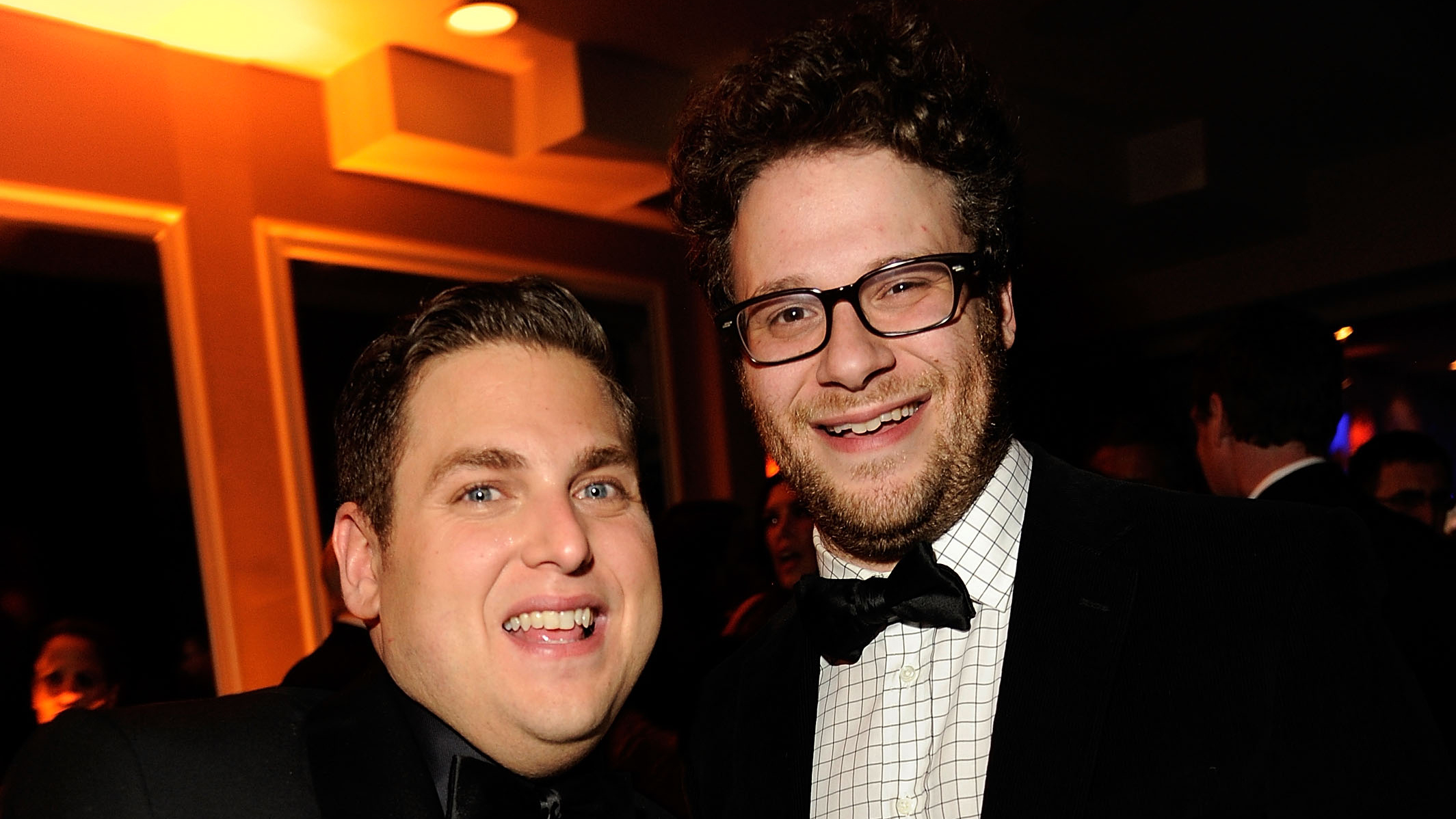
Tag: Seth Rogen

  • Seth Rogen and Jonah Hill’s Venice Filming Interrupted by YouTuber

    Seth Rogen and Jonah Hill’s Venice Filming Interrupted by YouTuber

    Actors Seth Rogen and Jonah Hill recently experienced an interruption during a film shoot in Venice, California. A YouTuber approached their set, initiating an interaction that was filmed and later shared across various online platforms. This event brought an unplanned element to the production day for the prominent Hollywood figures.

    The incident occurred as Rogen and Hill were engaged in their professional duties. The presence of a content creator with recording equipment is a common occurrence in public spaces where celebrities are present.

    The Unscripted Encounter in Venice

    The specific details of the film project Rogen and Hill were working on in Venice have not been fully disclosed. Production crews often operate in public areas, which inherently creates opportunities for public observation and interaction.

    Venice, with its vibrant street life and tourist attractions, is a frequent location for film and television shoots. The area draws significant foot traffic, making it a visible backdrop for any production.

    The YouTuber, whose identity was not immediately confirmed by official sources, initiated contact with the actors. Such encounters can range from brief greetings to more extended conversations, depending on the circumstances and the willingness of the individuals involved.

    The Rise of Public Filming

    The proliferation of smartphones and portable recording devices has transformed public spaces into potential content creation zones. Every individual with a device can become a reporter or a documentarian.

    This shift has introduced new considerations for public figures and film productions. What was once a relatively private professional endeavor can now become a public spectacle in real-time.

    Film sets often employ security measures to manage crowds and maintain the integrity of the production. However, these measures do not always prevent all interactions, especially in highly accessible public locations.

    Celebrity Responses to Unplanned Interactions

    Public figures like Seth Rogen and Jonah Hill navigate a complex landscape of public perception and personal privacy. Their responses to unplanned interactions can vary widely.

    Some celebrities embrace these moments, viewing them as opportunities to connect with their audience. Others prefer to maintain a professional distance, focusing on the work at hand.

    The manner in which Rogen and Hill handled the interruption was observed by those present and later by viewers of the circulated video. Their reactions contribute to their public image and the narrative surrounding the event.

    The Impact on Production

    Film productions operate on tight schedules and budgets. Unplanned interruptions can cause delays, requiring adjustments to the filming plan.

    Directors and production staff aim to maintain a controlled environment to capture the necessary footage. External factors, such as an unexpected public interaction, can disrupt this control.

    The specific impact on the Rogen and Hill project in Venice was not detailed in initial reports. However, any deviation from the schedule can have ripple effects on subsequent filming days.

    The Role of YouTubers in Public Discourse

    YouTubers have become significant figures in contemporary media, often bridging the gap between traditional media and direct audience engagement. Their content can shape public opinion and disseminate information rapidly.

    The interaction in Venice is an example of how independent content creators can directly engage with established public figures. This dynamic creates new forms of media spectacle.

    The motivation behind such an approach can vary. Some YouTubers seek to create viral content, while others may genuinely wish to interact with individuals they admire.

    Viral Content and Its Aftermath

    Videos of celebrity encounters, particularly those that are spontaneous or unexpected, often gain significant traction online. They can quickly become trending topics across social media platforms.

    The video featuring Rogen and Hill’s interaction with the YouTuber was no exception. Its circulation led to discussions and commentary from a wide audience.

    The aftermath of such a viral event can include increased scrutiny on both the celebrities and the content creator. Public reactions can be diverse, ranging from amusement to criticism.

    Privacy Concerns in Public Spaces

    The incident in Venice also raises broader questions about privacy in public spaces, especially for individuals who are constantly in the public eye. The line between public interest and personal space becomes increasingly blurred.

    For actors on a film set, their work is inherently public-facing, yet they also require a degree of concentration and control over their environment. The balance is delicate.

    Legal and ethical considerations surrounding filming individuals in public without their explicit consent are ongoing topics of debate. Different jurisdictions have varying laws on the matter.

    The Evolution of Paparazzi and Content Creators

    The role once primarily filled by paparazzi has expanded to include independent content creators. The tools and reach of these new players are more accessible than ever before.

    This evolution means that celebrities are subject to constant potential observation and documentation. Every public outing can become a piece of content.

    The industry continues to adapt to these changes, seeking ways to protect talent while acknowledging the realities of a digitally connected world.

    The Future of Celebrity-Fan Interactions

    The encounter between Seth Rogen, Jonah Hill, and the YouTuber in Venice serves as a contemporary example of celebrity-fan dynamics. These interactions are increasingly mediated by technology.

    As content creation tools become more sophisticated and widely available, such incidents are likely to become more frequent. Both celebrities and their teams are developing strategies to manage these occurrences.

    The narrative around these interactions is often shaped by the initial video and subsequent online commentary. Public perception can shift rapidly based on how an event is presented and interpreted.

    Actors worked. Crews filmed. A YouTuber approached. The camera rolled. Venice watched.


  • The End of a Comedy Empire – Why Seth Rogen Cut Ties With James Franco

    The End of a Comedy Empire – Why Seth Rogen Cut Ties With James Franco

    Seth Rogen has permanently severed his professional and personal ties with James Franco, confirming he has no plans to work with his former collaborator again and that the two have not spoken in a long time. The definitive split follows years of fallout after multiple women accused Franco of sexual misconduct in 2018. Rogen, who initially hesitated to distance himself publicly, has now cemented a rigid boundary. The creative partnership that defined a generation of American comedy is officially dead.

    The dissolution of this alliance marks the end of a two-decade comedic empire. From their early days on the 1999 set of Freaks and Geeks to the 2017 release of The Disaster Artist, Rogen and Franco built a brand on inseparable brotherhood. They were a packaged deal. Studios banked on their chemistry. Audiences paid for their camaraderie.

    That brotherhood is now a Hollywood artifact. The silence between the two men is absolute. There are no quiet reconciliations happening behind closed doors. There are no secret meetings at Soho House in West Hollywood.

    What looks like a simple celebrity feud is actually a stark case study in Hollywood accountability. The boundary lines of modern entertainment have shifted. Collateral damage is no longer absorbed for the sake of box office returns. The industry mechanics that once protected bankable stars have fundamentally changed.

    The Financial and Cultural Weight of a Comedy Empire

    To understand the magnitude of the fracture, one must understand the money. Rogen and Franco were not just friends. They were a massive economic engine.

    Their collaboration began under the guidance of Judd Apatow on the NBC cult classic Freaks and Geeks. The show lasted one season. The relationships lasted decades. By 2008, Rogen and Franco translated their dynamic into Pineapple Express. The stoner action-comedy was produced on a $27 million budget. It grossed $101 million globally. A formula was born.

    They repeated the success. In 2013, This Is the End grossed $126 million against a $32 million budget. In 2014, The Interview triggered an international incident. The film provoked North Korea, led to the infamous Sony Pictures hack, and dominated global headlines. Through it all, Rogen and Franco stood shoulder to shoulder. They presented a united front to the press, the public, and the studio executives.

    Their peak arrived in 2017. The Disaster Artist, directed by and starring Franco alongside Rogen, was a critical triumph. It earned Franco a Golden Globe for Best Actor. It seemed to validate their transition from stoner comedians to prestige Hollywood filmmakers.

    The Point Grey Machine

    Behind the scenes, the infrastructure was heavily intertwined. Rogen and his producing partner, Evan Goldberg, operated Point Grey Pictures. The company served as the production vehicle for many of these projects.

    • Pineapple Express (2008) established the tone.
    • This Is the End (2013) proved they could direct an ensemble.
    • The Interview (2014) tested their political and corporate leverage.
    • Sausage Party (2016) pushed R-rated animation to $140 million at the box office.
    • The Disaster Artist (2017) secured their prestige footprint.

    Franco was a constant fixture on the Point Grey call sheets. He was an honorary member of the brain trust. Then, the foundation cracked.

    The 2018 Allegations and the Initial Fracture

    The turning point arrived in January 2018. Franco attended the Golden Globe Awards. He won Best Actor for The Disaster Artist. He accepted the award wearing a Time’s Up pin, signaling support for the movement against sexual harassment in the entertainment industry.

    The hypocrisy was immediately called out. Days later, the Los Angeles Times published an extensive investigative report. Five women accused Franco of inappropriate or sexually exploitative behavior. Several of the women were former students at his acting school, Studio 4.

    Franco denied the allegations. He appeared on The Late Show with Stephen Colbert to defend himself. He stated that the things he heard on Twitter were not accurate, but added that if he had done something wrong, he would fix it.

    Rogen’s initial response was defensive. In press interviews throughout 2018, he stated he would continue to work with Franco. The industry was still navigating the early days of the #MeToo movement. The playbook for handling a disgraced collaborator was not yet fully written. Rogen attempted to thread the needle, separating his friend from the headlines.

    The culture did not allow it. The pressure mounted. The allegations were too specific, and the legal machinery was already in motion.

    The $2.2 Million Settlement at Studio 4

    The allegations against Franco were not limited to vague Hollywood rumors. They were tied to a physical business. In 2014, Franco opened Studio 4, an acting and film school with locations in New York and Los Angeles. He marketed it as a gateway to the industry.

    In 2019, former students filed a class-action lawsuit. They alleged fraud and sexual exploitation. The lawsuit claimed Franco pushed students into uncomfortable, sexually explicit situations under the guise of education. The plaintiffs argued that Franco used the promise of roles in his films to manipulate young, aspiring actors.

    The legal battle dragged on for two years. In 2021, the case reached a conclusion. Franco agreed to a $2.2 million settlement. The terms dictated that a significant portion of the money would go directly to the plaintiffs, while the rest covered legal fees.

    The settlement was a definitive legal resolution. It was also a definitive career marker. While Franco maintained his denials of the most severe claims, the financial payout cemented the end of his mainstream viability. Creative Artists Agency (CAA), one of the most powerful talent agencies in the world, quietly dropped him from their roster.

    The 2021 Pivot and the Final Severance

    As the legal reality of Franco’s situation solidified, Rogen’s stance changed. The initial defense vanished. The pivot was public and permanent.

    In May 2021, Rogen spoke to The Sunday Times. The interview served as a formal retraction of his 2018 statements. Rogen did not mince words. He acknowledged the pain caused by the allegations. He admitted the situation had changed their dynamic forever.

    “I look back to that interview in 2018 where I comment that I would keep working with James, and the truth is that I have not and I do not plan to right now,” Rogen stated.

    He went further. He addressed the personal fallout. Rogen confirmed that the allegations had fundamentally altered their relationship. It was not just a business decision. It was a personal severance.

    Actress Charlyne Yi, who worked with both men on The Disaster Artist, had publicly criticized Rogen weeks earlier. She accused him of enabling Franco’s behavior. Rogen’s interview was, in part, a response to that criticism. He realized that silence was complicity. He realized that continuing to associate with Franco was a liability to Point Grey Pictures, to his own reputation, and to the culture he claimed to support.

    The Mechanics of Hollywood Distancing

    When a Hollywood partnership of this magnitude dissolves, it requires a massive logistical untangling. The distancing is not just emotional. It is corporate.

    Point Grey Pictures had to scrub its development slate. Any project that had Franco attached as a director, producer, or star was quietly shelved or retooled. The company shifted its focus. Rogen and Goldberg leaned heavily into television and animation. They produced the massive Amazon Prime hit The Boys. They developed Invincible. They rebooted the Teenage Mutant Ninja Turtles franchise with Mutant Mayhem.

    Point Grey thrived. The company proved it did not need James Franco to generate hundreds of millions of dollars. The brand survived the amputation.

    Franco’s trajectory moved in the opposite direction. Exiled from the American studio system, he attempted a quiet return through independent European cinema. He secured roles in low-profile international projects like The Alley of Blind Macaques and a post-WWII drama directed by Bille August. These films exist far outside the Hollywood ecosystem. They do not receive massive marketing budgets. They do not get prime placement on streaming platforms.

    The divergence is complete. One man runs a thriving production empire in Los Angeles. The other seeks funding in European film markets.

    A Closed File

    The confirmation that Rogen still has “no plans” to work with Franco is not new information. It is simply a reaffirmation of a permanent state. The boundary has been tested by time, and it has held firm.

    The comedy landscape of the 2010s was built on their chemistry. They defined a specific era of American cinema. Scripts were written. Budgets were approved. Audiences paid.

    Now, the scripts belong to others. The budgets go elsewhere. The partnership is a closed file.

    Colleagues moved on. Studios moved on. Rogen moved on.

    Silence.