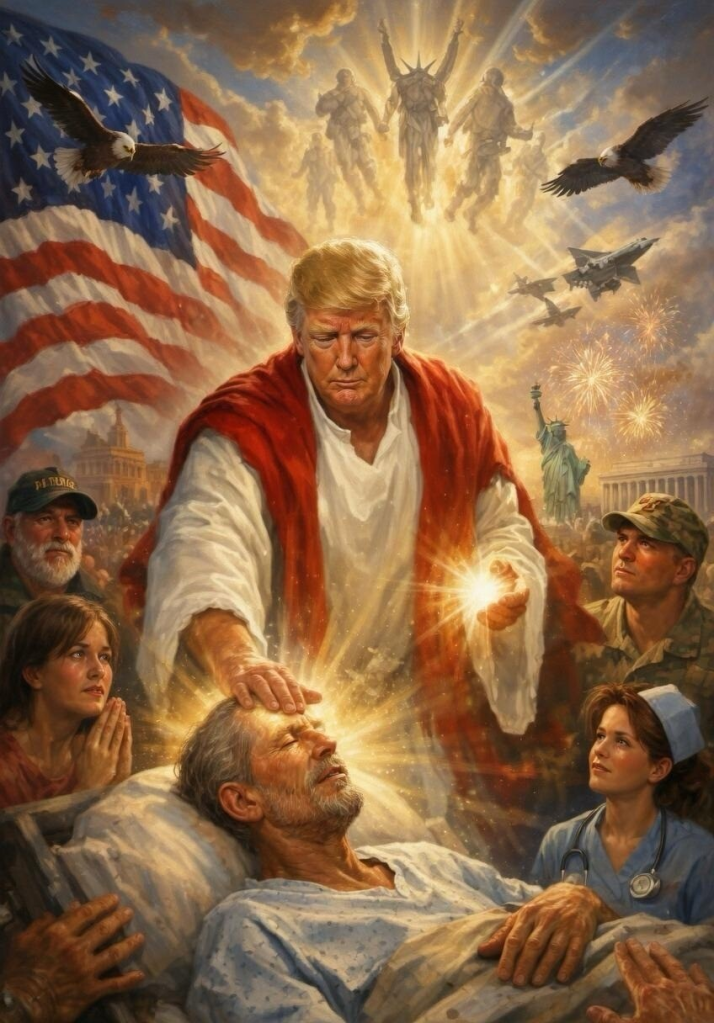
Donald Trump posted an AI-generated video in 2026 that portrayed him as a ‘doctor’ diagnosing celebrities such as Rosie O’Donnell, Whoopi Goldberg, and Robert De Niro with ‘Trump Derangement Syndrome.’ This digital content, shared on his Truth Social platform, utilized artificial intelligence to create a satirical narrative around the political polarization often associated with his public persona.
The video quickly became a point of discussion across various media outlets and social platforms. Its release highlighted the increasing intersection of political commentary, celebrity culture, and advanced AI technology. The term ‘Trump Derangement Syndrome’ has been used by Trump and his supporters to describe what they perceive as an irrational obsession or animosity towards him by political opponents and critics.
The Emergence of AI in Political Satire
The use of artificial intelligence to generate political content marks a significant shift in communication strategies. This particular video leveraged AI to create a visual and auditory representation of Donald Trump in a fictional role. The technology allowed for the manipulation of images and voices, crafting a narrative that would have been complex and costly to produce through traditional means.
AI tools, capable of deepfakes and synthetic media, have become more accessible. Their application extends beyond entertainment, entering the realm of political messaging and satire. The video served as a demonstration of how these technologies can be employed to create engaging, albeit controversial, content.
The production quality and rapid dissemination of such content raise questions about authenticity and intent. Audiences are increasingly exposed to media that blurs the lines between reality and digital fabrication. This particular video was clearly presented as satire, but its underlying technology has broader implications.
The ‘Doctor’ Persona and Its Message
In the video, Donald Trump assumed the persona of a medical professional, complete with a white lab coat and stethoscope. This ‘doctor’ character then proceeded to diagnose several well-known figures. The satirical nature of the portrayal aimed to mock the perceived reactions of these celebrities to Trump’s political career.
The specific diagnosis, ‘Trump Derangement Syndrome,’ is a phrase that has circulated widely within conservative media and among Trump’s supporters. It suggests that critics of Trump are not motivated by legitimate policy disagreements, but by an emotional or psychological affliction. The video amplified this narrative, presenting it in a visually striking and humorous format.
The targets of the video, Rosie O’Donnell, Whoopi Goldberg, and Robert De Niro, are all public figures who have been vocal critics of Donald Trump. Their inclusion was a deliberate choice, intended to resonate with an audience familiar with their past statements and public profiles. The video positioned Trump as an observer of their ‘condition,’ rather than the subject of their criticism.
Celebrity Reactions and Public Discourse
The release of the AI video prompted varied reactions from the public and the celebrities named. While some of Trump’s supporters found the video amusing and validating, others viewed it as divisive and an inappropriate use of advanced technology for political attacks.
Rosie O’Donnell, a long-standing public adversary of Trump, has frequently engaged in public spats with him since the mid-2000s. Her inclusion in the video continued this established dynamic. Whoopi Goldberg, a co-host on the television program The View, has also been an outspoken critic of Trump’s policies and rhetoric. Robert De Niro, an acclaimed actor, has publicly expressed strong disapproval of Trump on multiple occasions.
The video fueled existing debates about the role of celebrities in politics. Some argue that public figures have a right to express their political opinions, while others believe their influence should be limited. The ‘Trump Derangement Syndrome’ narrative attempts to delegitimize celebrity criticism by framing it as an emotional rather than rational response.
The Broader Impact of ‘Trump Derangement Syndrome’
The concept of ‘Trump Derangement Syndrome’ extends beyond individual celebrities. It has become a shorthand for describing a perceived irrational opposition to Donald Trump. This term is frequently employed in political discourse to dismiss criticism as biased or emotionally charged, rather than substantive.
The video’s use of this term served to reinforce a particular ideological viewpoint among Trump’s base. It provided a visual and narrative tool to categorize and understand their political adversaries. The satire aimed to create a sense of shared understanding and solidarity among those who feel that anti-Trump sentiment is excessive or unfounded.
Critics of the term argue that it unfairly dismisses legitimate concerns and criticisms of Trump’s actions and policies. They contend that it is a rhetorical device designed to shut down debate and demonize opposition. The AI video, by visually enacting this diagnosis, brought the concept to a new level of public visibility.
The Platform: Truth Social and Digital Dissemination
Donald Trump posted the AI video on Truth Social, his social media platform launched in 2022. This platform has served as a primary conduit for Trump’s direct communication with his supporters since his departure from other major social media sites. The choice of Truth Social for the video’s release was strategic.
Truth Social provides an environment where Trump’s content can be shared widely among his dedicated followers, often without the same level of moderation or content flagging seen on other platforms. This allows for the direct dissemination of messages that might be controversial elsewhere. The platform’s design facilitates rapid sharing and engagement within its user base.
The video’s reach, however, extended beyond Truth Social. News organizations and individual users frequently share content from Truth Social across other platforms, amplifying its visibility. This cross-platform dissemination ensures that Trump’s messages, even those initially posted on a niche platform, can achieve broad public awareness.
AI Ethics and Political Communication
The deployment of AI in political messaging, as seen with this video, raises important ethical considerations. The ability to create highly realistic synthetic media, including audio and video, has implications for truth and trust in public discourse. While this video was satirical, the underlying technology can be used for more deceptive purposes.
Concerns about deepfakes and their potential to spread misinformation are growing. The ease with which convincing, yet fabricated, content can be produced poses challenges for identifying and combating false narratives. The video serves as a reminder of the evolving landscape of digital communication and the need for media literacy.
The ethical debate centers on the responsibility of creators and platforms in managing AI-generated content. Guidelines and regulations for the use of synthetic media in political campaigns and public statements are still developing. This incident contributes to the ongoing conversation about how society will navigate the complexities introduced by advanced AI.
The Intersection of Culture and Politics
The ‘Doctor’ Trump AI video highlights the deep entanglement of culture and politics in contemporary society. Celebrities, often seen as cultural figures, are frequently drawn into political debates, and their opinions can significantly influence public perception. Conversely, political figures often leverage cultural references and celebrity associations in their messaging.
The video effectively used popular culture figures to advance a political point. By targeting well-known entertainers, Trump’s campaign aimed to connect with audiences who consume both political and entertainment news. This strategy is not new, but the AI component adds a novel layer to its execution.
The ongoing cultural wars often manifest in these types of exchanges. The video played into existing divisions, reinforcing the idea that certain cultural icons are aligned against a particular political viewpoint. This reinforces a ‘us vs. them’ mentality that characterizes much of modern political discourse.
Future Implications of AI in Campaigns
The 2026 AI video is likely a precursor to more sophisticated uses of artificial intelligence in future political campaigns. As AI technology continues to advance, its capabilities for content creation, audience targeting, and narrative shaping will grow. Political strategists will explore new ways to harness these tools.
Future applications could include personalized political ads generated by AI, AI-powered chatbots for voter engagement, or even entire campaign speeches delivered by AI-generated avatars. The speed and cost-effectiveness of AI content creation make it an attractive option for campaigns operating on tight budgets or deadlines.
The challenge for voters and media organizations will be to discern authentic human-generated content from AI-generated content, especially as the technology becomes more seamless. Education and critical thinking skills will become increasingly vital in an environment saturated with digitally synthesized information. The ‘Doctor’ Trump video serves as an early, albeit rudimentary, example of this evolving landscape.
The Legacy of Political Satire
Political satire has a long and storied history, serving as a tool for commentary, criticism, and humor. From ancient Greek comedies to modern-day late-night shows, satire often reflects and shapes public opinion. The ‘Doctor’ Trump AI video fits within this tradition, albeit with a modern technological twist.
The video’s satirical intent was clear: to poke fun at perceived political opponents and to rally a base. It employed exaggeration and caricature, common elements of satire, to deliver its message. The use of AI did not fundamentally change the purpose of the satire, but it did alter its production method and potential impact.
The effectiveness of political satire often lies in its ability to provoke thought and conversation. Whether this particular video achieved that beyond its immediate audience is a subject of ongoing debate. However, its existence demonstrates the adaptability of satire to new technological mediums.
Political figures will continue to use humor and satire. Digital tools will continue to evolve. The public will continue to react. The political landscape changes. The digital landscape changes. The conversation continues.
America.