Tag: Podcasting

  • iHeartMedia Layoffs Begin – The Restructuring Plan and $50 Million in Cost Savings

    iHeartMedia Layoffs Begin – The Restructuring Plan and $50 Million in Cost Savings

    iHeartMedia Initiates Restructuring and Workforce Reductions

    iHeartMedia has commenced layoffs across its organization as part of a significant restructuring plan. This strategic initiative is designed to achieve $50 million in annualized cost savings. The reductions are a response to evolving market conditions and the company’s efforts to streamline operations and enhance financial efficiency. These actions affect various segments of the company’s extensive radio and digital audio empire.

    The move follows a period of significant transformation within the media industry. Traditional radio broadcasters, including iHeartMedia, have been navigating shifts in advertising revenue, listener habits, and the rise of digital platforms. The company’s restructuring aims to position it for long-term sustainability in this dynamic environment.

    The Scope of the Restructuring Plan

    The restructuring at iHeartMedia is comprehensive, targeting operational efficiencies across multiple departments and markets. The company, which operates over 850 radio stations across the United States, is one of the largest audio content providers globally. The layoffs are not concentrated in a single area but are distributed to optimize the company’s overall cost structure.

    Sources indicate that the reductions are part of a broader effort to adapt to changing media consumption patterns. Listeners have increasingly shifted to digital streaming services and podcasts. This requires radio companies to innovate their content delivery and business models. The $50 million in targeted annual savings represents a substantial financial adjustment for the company.

    Financial Objectives and Market Pressures

    Achieving $50 million in annualized cost savings is a key financial objective for iHeartMedia. This figure underscores the company’s commitment to improving its fiscal health. The media landscape has been characterized by intense competition for advertising dollars, particularly from digital platforms like Google and Meta.

    For traditional media outlets, this competition necessitates a re-evaluation of operational expenditures. iHeartMedia’s strategy involves consolidating functions and reallocating resources to areas with higher growth potential, such as its podcasting and digital audio divisions. The company has invested heavily in its digital presence, aiming to capture a larger share of the digital audio market.

    Impact on Employees and Operations

    The layoffs at iHeartMedia have directly impacted a number of employees across the organization. While specific numbers were not immediately disclosed, such restructuring efforts typically affect various roles, from on-air talent to administrative and technical staff. The company has stated that these decisions are difficult but necessary for its future success.

    Operational changes are expected to accompany the workforce reductions. These may include the consolidation of certain programming functions, increased automation in some areas, and a greater emphasis on centralized content creation. The goal is to maintain the quality of content while reducing the overall cost footprint.

    Historical Context of iHeartMedia’s Evolution

    iHeartMedia, formerly known as Clear Channel Communications, has a long history of expansion and adaptation. The company was founded in 1972 and grew significantly through acquisitions in the 1980s and 1990s. Its vast portfolio includes local radio stations, national networks, and digital platforms.

    In recent decades, iHeartMedia has faced financial challenges, including a significant debt load. The company underwent a major financial restructuring in 2018, emerging from Chapter 11 bankruptcy in 2019. This history highlights a continuous effort to manage its financial structure while remaining a dominant force in the audio industry. The current restructuring is another chapter in this ongoing evolution.

    The company’s strategic moves often reflect broader trends in the media industry. As advertising markets shift and new technologies emerge, large media conglomerates must frequently reassess their business models. The current actions by iHeartMedia are consistent with similar adjustments seen across other media sectors.

    The Rise of Digital Audio and Podcasting

    The growth of digital audio and podcasting has significantly altered the media landscape. iHeartMedia has recognized this shift and has made substantial investments in its iHeartRadio digital platform and podcast network. The company now hosts a vast library of podcasts and offers streaming access to its radio stations.

    This dual strategy allows iHeartMedia to maintain its traditional radio audience while also attracting new listeners through digital channels. The restructuring may involve reallocating resources to further bolster these digital initiatives. The goal is to ensure that the company remains competitive in a market increasingly dominated by on-demand content.

    Podcasting, in particular, has seen exponential growth in recent years. Advertisers are increasingly turning to podcasts as a way to reach engaged audiences. iHeartMedia’s investment in this area is a strategic response to these market opportunities, aiming to diversify its revenue streams beyond traditional broadcast radio advertising.

    Industry Trends and Future Outlook

    The media industry continues to experience rapid transformation. Consolidation, technological innovation, and changing consumer habits are constant factors. iHeartMedia’s restructuring is indicative of these broader trends, as companies seek to optimize their operations for a digital-first future.

    Analysts suggest that media companies will continue to prioritize efficiency and diversification of revenue. This often involves difficult decisions regarding staffing and operational models. The long-term outlook for iHeartMedia will depend on its ability to successfully execute its restructuring plan and adapt to ongoing market shifts.

    The company’s focus on $50 million in annual cost savings is a clear signal of its commitment to financial prudence. This financial discipline, combined with strategic investments in digital audio, will be crucial for its sustained presence in the competitive media landscape. The future of audio content remains dynamic, with both challenges and opportunities for established players like iHeartMedia.

    Executives at iHeartMedia have emphasized the importance of these strategic adjustments. They aim to create a more agile and financially resilient organization. The company’s leadership must balance the immediate need for cost reduction with the long-term imperative of innovation and growth in new media formats.

    Navigating the Evolving Media Ecosystem

    The media ecosystem of 2026 is characterized by fragmentation and intense competition. Consumers have more choices for audio content than ever before, from satellite radio to music streaming services and an endless array of podcasts. Traditional radio, while still influential, must continually redefine its value proposition.

    iHeartMedia’s restructuring is an attempt to navigate this complex environment. By reducing costs and investing in digital, the company aims to strengthen its position as a leading audio content provider. This involves not only financial adjustments but also a cultural shift towards greater innovation and responsiveness to listener demands.

    The success of these changes will be measured by the company’s ability to maintain its audience base, attract new listeners, and generate sustainable revenue in the coming years. The $50 million in cost savings is a foundational step in this ongoing strategic journey.

    Companies across the media spectrum are making similar adjustments. Television broadcasters are investing in streaming platforms. Print publishers are focusing on digital subscriptions. The common thread is adaptation to a world where content is increasingly consumed on demand and through personalized digital channels.

    The Path Forward for iHeartMedia

    iHeartMedia’s path forward involves a delicate balance of cost management and strategic growth. The layoffs represent the cost management component. Investments in podcasting, digital platforms, and innovative content represent the growth component.

    The company’s extensive reach and brand recognition remain significant assets. Its ability to leverage these assets in the digital age will be critical. The restructuring is not merely about cutting expenses; it is about re-engineering the company for future success in a rapidly changing audio landscape.

    The media industry watches. Advertisers observe. Listeners continue to tune in.

    iHeartMedia adapts.
  • The Death of Late Night: Jay Leno on Joe Rogan, John Oliver, and the 11:30 Collapse

    The Death of Late Night: Jay Leno on Joe Rogan, John Oliver, and the 11:30 Collapse

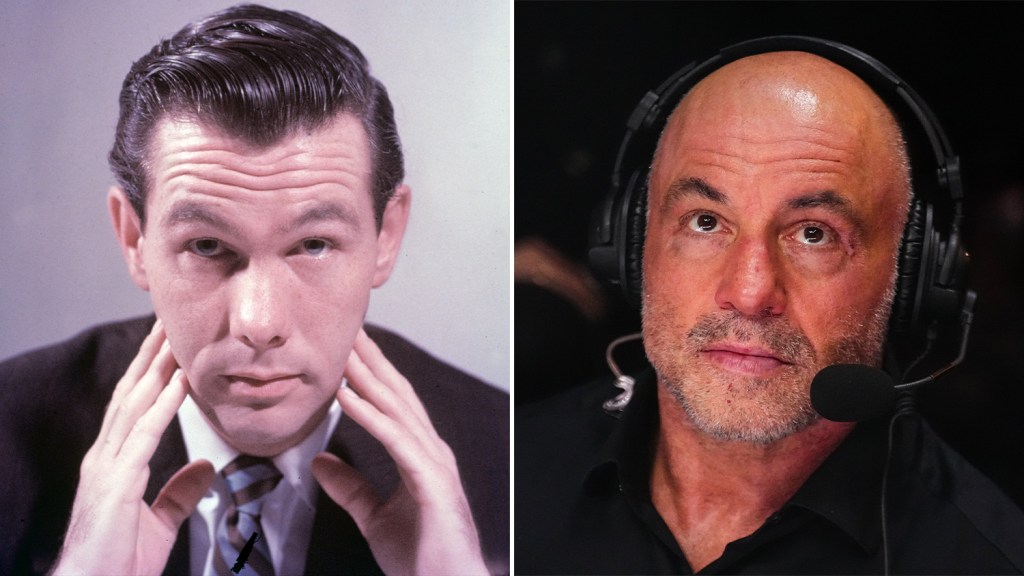
    Jay Leno declared traditional late-night television dead in a June 2026 interview, pointing to fractured audiences, the rise of long-form podcasting, and the partisan shift in modern comedy. Leno named Joe Rogan as the modern equivalent of Johnny Carson for his ability to unite massive, diverse audiences, while criticizing HBO’s John Oliver for prioritizing political lectures over universal humor. The former host of NBC’s The Tonight Show offered a blunt post-mortem on the 11:30 PM time slot he dominated for over two decades. The cultural gravity that once held the American viewing public together at the end of the day has evaporated. The audience did not simply change channels. The audience changed mediums entirely.

    The End of the 11:30 Consensus

    For half a century, the late-night monologue served as a national thermometer. At 11:30 PM, millions of Americans tuned in to see how the day’s events would be processed, packaged, and mocked. Johnny Carson perfected the format. Jay Leno industrialized it. During Leno’s peak in the late 1990s and early 2000s, The Tonight Show routinely pulled in over eight million viewers a night. Major cultural moments pushed that number past 15 million. The broadcast originated from Studio 3 in Burbank, California. It was the center of the entertainment universe.

    That center no longer holds. Leno’s assessment of the current late-night landscape is devoid of nostalgia. He views the collapse as a simple mathematical reality. The modern iterations of late-night television, currently helmed by Jimmy Fallon, Stephen Colbert, and Jimmy Kimmel, operate in a fundamentally different ecosystem. They are no longer broadcasting to a unified nation. They are narrowcasting to specific political and cultural demographics. The monologue was designed to be a broad, unifying force. It relied on a shared set of facts and a shared cultural baseline. When the baseline fractured, the format broke.

    Leno argues that the modern late-night hosts made a fatal tactical error. They abandoned the middle. By leaning heavily into specific political ideologies, the hosts secured a dedicated core audience but alienated half the country. The broad appeal that defined Carson’s 30-year run and Leno’s 22-year tenure was sacrificed for viral moments. The result is a shrinking pie. Network television ratings have plummeted. Advertising revenue has followed suit. The 11:30 PM time slot is now a legacy property, propped up by YouTube clips and social media engagement rather than live, appointment viewing.

    Why Joe Rogan is the New Johnny Carson

    The most striking revelation in Leno’s interview is his direct comparison between Joe Rogan and Johnny Carson. On the surface, the two men share little in common. Carson was a meticulously polished broadcaster who operated behind a desk in Burbank. Rogan is a former stand-up comedian and UFC commentator who hosts three-hour, unscripted conversations in a warehouse in Austin, Texas. But Leno looks past the aesthetics. He focuses on the cultural footprint.

    Carson was the ultimate kingmaker. A successful appearance on his couch could launch a career overnight. Rogan holds that exact same power today. The Joe Rogan Experience commands an audience of tens of millions of listeners per episode. It is the most valuable property in the audio landscape, backed by a massive licensing deal with Spotify reportedly worth $250 million. When Rogan speaks, the culture listens. When a comedian, author, or politician sits across from Rogan, their trajectory changes.

    Leno points out that Rogan achieved this by doing exactly what Carson did: he remains curious, he listens, and he refuses to talk down to his audience. Rogan does not deliver a monologue. He engages in a dialogue. In an era of tightly scripted, heavily edited media, Rogan’s unpolished, long-form format feels authentic. The audience trusts him. They do not view him as an elite broadcaster lecturing from a coastal studio. They view him as a proxy for their own curiosity. Carson possessed that same everyman quality. He was the Nebraska boy who made it to Hollywood but never lost his midwestern sensibilities. Rogan is the modern manifestation of that archetype.

    The Critique of John Oliver and Modern Political Comedy

    Leno reserved his sharpest criticism for John Oliver. The host of HBO’s Last Week Tonight has won numerous Emmy Awards for his deep-dive, investigative comedy. Oliver’s format involves a 30-minute, highly researched monologue focusing on a specific political or social issue. It is dense, fact-heavy, and unapologetically partisan. Leno views this approach as the antithesis of comedy.

    According to Leno, Oliver does not know what he is talking about when it comes to the daily realities of middle America. Leno argues that Oliver’s show is an exercise in validation rather than entertainment. The audience tunes in not to laugh, but to have their existing worldview confirmed. This phenomenon, often referred to in comedy circles as clapter, prioritizes applause over genuine laughter. The comedian makes a political statement, and the audience claps in agreement.

    Leno sees this as a fundamental betrayal of the comedian’s job. The comedian is supposed to observe the absurdity of life and present it in a way that unites the room. When a host turns the desk into a pulpit, the magic is lost. Oliver’s success on HBO, a premium cable network that relies on subscriptions rather than broad advertising, allows him to cater to a niche, highly educated, politically active demographic. But Leno argues that this niche approach has poisoned the broader comedy landscape. It has created an environment where comedians are expected to be political pundits first and entertainers second.

    The Economics of the Shift

    The death of late night is not just a cultural phenomenon. It is an economic reality. The broadcast networks, NBC, CBS, and ABC, built massive financial empires on the back of the 11:30 PM time slot. Madison Avenue paid premium rates to reach the millions of viewers winding down their day. That financial model is currently collapsing.

    The audience has migrated to digital platforms. YouTube, TikTok, and Spotify command the attention that once belonged to the networks. The economics of these digital platforms heavily favor long-form, on-demand content. A three-hour episode of The Joe Rogan Experience generates significantly more engagement, and therefore more ad revenue, than a six-minute late-night monologue chopped up for YouTube. The networks are trapped in a legacy cost structure. They maintain massive studios, large writing staffs, and union crews to produce a daily show that fewer and fewer people are watching live.

    Leno understands this transition intimately. He lived through the peak of the broadcast era. When he handed The Tonight Show over to Jimmy Fallon in 2014, the cracks in the foundation were already visible. The 2009 scheduling debacle, which saw Conan O’Brien briefly take over the 11:30 PM slot before Leno returned, was a desperate attempt by NBC to navigate a changing media landscape. By 2026, the transition is complete. The money has moved. The cultural relevance has moved. The center of gravity has shifted from the television set to the smartphone.

    The Legacy of The Tonight Show

    The Tonight Show will likely continue to exist. It is a legacy brand with over 70 years of history. But its role in American life has been permanently downgraded. It is no longer the national campfire. It is just another option in an infinite sea of content. Fallon, Colbert, and Kimmel are talented broadcasters, but they are playing a game that is mathematically impossible to win on the scale of their predecessors.

    Leno’s commentary is a stark reminder of how quickly cultural institutions can fade. The power of the 11:30 PM desk seemed absolute in 1992. It seemed unshakeable in 2002. Today, it is a relic. The audience demands authenticity over polish. They demand long-form conversation over scripted jokes. They demand to be spoken with, not spoken to.

    The architecture of comedy has fundamentally changed. The stand-up clubs like the Comedy Store in Los Angeles are thriving. Podcasting is booming. But the traditional late-night format is running on fumes. Leno’s willingness to state this plainly, without the usual industry diplomacy, underscores the finality of the shift. He is not predicting the death of late night. He is reporting it.

    The Terminal Drop

    The cameras still roll in New York. The cameras still roll in Los Angeles. The bands still play their opening numbers. The hosts still wear their tailored suits. The monologues are still written, rehearsed, and delivered into the lens. But the national audience is gone. The cultural conversation moved to Austin. The internet swallowed the broadcast. Silence.