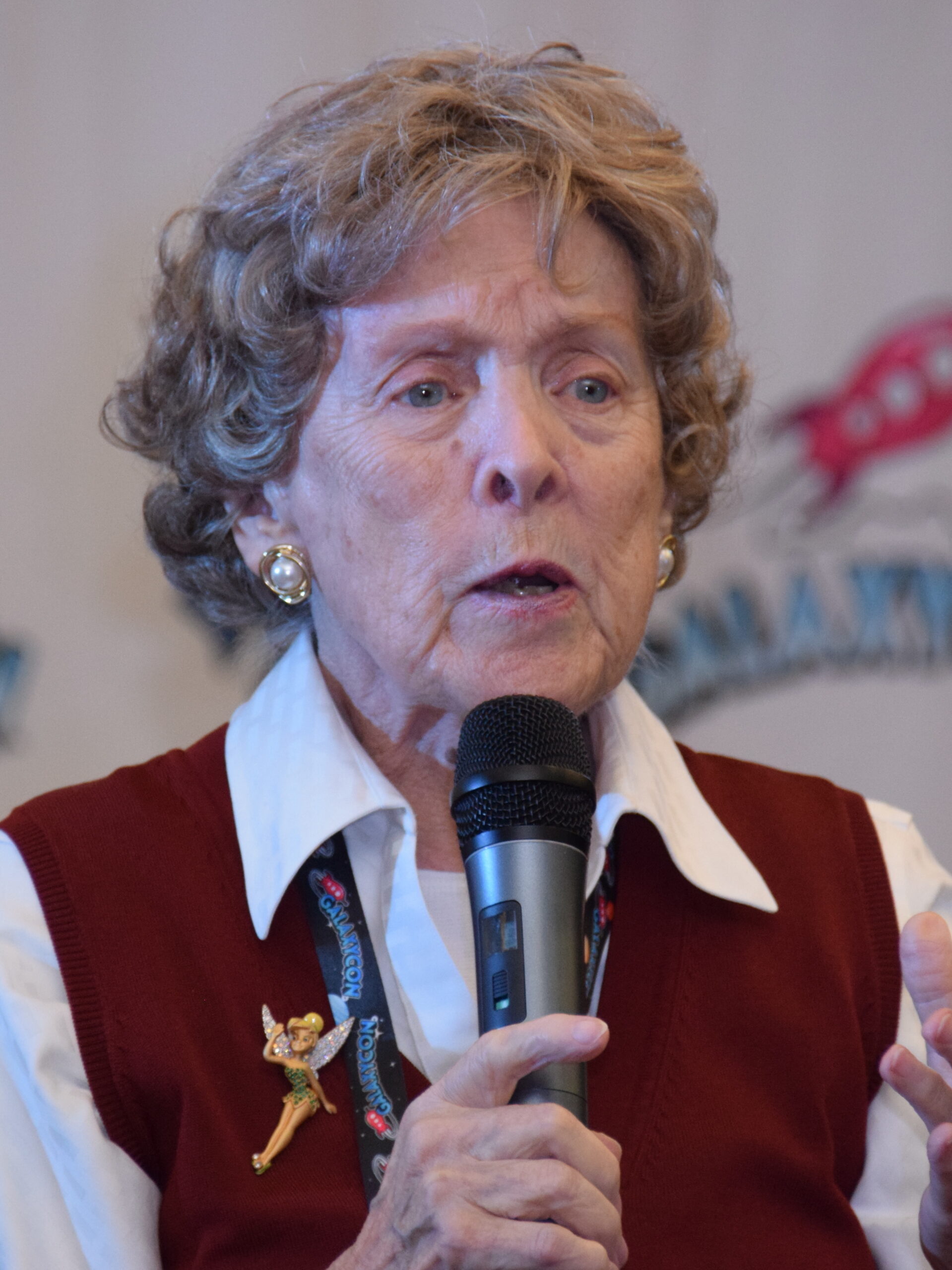
Margaret Kerry, the veteran actress, radio performer, and dancer who served as the live-action reference model for Tinker Bell in Walt Disney’s 1953 animated feature Peter Pan, has died at the age of 97. Her pantomime work on a Burbank soundstage shaped the physical comedy, posture, and iconic pout of one of the most recognizable characters in animation history. Without speaking a single line of dialogue, Kerry gave a drawing a distinct, fiery psychology.
For decades, an urban legend persisted across Hollywood. Whispers claimed that Marilyn Monroe had inspired the blonde, temperamental pixie. The timeline never aligned, but the rumor survived. The truth belonged entirely to Kerry.
She did not just lend a face to an animator. She engineered a performance. Kerry translated human movement into fairy proportions, helping the studio solve a massive narrative problem: how to make a mute, glowing ball of light emote across an eighty-minute film.
But the story of Margaret Kerry extends far beyond the borders of Neverland. From her early days in the Our Gang comedy shorts to pioneering early network television, her career tracked the evolution of 20th-century American entertainment. She was a working actor who accidentally became a permanent piece of global pop culture.
The Myth of Marilyn and the Reality of Margaret
The Marilyn Monroe rumor is one of Hollywood’s most enduring myths. It suggests that Walt Disney animators based Tinker Bell’s curves and blonde hair on the rising 20th Century Fox star. The reality of animation production dictates otherwise.
Walt Disney acquired the animation rights to J.M. Barrie’s play Peter Pan in 1939. The studio began early visual development shortly after, but World War II forced the project into a decade-long hiatus. By the time production resumed in earnest in the late 1940s, Marilyn Monroe was still an unknown entity. When the final design for Tinker Bell was locked in 1951, Monroe had only just begun to gain national attention.
The responsibility of bringing Tinker Bell to life fell to Marc Davis. Davis was one of Disney’s “Nine Old Men,” the core group of animators who defined the studio’s golden age. He had previously animated Cinderella and would go on to animate Maleficent and Cruella de Vil. Davis needed a live-action reference model to study how fabric moved, how weight shifted, and how a jealous fairy might physically express rage without uttering a sound.
He did not want a movie star. He needed a dancer.
In 1951, a 22-year-old Margaret Kerry received a call to audition at the Walt Disney Studios in Burbank, California. She prepared by listening to a phonograph record of the J.M. Barrie play. She choreographed a pantomime routine. During her audition, she pretended to make breakfast without using any real props. Davis watched her move. He hired her immediately.
Six Months on a Burbank Soundstage
Live-action reference was a standard practice at the Walt Disney Studios in the 1950s. Animators did not trace the actors, a process known as rotoscoping. Instead, they used the filmed footage as a dynamic anatomical guide. The actors provided the raw data. The animators provided the caricature.
Kerry spent six months on an empty soundstage. Because Tinker Bell interacted with normal-sized human objects, the studio built oversized props for Kerry to navigate.
- A giant wooden keyhole for her to squeeze through.
- A massive pair of scissors.
- An oversized hand mirror.
The mirror scene remains one of the film’s most famous sequences. Tinker Bell lands on Wendy Darling’s vanity, catches her reflection in a mirror, and critically examines the width of her own hips. Kerry improvised the movement. She stood on the soundstage, placed her hands on her hips, measured the distance, and sighed in exasperation. Davis captured the exact shift in her posture.
“Marc Davis was a genius. He didn’t just want my measurements. He wanted my attitude. Tinker Bell was a magical creature, but her emotions had to be entirely human. She was jealous. She was petty. She was fiercely loyal. I had to act all of that out with my shoulders and my chin.”
Kerry wore a custom bathing suit during the shoot. The studio wardrobe department designed it to match Tinker Bell’s strapless, jagged-hemmed dress. This allowed Davis to study the exact muscle movements in Kerry’s legs and back as she leaped off giant spools of thread and pretended to fly across the room.
High Stakes for the Mouse House
When Kerry stepped onto the soundstage in 1951, the Walt Disney Company was operating under immense financial pressure.
The studio had narrowly avoided bankruptcy with the massive success of Cinderella in 1950. However, their follow-up, Alice in Wonderland (1951), had disappointed at the box office. Peter Pan needed to be a commercial triumph. The budget swelled to $4 million, a staggering sum for an animated feature at the time.
Tinker Bell was viewed as a major risk. In J.M. Barrie’s original stage productions, the fairy was depicted simply as a darting spotlight accompanied by the sound of a ringing bell. Audiences had never seen her face. Giving her a human form, a distinct personality, and a visible temper was a massive creative gamble.
Kerry’s performance grounded the character. She made the fairy believable. When Peter Pan premiered in theaters on February 5, 1953, it grossed over $7 million in its initial run. It became the highest-grossing film of the year. Tinker Bell immediately transcended the film, becoming the unofficial mascot of the Walt Disney Company. She began flying over the sleeping castle in the studio’s television anthology series introductions, cementing her status as a global icon.
Voices in the Water: The Mermaid Connection
Kerry’s contribution to Peter Pan was not limited to silent pantomime. She also provided voice work for the film.
In the Mermaid Lagoon sequence, Peter Pan and the Darling children encounter a group of vain, sunbathing mermaids. Kerry served as the live-action reference model for the redheaded mermaid. She also provided the character’s voice, delivering lines as the mermaids playfully torment Wendy Darling.
Working alongside directors Gerry Geronimi, Hamilton Luske, and Wilfred Jackson, Kerry demonstrated her versatility. She could deliver the precise vocal inflection required for a snobby mermaid, and hours later, return to the soundstage to silently physically embody a jealous pixie.
Before the Pixie Dust: Early Life and ‘Our Gang’
Margaret Kerry was born Peggy Lynch on May 11, 1929, in Los Angeles, California. She was embedded in the entertainment industry from a remarkably young age.
At the age of four, she appeared in the legendary Our Gang (later known as The Little Rascals) comedy shorts. She acted alongside George “Spanky” McFarland, learning the mechanics of film production before she could read.
In 1935, she secured a small role in the Warner Bros. film adaptation of William Shakespeare’s A Midsummer Night’s Dream. In a stroke of massive historical irony, her role in the film was playing a fairy. She worked under the direction of Max Reinhardt, sharing the screen with Mickey Rooney and James Cagney.
As she transitioned into her teenage years, she adopted the stage name Margaret Kerry. She worked consistently in film and radio, developing a reputation as a reliable, hard-working performer who understood comedic timing.
Pioneering the Television Age
While her legacy is forever tied to a 1953 animated film, Kerry was also a pioneer of early network television.
From 1949 to 1952, she starred in The Ruggles, a family sitcom broadcast on the ABC network. The show starred veteran actor Charlie Ruggles. Kerry played his teenage daughter, Sharon. The Ruggles was one of the first network television series to be produced in Hollywood rather than New York, and it aired live to audiences across the country.
Live television required immense discipline. There were no retakes. Kerry’s background in dance and radio prepared her perfectly for the high-wire act of live broadcasting.
A Voice for Animation: Clutch Cargo and Beyond
In 1959, Kerry took on a role that would secure her place in a completely different corner of animation history. She joined the cast of Clutch Cargo, an animated television series produced by Cambria Productions.
Clutch Cargo utilized a bizarre, highly distinct animation technique called Syncro-Vox. To save money on animation costs, the studio filmed the actual lips of the voice actors and superimposed them onto the static drawings of the characters’ faces. The result was unsettling but undeniably memorable.
Kerry provided the voices for multiple characters on the show, most notably Spinner, the young sidekick, and Paddlefoot, the pet dachshund. She worked alongside voice actor Hal Smith, who would later become famous as Otis the town drunk on The Andy Griffith Show. Kerry’s ability to manipulate her voice to sound like a young boy kept her in constant demand in the voice-over industry throughout the 1960s.
The Legacy of a Working Actor
In her later years, Margaret Kerry embraced her unique place in Hollywood history. She did not shy away from the Tinker Bell legacy; she championed it.
She became a staple on the convention circuit, regularly attending Disneyana fan events and comic conventions across the globe. She was known for her boundless energy, often staying hours past her scheduled time to ensure every fan received an autograph and a story.
In 2016, she published her autobiography, Tinker Bell Talks: Tales of a Pixie Dusted Life. The book detailed her early years in Hollywood, her experiences on the Disney lot, and her perspective on the industry’s evolution. It served as a vital primary source for animation historians, debunking myths and preserving the reality of mid-century film production.
Kerry understood the distinction between the character and herself. She knew that Tinker Bell belonged to the world. But she also knew that the fairy’s soul, the hands on the hips, the tapping of the foot, the fierce loyalty, was born in a Burbank soundstage in 1951.
She was the human anchor for a magical property.
Animators drew lines. Audiences watched a screen. A company built an empire.
But the spark belonged to a woman on an empty soundstage, pretending to be trapped in a keyhole.
Margaret Kerry.