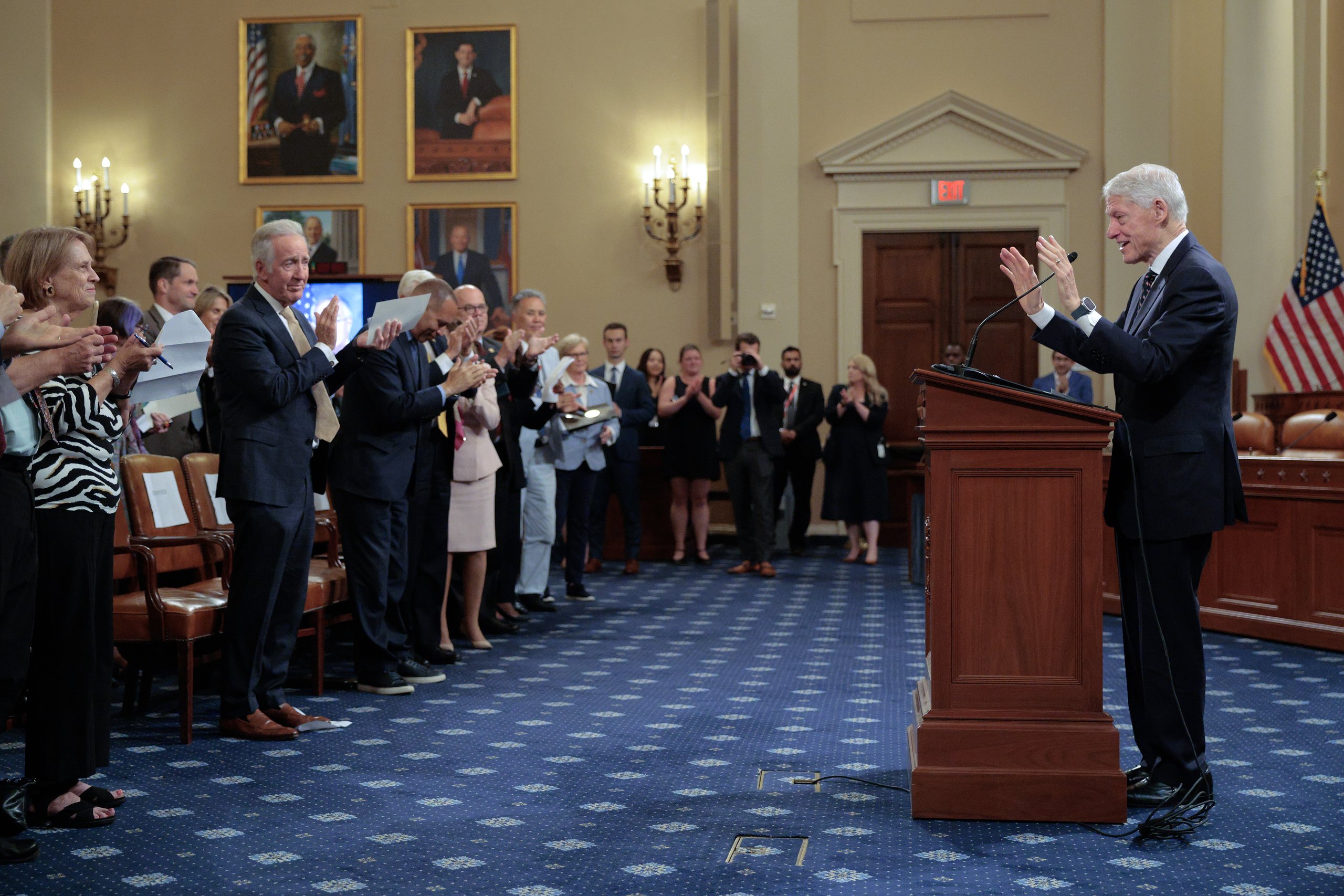
Former President Bill Clinton utilized his platform during the America 250 celebrations to launch a direct criticism of Donald Trump’s economic proposals. Trump’s economic vision, as implemented during his presidency and outlined for future endeavors, often centers on significant tax cuts for corporations and high-income earners, alongside broad deregulation across various sectors. Clinton characterized this approach as ‘socialism for the super-rich,’ directly challenging the former president’s economic philosophy. His comments were delivered as part of a national reflection on 250 years of American independence and its future trajectory.
Clinton’s address positioned Trump’s economic agenda as fundamentally divergent from policies aimed at broader societal benefit. He argued that such proposals would disproportionately favor the wealthy, leading to an unequal distribution of resources and opportunities. This critique resonated with long-standing Democratic arguments regarding wealth inequality and corporate influence, particularly pertinent in the political landscape of 2026.
The America 250 Context: A National Reflection
The America 250 initiative commemorates the 250th anniversary of the United States’ founding in 1776. This significant national observance spans several years, leading up to the climactic year of 2026. It encompasses a wide array of events, public discussions, and reflective programs focused on American history, foundational values, and its future trajectory.
Leaders from across the political spectrum have actively participated in these commemorative events. Their speeches frequently address the nation’s past achievements while confronting its present challenges. The platform provided by America 250 offers a unique opportunity for prominent figures to articulate their distinct visions for the country’s path forward.
Bill Clinton’s participation positioned him as a key voice reflecting on the nation’s historical journey. His remarks were delivered within this profound historical and forward-looking context. He deliberately connected contemporary economic debates to the enduring foundational principles of American democracy and its promise of opportunity for all citizens.
The Role of Historical Anniversaries in Political Discourse
Major anniversaries, such as America 250, often serve as catalysts for national introspection. They provide a stage for leaders to reflect on the nation’s progress and its unfulfilled aspirations. Such occasions allow for a re-evaluation of core principles in light of current societal conditions.
Political figures frequently leverage these platforms to advance their policy agendas. They frame their arguments within a historical narrative, linking present-day challenges to past struggles and triumphs. This rhetorical strategy aims to imbue contemporary debates with a sense of historical significance and national purpose.
Clinton’s speech exemplifies this approach. He used the solemnity of the America 250 observance to elevate his critique of Trump’s economic policies. He presented his arguments not merely as partisan attacks, but as essential considerations for the nation’s future well-being and adherence to its founding ideals.
Clinton’s Core Critique: ‘Socialism for the Super-Rich’
The central point of Clinton’s criticism revolved around his interpretation of Donald Trump’s economic plans. He employed the vivid and provocative phrase ‘socialism for the super-rich’ to encapsulate his argument. This phrase suggests that while Trump’s policies are often presented as broadly beneficial, their primary effect is to serve the interests of the wealthiest segment of the population.
This framing represents a sharp rhetorical contrast with traditional definitions of socialism. Socialism typically advocates for collective or governmental ownership and control of the means of production and distribution. Its core goal is often to reduce economic inequality and ensure a more equitable distribution of wealth and resources among all citizens.
Clinton’s use of the term was therefore rhetorical and deliberately ironic. It aimed to highlight what he perceived as a perverse and contradictory outcome of Trump’s policies. He implied that policies designed to ostensibly boost the economy would, in practice, create a system that concentrates wealth at the top, rather than distributing it more broadly.
Dissecting the ‘Socialism’ Label
The term ‘socialism’ carries significant historical and political baggage in American discourse. It is often used by conservatives to criticize any form of extensive government intervention or wealth redistribution. Clinton’s inversion of the term aimed to turn this rhetorical weapon against its usual proponents.
By attaching ‘socialism’ to the ‘super-rich,’ Clinton sought to expose what he viewed as hypocrisy. He suggested that policies favoring the wealthy were, in their own way, a form of government intervention. This intervention, he argued, was designed to benefit a select few, rather than the collective good.
This rhetorical maneuver forced listeners to reconsider their assumptions about who benefits from government action. It challenged the notion that policies favoring the wealthy are inherently ‘free-market’ while those benefiting the poor or middle class are ‘socialist.’ Clinton aimed to reframe the debate around equity and who truly benefits from economic policy decisions.
Economic Policy Divides: Democratic vs. Republican Approaches
The debate over economic policy has been a persistent and defining theme in American politics for decades. Democrats and Republicans often present fundamentally different philosophies regarding the role of government in the economy and the optimal path to prosperity and equity.
Democrats frequently advocate for policies such as progressive taxation, where higher earners pay a larger percentage of their income in taxes. They champion robust social safety nets, including programs like Social Security and Medicare, and support government investment in public services like education, infrastructure, and healthcare. They argue these policies promote economic equality, enhance social mobility, and create opportunities for all citizens, not just a privileged few.
Republicans, conversely, typically champion lower overall tax rates, particularly for corporations and high-income individuals. They advocate for deregulation across various industries, believing it stimulates economic growth and innovation by reducing burdens on businesses. They also generally favor reduced government spending and less government intervention in the market. Republicans contend that these measures foster individual prosperity, create jobs, and ultimately benefit the entire economy through trickle-down effects.
Clinton’s remarks highlighted this fundamental ideological divide. He positioned Trump’s approach firmly within the conservative economic tradition, characterized by tax cuts and deregulation. He then offered a pointed criticism of its potential consequences, arguing it would primarily benefit the wealthy and exacerbate existing inequalities for the majority of Americans.
Historical Precedents for Economic Disparity Debates
Discussions about economic disparity and the role of government are not new to American history. The Gilded Age of the late 19th century saw immense wealth accumulation alongside widespread poverty and labor unrest. This era led to the rise of progressive movements advocating for economic reforms.
The New Deal era in the 1930s, under President Franklin D. Roosevelt, represented a significant expansion of government intervention in the economy. Programs like Social Security, unemployment insurance, and public works aimed to address the Great Depression and create a more equitable society. These policies laid the groundwork for many of the social safety nets that Democrats continue to defend and expand.
More recently, debates intensified after the 2008 financial crisis, which exposed vulnerabilities in the financial system and led to renewed calls for regulation and wealth redistribution. The Occupy Wall Street movement, for instance, brought attention to the vast disparities between the wealthiest 1% and the remaining 99% of the population.
Clinton’s ‘socialism for the super-rich’ rhetoric taps into this long history of economic debate. He frames Trump’s policies as a continuation of historical trends that exacerbate inequality, rather than alleviating it. This historical context lends weight to his argument, connecting current policy choices to enduring questions of fairness and economic justice in America.
The Legacy of Donald Trump’s Economic Policies
Donald Trump’s presidency, from 2017 to 2021, was marked by the implementation of several significant economic policies. The Tax Cuts and Jobs Act of 2017 stands as a centerpiece of his economic agenda. This legislation substantially reduced the corporate tax rate from 35% to 21% and offered various tax cuts for individuals, with a demonstrably greater share of the benefits accruing to higher-income earners and large corporations.
Supporters of the 2017 tax cuts argued vigorously that they would stimulate business investment, encourage companies to repatriate overseas profits, and ultimately lead to robust job creation and wage growth for all Americans. Critics, however, maintained that these cuts primarily exacerbated wealth inequality, disproportionately benefiting the wealthy, and added trillions to the national debt without yielding the promised widespread economic benefits. The long-term effects of these policies continue to be a subject of intense economic analysis and political debate in 2026.
Beyond tax reform, the Trump administration also pursued an aggressive agenda of deregulation across numerous sectors. This included rollbacks of environmental protections, loosening of financial regulations, and reduced oversight in areas such as labor and consumer safety. The stated goal was to reduce perceived burdens on businesses, thereby fostering greater economic activity and competitiveness. Opponents, conversely, argued that these actions could lead to significant harm to public health, environmental quality, and financial stability, potentially paving the way for future crises.
Trade policy underwent a dramatic transformation under Trump’s leadership. His administration imposed tariffs on a wide range of imported goods, notably from China, but also from allies such as Canada and the European Union. These actions were aimed at protecting American industries, bringing manufacturing jobs back to the United States, and renegotiating what he deemed unfair trade agreements. While some domestic industries saw benefits, these tariffs also sparked retaliatory measures from other countries, leading to trade disputes and raising concerns about global economic stability and increased costs for American consumers.
Clinton’s ‘socialism for the super-rich’ label directly addressed these foundational policy choices. He implied that the benefits generated by such policies were overwhelmingly concentrated at the very top of the economic ladder. This concentration, in his view, stood in direct contradiction to the principles of a fair, equitable, and broadly prosperous American economy, which he argued should be the goal of any responsible government.
The Broader Political Landscape in 2026
The year 2026 finds the United States immersed in a period of significant political and social contention. Debates over economic justice, social equity, the future of democracy, and the appropriate role of government continue to dominate public discourse. The upcoming national elections are anticipated to be among the most highly competitive and consequential in recent memory, with deep divisions evident across the electorate.
Former President Trump remains an exceptionally prominent and influential figure within the Republican Party. His continued presence and robust public engagement mean that his past policies and future proposals continue to shape the party’s platform and messaging. His economic proposals, whether explicitly stated or implied through his previous actions and public statements, remain a key point of discussion and critique for political opponents and analysts alike.
The Democratic Party, meanwhile, continues to advocate for a distinct set of policies aimed at strengthening the middle class, reducing income disparities, and expanding access to healthcare and education. Figures like Bill Clinton often articulate these positions, drawing on their extensive past experiences, the party’s established platforms, and their deep understanding of economic theory and policy. They seek to present a clear alternative vision for the nation’s economic future.
The America 250 celebrations provide a unique and highly visible stage for these critical discussions. They allow political figures to frame their arguments within the grand context of the nation’s historical journey, its founding ideals, and its ongoing evolution. The speeches delivered during these observances become integral components of the ongoing narrative of American identity, purpose, and the fundamental choices facing its citizens.
Clinton’s Rhetorical Strategy: Crafting a Memorable Message
Bill Clinton is widely recognized for his exceptional rhetorical skill and his ability to connect with audiences. His speeches frequently employ vivid language, compelling narratives, and accessible analogies that resonate with a broad public. The phrase ‘socialism for the super-rich’ exemplifies this approach; it is designed to be both memorable and provocative, instantly capturing attention and sparking debate.
The term ‘socialism’ carries specific and often negative connotations within American political discourse. It is frequently deployed by conservative politicians and commentators to criticize government intervention, wealth redistribution, or any policies that expand the public sector. By strategically inverting this term and attaching it to the ‘super-rich,’ Clinton aimed to disarm his political opponents and reframe the debate on his own terms. He used a word typically associated with government overreach for the many, to describe what he perceived as government overreach for the few.
This rhetorical inversion served several purposes. Firstly, it created a memorable soundbite that could easily be disseminated and remembered by the public and media. Secondly, it challenged the conventional understanding of economic policy, forcing listeners to consider whether policies that disproportionately benefit the wealthy could also be seen as a form of government favoritism or intervention. Thirdly, it tapped into existing public anxieties about wealth inequality and corporate power, aligning his critique with broader societal concerns.
The Power of Language in Political Discourse
The careful selection of words and phrases is a cornerstone of effective political communication. Rhetorical devices like metaphors, irony, and alliteration can significantly amplify a message’s impact. A well-crafted phrase can distill complex policy arguments into an easily digestible and emotionally resonant statement.
Clinton’s choice of ‘socialism for the super-rich’ is a prime example of such a device. It is a concise and potent phrase that immediately conveys a sense of injustice and hypocrisy. It implies that while some policies are labeled ‘socialist’ to demonize them, others, which benefit the wealthy, are allowed to pass without similar scrutiny, despite arguably representing a form of state-sponsored favoritism.
This strategic use of language allowed Clinton to succinctly summarize his critique of Trump’s economic philosophy. It enabled him to frame the debate not just as a difference in policy, but as a fundamental divergence in values and priorities. The phrase aimed to expose what he viewed as the underlying unfairness of an economic system that he believed disproportionately rewarded those at the top.
Bill Clinton’s address at the America 250 celebrations served as a powerful reminder of the enduring ideological battles that shape American economic policy. His sharp critique of Donald Trump’s economic vision, encapsulated in the phrase ‘socialism for the super-rich,’ resonated across the political spectrum. It sparked renewed discussions about wealth distribution, government’s role, and the future direction of the nation.
The speech highlighted the deep chasm between Democratic and Republican approaches to economic governance. It underscored the ongoing struggle to define what constitutes a fair and prosperous society. It reminded Americans that the principles of equity and opportunity remain central to the national dialogue.
Leaders gathered. Citizens listened. Debates continued.
America.