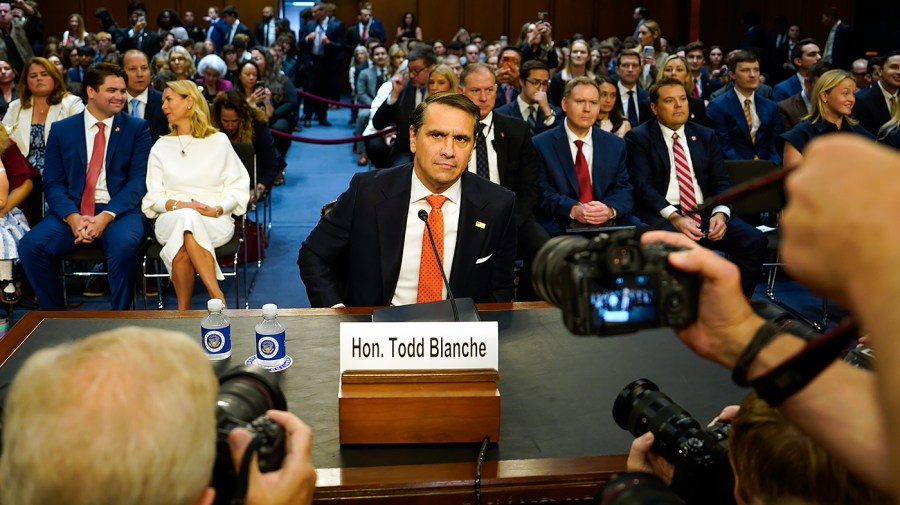
Tag: Confirmation

  • Trump Considers Withdrawing Blanche Nomination Amidst Senate Limbo

    Trump Considers Withdrawing Blanche Nomination Amidst Senate Limbo

    President Donald Trump has indicated a potential move to withdraw Todd Blanche’s nomination for Attorney General. This nomination has been stalled in the United States Senate since its submission in April 2026. The suggestion points to ongoing political maneuvering and growing frustration within Washington D.C. regarding executive appointments, particularly judicial ones. The potential withdrawal highlights the persistent challenges of judicial confirmations in the current political climate.

    The Eleventh Circuit covers Alabama, Florida, and Georgia. It handles a significant caseload. A vacant seat can strain the court’s resources and impact the pace of justice.

    The Stalled Nomination of Judge Blanche

    Todd Blanche’s nomination has faced an unusually protracted delay. The nomination was submitted by President Trump in April 2026. It has remained in what is commonly referred to as ‘Senate limbo’ since that time.

    Typically, judicial nominations move through the Senate Judiciary Committee within a few months. Blanche’s nomination has yet to receive a committee hearing. It has also not received a vote from the committee or the full Senate.

    Judge Blanche is a sitting federal district judge. The individual was nominated to fill a vacancy on the influential Eleventh Circuit. This court is critical for legal precedent in the southeastern United States.

    The specific details of the Senate’s hesitation have not been publicly disclosed. The lack of public explanation contributes to the perception of a stalled process. This delay prevents the administration from filling a critical judicial vacancy.

    Understanding Senate Confirmation Process

    The Senate confirmation process for presidential nominees is a critical aspect of American governance. It requires a majority vote in the Senate for most executive branch appointments. This includes cabinet secretaries, ambassadors, and federal judges.

    Nominations can face delays due to various factors. Partisan opposition is one common reason. Procedural hurdles can also cause slowdowns. A lack of legislative priority for a specific nomination can also contribute to delays.

    When a nomination remains in ‘limbo,’ it typically means one of two things. Either it has been referred to a Senate committee but has not yet received a hearing or a vote. Or, it has cleared committee but awaits a full Senate vote.

    Such delays can last for weeks or even months. They prevent the administration from filling key positions. This can impact government functionality and the efficiency of the judicial system.

    The process is designed to provide a check on executive power. It ensures that nominees are thoroughly vetted. However, it can also become a tool for political obstruction. This is especially true in periods of narrow partisan majorities.

    Historical Context of Judicial Nominations

    Judicial nominations have historically been contentious. The balance of power on federal courts is a significant political prize. Presidents often seek to appoint judges who align with their judicial philosophy.

    The Senate, in turn, scrutinizes these nominees. Senators consider qualifications, temperament, and judicial ideology. The process has become increasingly politicized over recent decades.

    Major shifts in court composition often follow presidential elections. The stakes are particularly high for lifetime appointments to federal appellate courts and the Supreme Court. The Eleventh Circuit is one of the busiest federal appellate courts.

    Past administrations have faced similar challenges. President George W. Bush encountered significant resistance to some judicial nominees. President Barack Obama also saw many of his nominees delayed or blocked.

    The current environment in 2026 continues this trend. The Senate’s narrow majority amplifies the impact of partisan divisions. Every vote becomes critical in the confirmation process.

    Implications of a Potential Withdrawal

    A presidential decision to withdraw a nomination is not unprecedented. It can occur for several reasons. A nominee’s inability to secure sufficient support is one common cause. The discovery of new information about the nominee can also lead to withdrawal.

    A shift in the administration’s policy objectives might also prompt such a move. In 2023, former President Joe Biden withdrew several judicial nominees. This occurred after prolonged Senate inaction on those nominations.

    In this instance, President Trump’s suggestion of a potential withdrawal holds multiple interpretations. It could be a tactic to pressure the Senate into action. The implication is that if the Senate does not act, they risk losing the opportunity to confirm this specific nominee.

    It might also be a prelude to nominating an alternative candidate. Such a candidate might be perceived as more likely to garner quicker approval. This move underscores the power dynamics between the executive branch and the legislative branch in the appointment process.

    A withdrawal could also signal a strategic recalibration by the White House. They might aim to conserve political capital. This capital could then be used for other legislative priorities or future nominations.

    Impact on Judicial Vacancies

    The continued vacancy on the Eleventh Circuit has practical consequences. It can increase the workload for the remaining judges. This can lead to delays in case processing. It can also impact the consistency of legal rulings.

    The Eleventh Circuit covers a vast geographic area. It addresses a wide range of complex legal issues. These include civil rights, environmental law, and business disputes.

    Filling judicial vacancies is a priority for any administration. It ensures the efficient functioning of the federal judiciary. Prolonged vacancies can create backlogs and undermine public confidence in the justice system.

    President Trump’s administration seeks to shape the federal judiciary. This involves appointing judges who interpret the Constitution in a specific manner. Delays like Blanche’s nomination impede this objective.

    Political Context in 2026

    The political landscape in 2026 continues to present challenges for presidential administrations. Filling key roles remains a complex endeavor. The Senate, currently with a narrow majority, faces increasing partisan divisions. These divisions significantly affect the confirmation process.

    This environment often leads to extended vetting periods. It also creates potential roadblocks for appointments. This applies even to nominations that might otherwise be considered routine.

    The current situation with Judge Blanche’s nomination highlights these ongoing tensions. Delays and potential withdrawals are becoming more common. This reflects the complexities of navigating legislative approval. This occurs particularly in a highly polarized political environment.

    The White House faces pressure to ensure its judicial appointments are confirmed efficiently. This is crucial for shaping the federal judiciary according to its vision. The executive branch must balance its desires with the realities of Senate procedure.

    Future of Judicial Appointments

    The trend of contentious judicial appointments is likely to continue. Both parties view judicial appointments as critical. They are seen as a means to influence legal and social policy for decades.

    Presidents will continue to seek nominees who align with their ideologies. The Senate will continue to exercise its constitutional role of advice and consent. This dynamic often results in prolonged battles over judicial seats.

    The possibility of a presidential withdrawal adds another layer to this dynamic. It can be a powerful negotiating tool. It can also signal a willingness to pivot to new strategies.

    The outcome for Judge Blanche’s nomination will set a precedent. It will illustrate the current state of play between the White House and the Senate. It will also show the limits of executive power in a divided government.

    The Broader Implications for Governance

    The challenges in confirming judicial nominees extend beyond individual appointments. They reflect broader issues in American governance. The ability of the government to function effectively depends on filling key positions.

    When the confirmation process becomes overly politicized, it can hinder governmental operations. This can affect the judiciary, the executive branch, and even the legislative agenda.

    The interaction between the President and the Senate is a foundational aspect of the U.S. system of checks and balances. When this interaction is strained, it impacts the entire system. The current situation with Judge Blanche is a microcosm of these larger tensions.

    The resolution of this specific nomination will be observed closely. It will offer insights into the strategies employed by both the White House and the Senate in 2026. It will also indicate the potential for future cooperation or continued gridlock.

    The President suggested. The Senate stalled. The judiciary waited. The nation watched.


  • Jay Clayton Confirmed as Director of National Intelligence

    Jay Clayton Confirmed as Director of National Intelligence

    Jay Clayton was confirmed as the Director of National Intelligence (DNI) by the U.S. Senate on Tuesday, July 28, 2026. This appointment places a former Chairman of the U.S. Securities and Exchange Commission (SEC) at the head of America’s 18 intelligence organizations. Clayton’s background in financial regulation and corporate law marks a departure from traditional intelligence community appointments.

    His new role involves advising President Donald Trump and coordinating the vast U.S. intelligence apparatus. The confirmation vote concluded a nomination process that spanned several weeks. Debates in the Senate focused on Clayton’s experience relevant to intelligence gathering and analysis.

    The Director of National Intelligence: A Critical Role

    The Director of National Intelligence holds a Cabinet-level position within the executive branch. The DNI serves as the principal advisor to the President, the National Security Council, and the Homeland Security Council on all intelligence matters. This office was established in 2004.

    The establishment of the DNI was a direct recommendation from the 9/11 Commission. Its purpose was to improve integration and information sharing among disparate intelligence agencies. This structural change aimed to prevent future intelligence failures by creating a central coordinating authority.

    Key responsibilities include overseeing and directing the National Intelligence Program budget. The DNI also establishes objectives and priorities for intelligence collection and analysis across the entire Intelligence Community. This role is central to shaping U.S. national security and foreign policy.

    The DNI’s authority extends to ensuring that intelligence agencies work together effectively. This involves setting strategic direction and fostering collaboration. The position demands a comprehensive understanding of global threats and domestic security concerns.

    The Intelligence Community’s Structure

    The U.S. Intelligence Community (IC) is a federation of 18 separate government agencies. These agencies work independently and collaboratively to gather and analyze intelligence. Their missions range from foreign intelligence to counterterrorism and cybersecurity.

    Agencies within the IC include the Central Intelligence Agency (CIA), the National Security Agency (NSA), the Defense Intelligence Agency (DIA), and components of the Federal Bureau of Investigation (FBI). Other members include intelligence elements from the Departments of State, Energy, and Treasury.

    Each agency has a specialized focus, contributing to the overall intelligence picture. The DNI’s role is to synthesize this diverse information. This ensures a unified and coherent intelligence assessment for policymakers.

    Jay Clayton’s Background and Expectations

    Jay Clayton previously served as the Chairman of the U.S. Securities and Exchange Commission from 2017 to 2020. During his tenure at the SEC, he focused on protecting investors, facilitating capital formation, and ensuring fair markets. He navigated complex financial regulations and oversaw enforcement actions.

    His experience managing a complex federal agency and navigating intricate regulatory landscapes is seen as a key asset for the DNI role. The SEC is a large organization with a broad mandate. Leading it required significant administrative and policy expertise.

    Prior to his government service, Clayton was a partner at Sullivan & Cromwell LLP. He specialized in mergers and acquisitions and capital markets. He advised on numerous high-profile transactions. His legal career provided extensive experience in international financial law and corporate governance.

    Critics of his nomination questioned his lack of direct intelligence operations experience. They argued that the DNI role requires a deep understanding of clandestine operations and intelligence tradecraft. Concerns were raised about his readiness to lead agencies with highly specialized and sensitive missions.

    Supporters emphasized his management acumen and ability to synthesize complex information. They highlighted his track record of leading a major regulatory body. His proponents argued that the DNI role is primarily one of management and coordination, for which Clayton is well-suited.

    From Wall Street to the Intelligence Community

    Clayton’s career trajectory moved from private legal practice to financial regulation. Now, he transitions to the national security sector. This path is unconventional for a DNI appointee. Most previous DNIs have had extensive backgrounds in intelligence or military service.

    His supporters suggest that an outsider’s perspective could be beneficial. A fresh approach might challenge existing paradigms within the intelligence community. This could lead to more innovative solutions for persistent problems.

    His experience in capital markets also provides a unique understanding of global financial systems. These systems are increasingly intertwined with national security concerns. Economic intelligence and financial warfare are growing areas of focus for intelligence agencies.

    Challenges and Priorities for the New DNI

    Clayton steps into the DNI role facing a complex global intelligence landscape. Ongoing geopolitical tensions present significant challenges. Regions like Eastern Europe, the Middle East, and the Indo-Pacific are sources of constant concern. The intelligence community must monitor these areas closely.

    The rise of cyber warfare is another critical issue. State-sponsored cyber attacks and criminal hacking groups pose threats to critical infrastructure, government systems, and private industry. The DNI must prioritize defenses and offensive capabilities in this domain.

    The proliferation of advanced technologies also presents challenges. Artificial intelligence, quantum computing, and biotechnology offer both opportunities and risks. Intelligence agencies must leverage these technologies while guarding against their misuse by adversaries.

    His priorities will likely include enhancing intelligence integration. This means improving how different agencies share information and coordinate operations. Seamless data flow is crucial for effective intelligence gathering and analysis.

    Adapting to evolving threats is another key priority. The nature of global threats changes rapidly. The DNI must ensure that the intelligence community remains agile and responsive. This requires continuous assessment and adjustment of strategies.

    Ensuring the timely delivery of actionable intelligence to President Trump and other policymakers is paramount. Decision-makers rely on accurate and current intelligence. The DNI is responsible for streamlining the intelligence pipeline from collection to presidential brief.

    Oversight and Public Trust

    The DNI is also responsible for overseeing intelligence community reforms. This includes addressing internal challenges within the agencies. Issues of data privacy are a constant concern in a digital age. Balancing national security with individual liberties is a delicate act.

    Ethical intelligence gathering is another area requiring attention. The DNI must ensure that all intelligence activities adhere to legal and ethical standards. This is crucial for maintaining both domestic and international legitimacy.

    Maintaining public trust is vital for the long-term effectiveness of the intelligence community. Transparency, where possible, and accountability are key components. Clayton’s leadership will be tested by the need to balance national security requirements with civil liberties.

    The DNI must also navigate the political environment in Washington D.C. This involves working with Congress on oversight matters and budget allocations. Building consensus and trust across the political spectrum is essential for the intelligence community’s mission.

    The Senate Confirmation Process

    The Senate confirmation process for Jay Clayton involved extensive hearings and deliberations. Senators questioned Clayton on his views regarding intelligence oversight. They probed his understanding of the scope of presidential authority in intelligence matters. His plans for addressing specific threats were also scrutinized.

    The vote was largely along party lines, reflecting the current political climate in Washington D.C. This partisan division is common for high-level executive appointments. It underscores the political nature of national security leadership roles.

    While specific vote counts were not immediately released, the confirmation demonstrates sufficient support in the Senate. This outcome allows the Trump administration to finalize its national security leadership team for the current term. The Intelligence Community now looks to Clayton for strategic direction.

    The confirmation process involves several stages. Nominees first undergo background checks. Then, they participate in hearings before relevant Senate committees, in this case, likely the Senate Intelligence Committee. Following committee approval, the nomination proceeds to a full Senate vote.

    Senators use these hearings to assess a nominee’s qualifications, policy views, and temperament. Public and closed-door sessions allow for detailed questioning. The process ensures a thorough vetting before a nominee can assume office.

    The final Senate vote confirms the President’s choice. This concludes a critical step in staffing the executive branch. It signals the official beginning of the appointee’s tenure.

    The Intelligence Community leadership. The national security apparatus. The oversight committees. The global intelligence landscape. The new Director of National Intelligence. Jay Clayton.