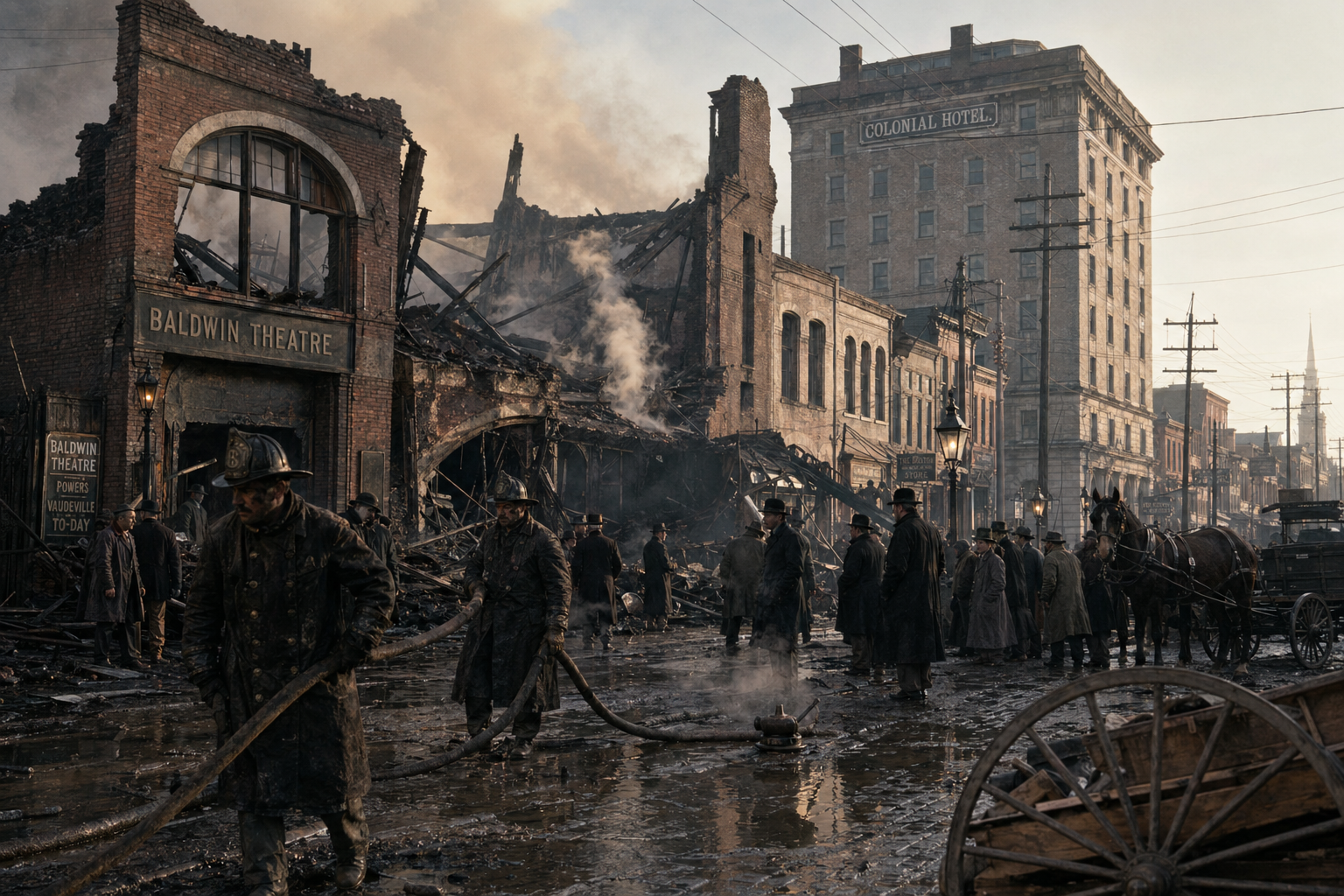
The year 1909 began with a disaster that should have broken Springfield’s spirit. Instead, it launched an era of gritty improvisation that would define the “Queen City” for decades. If the 1899 Tenth Ballot Heartbreak taught the city that it lacked ground, the night of January 6, 1909, taught it that even its most expensive thrones were fragile.
The Gilded Throne: The Baldwin’s Reign
Before it was a memory, the Baldwin Theatre was the undisputed cultural heart of the Ozarks. Built in 1891 at 318-322 St. Louis Street for $109,000 (roughly $3-4 million today), it was a multi-use commercial powerhouse. Named after a Mr. Baldwin who came from Cleveland to start a stove factory, the building housed dozens of offices and retail stores alongside its grand auditorium seating nearly 800.
For nearly twenty years, the Baldwin hosted the world. It saw literary giants, political rallies, and everything from Shakespearean tragedies to controversial spectacles like The Clansman – the Thomas Dixon play later adapted into Birth of a Nation and linked by contemporaries to racial violence in Springfield. The last person to grace its stage was journalist and lecturer Opie Read, who performed on the evening of January 5. No one knew that by the next morning, the preeminent cultural institution of Southwest Missouri would be reduced to a pile of brick and ash.
The Night of the Conflagration
The fire ignited in the early morning hours of January 6, 1909, in the theater’s boiler room. In an age of velvet draperies and oil-painted canvas scenery, the building was a tinderbox. According to the Springfield Fire Department’s documented history, the blaze was a total loss – the city’s equipment could not stop it.
The only thing that saved downtown was the Colonial Hotel next door. Built with innovative fireproof reinforced masonry, the hotel acted as a massive shield, preventing the flames from consuming the entire business district. The disaster exposed a painful gap in Springfield’s modernization: the sophisticated Queen City lacked the infrastructure to protect its own crown jewel.
The Phoenix and the Nomad
Springfield’s response was characteristically fast. According to the Landers Theatre’s documented history, plans for the replacement theater were announced just ten days after the Baldwin fell, and the Landers opened eight months later in September 1909 with advanced fire-resistant brick and terracotta. But while the indoor throne was being rebuilt, the city’s agricultural heart remained homeless.
From the early 1900s through the mid-1920s, what we now know as the Ozark Empire Fair lived through a nomadic era. Without a permanent headquarters, the event moved between various vacant lots and public squares. Prior fairs had been attempted sporadically but, as local historian Cheryl Kepes has noted, none of them ever took root where they were.
The Pickwick and Grand Era
By the late 1920s, this nomadic spirit found a semi-permanent home at the intersection of Pickwick Avenue and Grand Street – land that is now part of the Missouri State University campus.
This was the era of the Free Fair. During the Great Depression, civic leaders insisted on eliminating gate admission – a move focused on civic pride over profit, ensuring that struggling Ozark families could still gather without a financial burden. The site featured a makeshift racetrack for horse and early automotive races, serving as a living classroom for the region’s youth.
Finding the Foundation
The nomadic era finally reached its destination in 1937. Organizers secured land on Norton Road after a WPA grant was confirmed in 1936, with the Greene County Agricultural and Mechanical Society filing its charter on July 6, 1937.
On October 10, 1937, the fair opened at its permanent home. According to Ozarks Alive’s retrospective on the fair’s founding, it was a scrappy beginning – the first fair was so cold that exhibitors huddled in tents, and the grandstand was still a primitive wooden structure. But after decades of wandering, the Ozarks finally had a foundation that would not burn and could not be moved.
Next in the Series: The “Infrastructure Reckoning” of 1909 and the nomadic 1920s had proven that Springfield could survive anything. But in 1923, a new kind of monument would rise on St. Louis Avenue – one so massive, so exotic, and so permanent that it would reclaim the city’s title as the undisputed host of the Midwest. It was time for the Shrine Mosque.