Tag: Checks And Balances

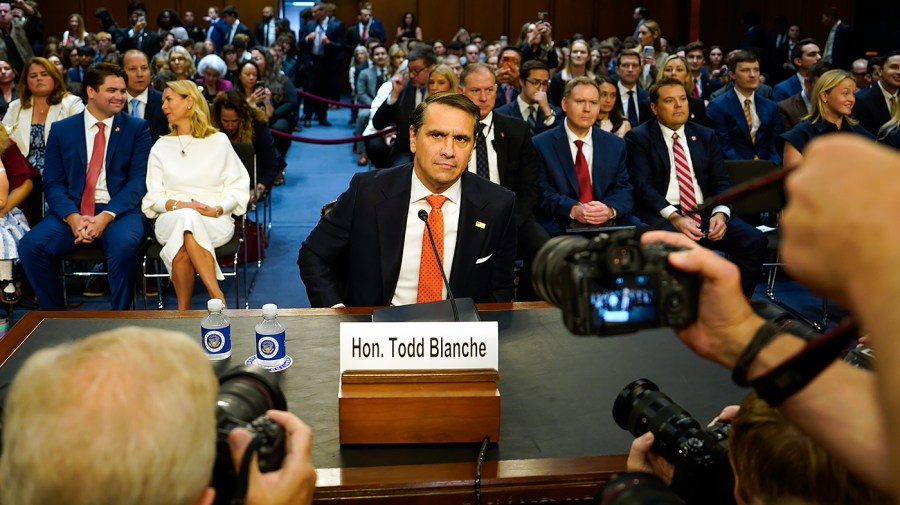
  • Trump Considers Withdrawing Blanche Nomination Amidst Senate Limbo

    Trump Considers Withdrawing Blanche Nomination Amidst Senate Limbo

    President Donald Trump has indicated a potential move to withdraw Todd Blanche’s nomination for Attorney General. This nomination has been stalled in the United States Senate since its submission in April 2026. The suggestion points to ongoing political maneuvering and growing frustration within Washington D.C. regarding executive appointments, particularly judicial ones. The potential withdrawal highlights the persistent challenges of judicial confirmations in the current political climate.

    The Eleventh Circuit covers Alabama, Florida, and Georgia. It handles a significant caseload. A vacant seat can strain the court’s resources and impact the pace of justice.

    The Stalled Nomination of Judge Blanche

    Todd Blanche’s nomination has faced an unusually protracted delay. The nomination was submitted by President Trump in April 2026. It has remained in what is commonly referred to as ‘Senate limbo’ since that time.

    Typically, judicial nominations move through the Senate Judiciary Committee within a few months. Blanche’s nomination has yet to receive a committee hearing. It has also not received a vote from the committee or the full Senate.

    Judge Blanche is a sitting federal district judge. The individual was nominated to fill a vacancy on the influential Eleventh Circuit. This court is critical for legal precedent in the southeastern United States.

    The specific details of the Senate’s hesitation have not been publicly disclosed. The lack of public explanation contributes to the perception of a stalled process. This delay prevents the administration from filling a critical judicial vacancy.

    Understanding Senate Confirmation Process

    The Senate confirmation process for presidential nominees is a critical aspect of American governance. It requires a majority vote in the Senate for most executive branch appointments. This includes cabinet secretaries, ambassadors, and federal judges.

    Nominations can face delays due to various factors. Partisan opposition is one common reason. Procedural hurdles can also cause slowdowns. A lack of legislative priority for a specific nomination can also contribute to delays.

    When a nomination remains in ‘limbo,’ it typically means one of two things. Either it has been referred to a Senate committee but has not yet received a hearing or a vote. Or, it has cleared committee but awaits a full Senate vote.

    Such delays can last for weeks or even months. They prevent the administration from filling key positions. This can impact government functionality and the efficiency of the judicial system.

    The process is designed to provide a check on executive power. It ensures that nominees are thoroughly vetted. However, it can also become a tool for political obstruction. This is especially true in periods of narrow partisan majorities.

    Historical Context of Judicial Nominations

    Judicial nominations have historically been contentious. The balance of power on federal courts is a significant political prize. Presidents often seek to appoint judges who align with their judicial philosophy.

    The Senate, in turn, scrutinizes these nominees. Senators consider qualifications, temperament, and judicial ideology. The process has become increasingly politicized over recent decades.

    Major shifts in court composition often follow presidential elections. The stakes are particularly high for lifetime appointments to federal appellate courts and the Supreme Court. The Eleventh Circuit is one of the busiest federal appellate courts.

    Past administrations have faced similar challenges. President George W. Bush encountered significant resistance to some judicial nominees. President Barack Obama also saw many of his nominees delayed or blocked.

    The current environment in 2026 continues this trend. The Senate’s narrow majority amplifies the impact of partisan divisions. Every vote becomes critical in the confirmation process.

    Implications of a Potential Withdrawal

    A presidential decision to withdraw a nomination is not unprecedented. It can occur for several reasons. A nominee’s inability to secure sufficient support is one common cause. The discovery of new information about the nominee can also lead to withdrawal.

    A shift in the administration’s policy objectives might also prompt such a move. In 2023, former President Joe Biden withdrew several judicial nominees. This occurred after prolonged Senate inaction on those nominations.

    In this instance, President Trump’s suggestion of a potential withdrawal holds multiple interpretations. It could be a tactic to pressure the Senate into action. The implication is that if the Senate does not act, they risk losing the opportunity to confirm this specific nominee.

    It might also be a prelude to nominating an alternative candidate. Such a candidate might be perceived as more likely to garner quicker approval. This move underscores the power dynamics between the executive branch and the legislative branch in the appointment process.

    A withdrawal could also signal a strategic recalibration by the White House. They might aim to conserve political capital. This capital could then be used for other legislative priorities or future nominations.

    Impact on Judicial Vacancies

    The continued vacancy on the Eleventh Circuit has practical consequences. It can increase the workload for the remaining judges. This can lead to delays in case processing. It can also impact the consistency of legal rulings.

    The Eleventh Circuit covers a vast geographic area. It addresses a wide range of complex legal issues. These include civil rights, environmental law, and business disputes.

    Filling judicial vacancies is a priority for any administration. It ensures the efficient functioning of the federal judiciary. Prolonged vacancies can create backlogs and undermine public confidence in the justice system.

    President Trump’s administration seeks to shape the federal judiciary. This involves appointing judges who interpret the Constitution in a specific manner. Delays like Blanche’s nomination impede this objective.

    Political Context in 2026

    The political landscape in 2026 continues to present challenges for presidential administrations. Filling key roles remains a complex endeavor. The Senate, currently with a narrow majority, faces increasing partisan divisions. These divisions significantly affect the confirmation process.

    This environment often leads to extended vetting periods. It also creates potential roadblocks for appointments. This applies even to nominations that might otherwise be considered routine.

    The current situation with Judge Blanche’s nomination highlights these ongoing tensions. Delays and potential withdrawals are becoming more common. This reflects the complexities of navigating legislative approval. This occurs particularly in a highly polarized political environment.

    The White House faces pressure to ensure its judicial appointments are confirmed efficiently. This is crucial for shaping the federal judiciary according to its vision. The executive branch must balance its desires with the realities of Senate procedure.

    Future of Judicial Appointments

    The trend of contentious judicial appointments is likely to continue. Both parties view judicial appointments as critical. They are seen as a means to influence legal and social policy for decades.

    Presidents will continue to seek nominees who align with their ideologies. The Senate will continue to exercise its constitutional role of advice and consent. This dynamic often results in prolonged battles over judicial seats.

    The possibility of a presidential withdrawal adds another layer to this dynamic. It can be a powerful negotiating tool. It can also signal a willingness to pivot to new strategies.

    The outcome for Judge Blanche’s nomination will set a precedent. It will illustrate the current state of play between the White House and the Senate. It will also show the limits of executive power in a divided government.

    The Broader Implications for Governance

    The challenges in confirming judicial nominees extend beyond individual appointments. They reflect broader issues in American governance. The ability of the government to function effectively depends on filling key positions.

    When the confirmation process becomes overly politicized, it can hinder governmental operations. This can affect the judiciary, the executive branch, and even the legislative agenda.

    The interaction between the President and the Senate is a foundational aspect of the U.S. system of checks and balances. When this interaction is strained, it impacts the entire system. The current situation with Judge Blanche is a microcosm of these larger tensions.

    The resolution of this specific nomination will be observed closely. It will offer insights into the strategies employed by both the White House and the Senate in 2026. It will also indicate the potential for future cooperation or continued gridlock.

    The President suggested. The Senate stalled. The judiciary waited. The nation watched.


  • House Rebukes Trump’s Iran War: A Constitutional Showdown

    House Rebukes Trump’s Iran War: A Constitutional Showdown

    On July 23, 2026, the United States House of Representatives cast a pivotal vote. The measure formally rebukes President Donald Trump’s recent military actions concerning Iran. This legislative maneuver directly challenges the President’s authority to commit U.S. armed forces to hostilities against Iran without explicit congressional authorization. The resolution specifically invokes the War Powers Act of 1973. It aims to restrict the executive branch’s ability to initiate or escalate military engagements.

    This action represents a significant challenge to the President’s foreign policy directives. It reignites a long-standing constitutional debate. This debate concerns the balance of power between the executive and legislative branches regarding military force. The vote carries implications for both domestic governance and international relations, particularly in the volatile Persian Gulf region.

    The War Powers Act of 1973: Congressional Assertion

    The War Powers Act of 1973, officially known as the War Powers Resolution, was enacted over President Richard Nixon’s veto. Its primary purpose was to limit the President’s ability to initiate or escalate military action abroad without congressional approval. The Act requires the President to notify Congress within 48 hours of deploying armed forces into hostilities or situations where hostilities are imminent.

    Furthermore, it mandates that the President terminate any use of military force within 60 days. This applies unless Congress has declared war or granted a specific authorization for the use of military force. A 30-day extension is allowed for troop withdrawal. The Act was a direct response to concerns that Presidents had bypassed Congress in committing U.S. forces to conflicts, notably during the Vietnam War. It sought to reassert Congress’s role in war-making.

    Despite its clear intent, the War Powers Act has faced consistent challenges. Various administrations have interpreted its provisions differently. Presidents have often argued that the Act infringes upon their constitutional role as Commander-in-Chief. Congress, in turn, has periodically sought to reassert its Article I powers to declare war and control military deployments. This ongoing tension defines the Act’s history.

    Constitutional Foundations of War Powers

    The U.S. Constitution divides war powers between the legislative and executive branches. Article I, Section 8, Clause 11, explicitly grants Congress the power to ‘declare war.’ This clause is a cornerstone of congressional authority over military engagements. It signifies the framers’ intent for collective decision-making on matters of national security. It also emphasizes the gravity of committing American lives to conflict.

    Conversely, Article II, Section 2, Clause 1, designates the President as ‘Commander-in-Chief of the Army and Navy of the United States.’ This role empowers the President to direct military operations once war has been declared or authorized. The tension between these two constitutional provisions forms the core of the current debate. Presidents often argue their inherent authority to protect U.S. interests and personnel, sometimes without prior congressional approval.

    Throughout U.S. history, this division of power has been a source of contention. Major conflicts, from Korea to Vietnam to the recent actions in the Middle East, have seen Presidents commit troops without a formal declaration of war. Instead, they have relied on resolutions, international agreements, or their inherent executive authority. The current House vote aims to clarify and reinforce Congress’s constitutional role in this delicate balance, pushing back against decades of executive expansion.

    House Challenges Executive War Powers in Iran

    The House vote on July 23, 2026, directly confronts this long-standing constitutional debate. Many members of Congress argue that President Trump has exceeded his constitutional mandate. They cite recent undisclosed military actions in the Persian Gulf region as evidence of this overreach. These actions, lawmakers contend, risk drawing the U.S. into a broader conflict without proper legislative oversight or public debate. This concern transcends party lines.

    The specific resolution considered calls for the immediate cessation of any U.S. military engagement in or against Iran that has not been authorized by Congress. It also includes a provision requiring the President to report to Congress on all current military activities in the region. This demand for transparency is a key component of the resolution. It aims to ensure Congress is fully informed of ongoing operations and can exercise its oversight responsibilities effectively.

    The push for this resolution reflects a growing concern among lawmakers. This concern centers on the executive branch’s expansive interpretation of its war powers. They believe that bypassing Congress undermines democratic principles and the system of checks and balances. The vote seeks to send a clear message: Congress must reclaim its constitutional duty in matters of war and peace, reasserting its authority as a co-equal branch of government.

    Bipartisan Concern Fuels Resolution

    Reports indicate that the measure garnered significant bipartisan support. Both Democratic and Republican lawmakers expressed concerns about the potential for escalating conflict. They also voiced worry over the perceived lack of transparency surrounding recent operations. This bipartisan consensus underscores the gravity of the issue, transcending typical party divisions and highlighting a shared commitment to constitutional order.

    Representative Elara Vance (D-NY) stated, “This is not about party; it’s about principle. Congress must reclaim its constitutional duty to authorize war.” Similarly, Senator Marcus Thorne (R-TX), known for his vocal criticism of executive overreach, added, “No President, regardless of party, should bypass the people’s representatives on matters of war and peace.” These statements highlight a shared commitment to constitutional order over partisan loyalty.

    The broad support for the resolution signals a collective legislative effort to assert congressional authority. It also reflects a desire to prevent unilateral executive action that could have far-reaching consequences for national security and international stability. The bipartisan nature of the challenge makes it particularly potent. It demonstrates a unified front against perceived executive overreach, making the message to the White House unmistakable.

    Implications for U.S. Foreign Policy and Executive Power

    The outcome of this vote holds significant implications for U.S. foreign policy and the future scope of executive power. If the resolution passes and gains traction, it could force the Trump administration to reconsider its approach to military engagements. It could establish a precedent that strengthens congressional oversight in future conflicts. This shift would mark a notable change from recent decades, where executive power in foreign policy often expanded.

    Internationally, this congressional action sends a message to allies and adversaries alike. It signals that U.S. military action, particularly in sensitive regions like the Persian Gulf, requires broad domestic consensus. This could impact diplomatic efforts and the perception of American leadership. Allies might view it as a return to more predictable foreign policy, while adversaries might interpret it as a sign of internal division, potentially altering their strategic calculations.

    For the President, a formal rebuke from Congress could limit his operational flexibility. It might necessitate greater consultation with Capitol Hill before deploying forces or engaging in hostilities. This would represent a significant check on the Commander-in-Chief role. It would force a more collaborative approach to national security decisions. The resolution’s passage would be a win for legislative power. It would be a constraint on executive discretion in military matters.

    Previous Challenges to Presidential War Powers

    The current House action is not an isolated event. Throughout history, Congress has periodically attempted to rein in presidential war powers. In the aftermath of the Korean War, for instance, debates intensified over presidential authority to commit troops without a formal declaration. The Vietnam War further solidified the perceived need for legislative checks, leading directly to the War Powers Act of 1973.

    More recently, congressional debates surrounded military actions in Libya in 2011 and Syria in 2013 and 2018. In each instance, lawmakers questioned the executive’s legal basis for intervention without explicit congressional authorization. These past challenges, while not always leading to successful legislative restraints, built a foundation of concern. They highlighted a recurring pattern of executive action preceding formal congressional consent. The July 2026 vote draws upon this history.

    The current resolution against President Trump’s actions in Iran therefore fits into a broader historical narrative. It is a continuous struggle between the branches for control over the ultimate decision of war and peace. Each challenge, successful or not, contributes to the evolving interpretation of constitutional war powers. This ongoing dialogue shapes the framework within which the U.S. engages with the world. It underscores the enduring relevance of the framers’ original intent.

    The Future of U.S. Military Engagements

    The outcome of the House vote could reshape the future landscape of U.S. military engagements. If the resolution passes both chambers and withstands a potential presidential veto, it could establish a new precedent. This precedent would demand more robust congressional involvement in decisions to use military force. It would compel a return to a more deliberative process for deploying American troops abroad.

    Such a shift would mean that future Presidents, regardless of party, would face greater scrutiny. They would need to build stronger cases for military action to secure congressional approval. This could lead to fewer unilateral interventions and a greater reliance on diplomacy and international coalitions. The emphasis would shift from executive prerogative to legislative consensus. This would be a significant rebalancing of power.

    The debate surrounding this resolution also highlights the critical role of an informed public. As details of military actions become more transparent, public discourse intensifies. This increased transparency can pressure lawmakers to act. It can also hold the executive accountable for its decisions. The intertwining of constitutional authority, public opinion, and international relations will define the path forward for U.S. military policy. It promises a more scrutinized approach to global conflict.

    Lawmakers debated. Constituents watched. The world observed. The vote determined the balance of power. The constitutional framework was tested. The future of war powers was on the line. The implications were vast. The decision resonated. The House acted. The President reacted. The nation considered. The world took note.

    Congress.


  • Supreme Court Expands Presidential Power – Implications for Top Officials

    Supreme Court Expands Presidential Power – Implications for Top Officials

    A Redefinition of Executive Authority

    The United States Supreme Court recently issued a landmark decision that significantly expands the President’s authority to remove high-level officials from their positions. This ruling fundamentally alters the balance of power within the executive branch, granting the President greater control over federal agencies and the individuals leading them. The implications extend to various independent agencies and the civil service system, sparking immediate debate among legal experts and political observers.

    This decision, delivered in 2026, represents a substantial reinterpretation of the separation of powers doctrine as it applies to presidential appointments and removals. It consolidates power within the Oval Office, potentially allowing future administrations to more readily shape the federal bureaucracy to align with their policy objectives.

    Historical Context of Presidential Removal Powers

    The President’s power to remove executive branch officials has been a subject of constitutional debate since the early days of the republic. Article II of the U.S. Constitution outlines the President’s power to appoint officers, but it is silent on the power of removal. This ambiguity has led to centuries of legal interpretation and legislative action.

    Key historical cases have shaped this understanding. The 1789 debates in the First Congress established an early precedent for presidential removal authority. Later, the 1926 case of Myers v. United States affirmed the President’s broad power to remove executive officers appointed with Senate consent. However, the 1935 case of Humphrey’s Executor v. United States introduced limitations, establishing that Congress could create independent agencies whose heads could only be removed for cause, thereby protecting them from arbitrary presidential dismissal.

    More recently, the 1988 case of Morrison v. Olson upheld the ‘for cause’ removal protection for independent counsels, further cementing the idea of congressional limits on presidential removal power for certain officials. These precedents created a complex legal landscape where some officials were insulated from presidential will, designed to ensure independent decision-making in areas like financial regulation, law enforcement, and consumer protection.

    The Supreme Court’s 2026 Ruling

    The Supreme Court’s 2026 decision revisited these foundational principles. The specific case involved a challenge to the removal protections afforded to an official within a particular federal agency. The Court’s majority opinion articulated a broad interpretation of presidential authority, emphasizing the unitary executive theory.

    The ruling effectively curtails Congress’s ability to impose ‘for cause’ removal restrictions on a wider range of executive branch officials. It posits that such restrictions unduly infringe upon the President’s constitutional duty to ensure that laws are faithfully executed. The Court’s reasoning focused on the President’s accountability to the public and the need for direct control over the executive apparatus.

    Justice Elena Kagan, in a dissenting opinion, argued that the decision undermines the historical role of independent agencies and risks politicizing crucial governmental functions. She highlighted the intent behind ‘for cause’ provisions: to shield certain offices from direct political pressure, allowing them to make impartial decisions based on expertise and law.

    Impact on Federal Agencies

    This ruling has direct and immediate consequences for numerous federal agencies. Agencies previously structured with independent leadership, such as certain regulatory bodies and commissions, may now find their leaders more vulnerable to presidential removal. This could lead to a significant shift in the operational independence of these entities.

    For example, the heads of agencies responsible for financial stability, environmental protection, or public health could face increased pressure to align with the President’s agenda, potentially compromising their ability to act as non-partisan arbiters. The decision could also affect the morale and career stability of federal employees who serve under these officials.

    The Unitary Executive Theory

    The Supreme Court’s decision strongly aligns with the unitary executive theory, a legal doctrine asserting that the President possesses all executive power, without exception or limitation, unless explicitly granted to another branch by the Constitution. Proponents of this theory argue that it is essential for presidential accountability and effective governance.

    Opponents, however, contend that an unchecked unitary executive can lead to abuses of power and undermine the checks and balances designed by the framers of the Constitution. They argue that independent agencies serve a vital role in providing expertise and stability, protecting certain functions from the ebb and flow of political tides.

    Political and Legal Repercussions

    The political repercussions of this ruling are substantial. The current administration, led by President Joseph R. Biden, Jr., now possesses enhanced power over appointments and removals. This increased authority could influence policy implementation across various sectors, from economic regulation to foreign policy.

    Future administrations will also inherit this expanded power, potentially leading to more rapid and sweeping changes in federal leadership and policy direction. This could intensify political polarization, as each new President seeks to exert greater control over the bureaucracy.

    From a legal perspective, the decision invites further challenges regarding the precise boundaries of presidential power. While the Court has clarified certain aspects of removal authority, new questions may arise concerning the definition of ‘principal officers’ versus ‘inferior officers’ and the extent to which Congress can still insulate certain functions through other means.

    Checks and Balances in a New Era

    The ruling prompts a reevaluation of the system of checks and balances. While the President’s power has expanded, Congress retains its legislative authority, including the power to create and fund agencies. The judiciary, through its power of judicial review, continues to serve as an arbiter of constitutional disputes.

    However, the direct control over executive personnel afforded by this decision could make it more challenging for Congress to hold agencies accountable independently of the President. This places a greater onus on congressional oversight committees and the legislative process to scrutinize executive actions.

    Public opinion and media scrutiny will also play a critical role in monitoring the exercise of this expanded presidential power. Transparency in appointments and removals, as well as clear justifications for such actions, will be crucial in maintaining public trust.

    Looking Ahead

    The Supreme Court’s 2026 decision marks a significant moment in American constitutional law. It reshapes the relationship between the President, federal agencies, and Congress, with long-term implications for governance and public policy. The ruling underscores the dynamic nature of constitutional interpretation and the continuous evolution of governmental structure.

    Legal scholars will analyze the nuances of the majority and dissenting opinions for years to come. Policymakers will grapple with how to adapt legislative frameworks to this new legal reality. The public will observe how this enhanced presidential power is exercised and its effects on the daily operations of government.

    Administrations will assert this new authority. Congress will seek new avenues of oversight. The courts will hear fresh challenges.

    The balance shifts.