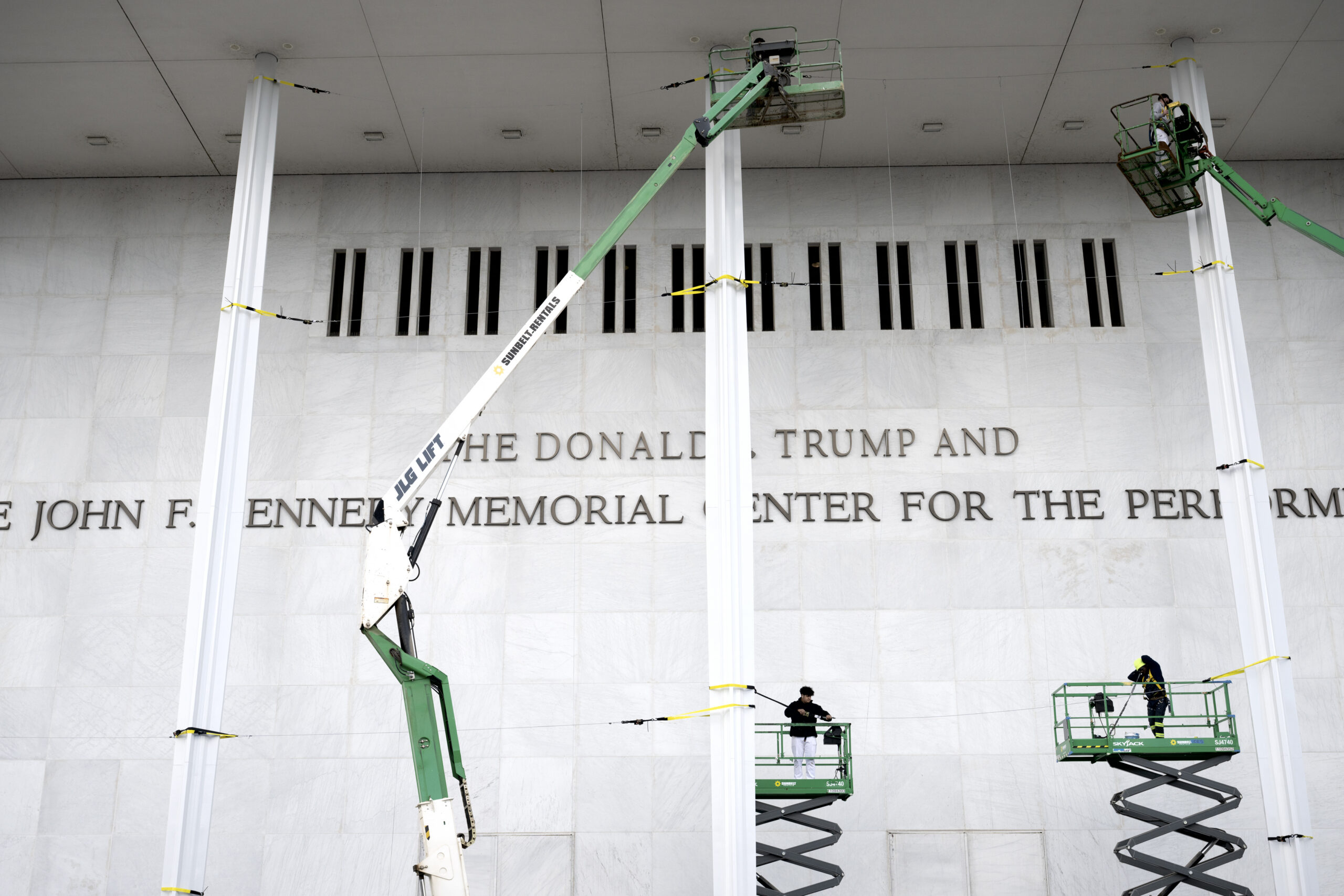
In June 2026, the John F. Kennedy Center for the Performing Arts formally petitioned a federal appellate court to halt the court-ordered removal of Donald Trump’s name from its facade. The Board of Trustees is seeking an emergency injunction to keep the 45th and 47th president’s name etched in stone while it appeals a controversial lower court decision. The legal maneuver is not an endorsement of a political figure. It is a defense of institutional autonomy.
The conflict began when a coalition of cultural activists successfully sued to mandate the erasure of Trump’s name from the national cultural center. A federal district judge agreed, citing novel arguments about public space and community injury. Now, the Kennedy Center is fighting back.
What looks like a modern political skirmish is actually a profound legal battle over who controls the history recorded on federal monuments. The Board of Trustees argues that stripping a former president’s name violates internal governance mandates and sets a dangerous precedent. If a federal judge can order the removal of one president’s name today, the board argues, no historical marker is safe tomorrow.
The Emergency Injunction and the D.C. Circuit
The legal mechanics of the dispute are moving rapidly through the federal pipeline. The Kennedy Center’s legal team filed an emergency motion for a stay pending appeal in the U.S. Court of Appeals for the District of Columbia Circuit. The goal is simple.
Stop the chisels.
The lower court had given the Center a strict deadline to begin the physical removal of the lettering from the marble facade. The Board of Trustees refused to comply without exhausting all appellate options. They argue that the physical alteration of the building constitutes irreparable harm to the institution’s historical record.
The D.C. Circuit is uniquely positioned to handle this. The court routinely adjudicates disputes involving federal agencies, national monuments, and administrative law. The Kennedy Center occupies a unique space in this ecosystem. It is a public-private partnership, receiving federal appropriations for building maintenance while relying on private philanthropy for its artistic programming.
This hybrid status complicates the legal landscape. The plaintiffs in the lower court argued that because the building is maintained by the National Park Service, the public has a right to dictate its inscriptions. The Board counters that curation and naming rights fall strictly under the purview of the Trustees.
A Monument Built on Presidential Protocol
To understand the stakes, one must understand the architecture of the institution. The Kennedy Center is not just a theater. It is a living memorial. Its relationship with the American presidency is baked into its foundation.
The concept was born in 1958 when President Dwight D. Eisenhower signed the National Cultural Center Act. President John F. Kennedy championed the project, raising funds and elevating its national profile. After Kennedy’s assassination in 1963, Congress passed bipartisan legislation renaming the planned structure in his honor. President Lyndon B. Johnson presided over its opening in 1971.
Architect Edward Durell Stone designed the massive structure. Italy donated 3,700 tons of Carrara marble for its construction. From the moment the doors opened, presidential protocol dictated its operations.
Every sitting president serves as an honorary chair of the Kennedy Center. Every president’s legacy is intertwined with the building’s history. Presidential boxes overlook the stages. Presidential names are inscribed on donor walls and historical plaques. The inclusion of Donald Trump is a matter of established institutional routine, not a unique endorsement.
Removing a name breaks a half-century of unbroken protocol.
The Lower Court’s Unprecedented Ruling
The crisis was triggered by a highly coordinated legal campaign. A coalition of local activists and national cultural watchdogs filed suit in the U.S. District Court for the District of Columbia. Their argument was aggressive and unprecedented.
They claimed that the continued presence of Donald Trump’s name on a federally maintained living memorial constituted an ongoing “public injury.” The plaintiffs argued that the facade of a national cultural center must reflect the prevailing values of the public that funds its maintenance.
Legal observers expected the case to be dismissed on standing. It was not.
The district judge issued a sweeping ruling in favor of the coalition. The judge determined that the Kennedy Center’s mandate to serve as a national cultural unifier superseded its internal naming protocols. The order mandated the prompt removal of the specific inscriptions bearing Trump’s name.
“The mandate of a living memorial is to elevate the human spirit, not to anchor it to figures who actively subvert the cultural cohesion the institution was built to foster. The facade must reflect the highest ideals of the republic.”
The ruling sent shockwaves through the museum and memorial community. It introduced a subjective legal standard, “cultural cohesion”, into the management of historical markers.
The Board of Trustees Draws a Line
The Kennedy Center Board of Trustees did not hesitate to appeal. The board is composed of prominent philanthropists, corporate leaders, and government officials. They are not political activists. They are institutional guardians.
The board’s defense rests on the principle of institutional neutrality. A living memorial cannot function if its historical record is subjected to the shifting winds of judicial preference. The record must remain static, even when the politics are volatile.
If the lower court’s ruling stands, the board argues, the Kennedy Center will face endless litigation. Activist groups from across the political spectrum will file suits demanding the removal of names they find objectionable. The names of Richard Nixon, Bill Clinton, or George W. Bush could be targeted next based on newly defined standards of “public injury.”
The facade of the Kennedy Center would become a dry-erase board, constantly wiped clean by federal judges.
The Trustees argue that the First Amendment protects the institution’s right to curate its own historical and philanthropic markers without government interference. Even though the building is federal property, the curation of the memorial is an expressive act protected from judicial editing.
The Philanthropic Ripple Effect
Beyond the philosophical arguments, the Kennedy Center faces a massive financial threat. The institution survives on private philanthropy.
Naming rights are the currency of high-level fundraising. When donors give $10 million, $20 million, or $50 million to an institution, they expect permanence. The 2019 opening of the REACH, a $250 million expansion of the Kennedy Center, was funded entirely by private donations. Many of those donations were secured with promises of architectural recognition.
The lower court’s ruling destroys the guarantee of permanence. If a federal judge can order a former president’s name removed from the facade, no donor’s name is safe. Future boards could face lawsuits demanding the removal of corporate sponsors or wealthy philanthropists based on shifting public sentiment.
The Board of Trustees made this explicit in their appellate brief. They warned the D.C. Circuit that the lower court’s ruling creates a “chilling effect” on national philanthropy. Why would a donor write a massive check for a naming right that can be voided by a district judge a decade later?
The defense of Trump’s name is, in practical terms, a defense of the Center’s endowment.
The Intersection of Stone and State
The battle over the Kennedy Center facade is part of a broader cultural war over architecture and memory. Throughout the 2020s, institutions across the country grappled with the legacy of historical figures. Statues were removed. Buildings were renamed. Universities scrubbed their campuses of controversial founders.
But the Kennedy Center case is fundamentally different.
This is not about a figure from the 19th century. This is about a modern president. Furthermore, the Kennedy Center is not a private university. It is a federal living memorial explicitly designed to interact with the executive branch.
The attempt to retroactively edit the architectural record of a living memorial crosses a new legal threshold. It moves the debate from the curation of distant history to the active censorship of recent political reality.
The Next Legal Steps
The D.C. Circuit will now weigh the emergency request for a stay. If granted, the name will remain on the facade while the full appeal is argued. If denied, the Kennedy Center will be forced to physically alter the building while the legal battle continues, creating a chaotic and highly visible architectural scar.
Legal experts anticipate the case could ultimately reach the Supreme Court. The questions it raises about government speech, public forums, and the autonomy of public-private partnerships are entirely unresolved in current jurisprudence.
For now, the Kennedy Center waits. The marble remains untouched. The Potomac flows past the grand terraces. The institution continues to host symphonies, ballets, and operas inside, while a profound battle over its identity rages outside.
Lawyers drafted briefs. Activists organized protests. Judges reviewed precedents. The modern political machine demanded erasure.
Stone.