Tag: art

  • Biennale Chief Slams EU – Funding Cut Over Russia’s Art Exhibition Presence

    Biennale Chief Slams EU – Funding Cut Over Russia’s Art Exhibition Presence

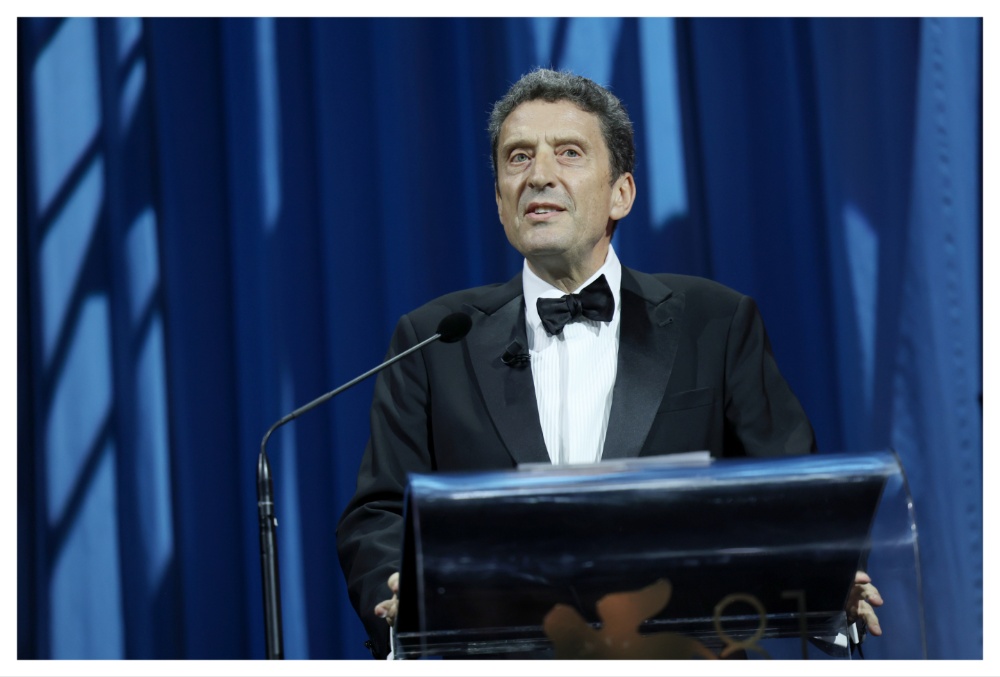
    A Biennale chief expressed strong disapproval of the European Union’s decision to withdraw funding from an art exhibition due to Russia’s participation. The chief’s comments, delivered during a film festival press conference, articulated a sense of abandonment and frustration regarding the EU’s stance on cultural engagement amidst geopolitical tensions. This incident underscores the complex challenges faced by international cultural institutions in balancing artistic freedom with political considerations.

    The withdrawal of financial support by the EU has significant implications for the exhibition’s operational capacity and future programming. It brings to the forefront the debate over whether cultural events should remain insulated from political conflicts or if they bear a responsibility to reflect prevailing international sentiments.

    The European Union’s Stance on Russian Cultural Presence

    The European Union has maintained a firm stance against Russia following the 2022 invasion of Ukraine. This position has led to widespread sanctions across various sectors, including finance, trade, and cultural exchange. The EU’s policy aims to isolate Russia on the international stage and pressure its government to cease military actions.

    Cultural institutions receiving EU funding are often expected to align with these broader political objectives. The decision to withdraw funding from the Biennale over Russia’s presence reflects this overarching policy. It signals a clear message that association with official Russian entities, even in cultural contexts, may lead to financial repercussions.

    This approach has been a point of contention within the cultural community. Some argue for the importance of maintaining cultural bridges, even during times of conflict, believing art can foster understanding. Others contend that engagement with state-sponsored Russian culture legitimizes the current regime.

    The Biennale’s Position and Reaction

    The Biennale chief articulated a different perspective. The chief emphasized the institution’s role in promoting artistic dialogue and cultural exchange without political censorship. The statement, ‘They are abandoning us,’ conveyed a feeling of betrayal and a lack of support for the Biennale’s mission.

    The chief’s comments suggest a belief that cultural events should transcend political divides. Such institutions often strive to be platforms for diverse voices and perspectives, including those from nations in geopolitical conflict. The withdrawal of funds is seen as undermining this fundamental principle.

    This reaction highlights the tension between the EU’s political objectives and the perceived autonomy of cultural organizations. The Biennale, as an international event, aims to bring together artists and audiences from around the globe, regardless of their national affiliations.

    Impact on the Art Exhibition

    The immediate impact of the EU’s funding withdrawal is financial. Cultural events, especially large-scale international exhibitions like the Biennale, rely heavily on diverse funding streams. EU grants often cover significant operational costs, including logistics, artist support, and public programming.

    Loss of this funding can lead to reduced scope, cancellation of specific projects, or even the overall viability of the exhibition. It forces organizers to seek alternative financial support, which may not be readily available or sufficient to cover the shortfall.

    Beyond the financial aspect, there is a reputational impact. Such controversies can overshadow the artistic content of the exhibition, shifting public attention from the art itself to the political dispute. This can detract from the event’s primary purpose of showcasing contemporary art.

    Logistical Challenges and Artistic Freedom

    The logistical challenges posed by a sudden funding cut are substantial. Contracts with artists, venues, and service providers may need to be renegotiated or terminated. This can create a ripple effect, impacting numerous individuals and organizations involved in the exhibition.

    Furthermore, concerns arise about artistic freedom. If funding is contingent on political alignment, it could lead to self-censorship or a reluctance to include artists or themes deemed politically sensitive. This compromises the integrity and independence of artistic expression, a core value for many cultural institutions.

    The incident raises questions about the future of international cultural collaboration in a fragmented geopolitical landscape. It challenges cultural leaders to find new models of funding and engagement that protect artistic autonomy while navigating complex global politics.

    Cultural Diplomacy and Its Evolving Role

    Cultural diplomacy traditionally serves as a tool for fostering understanding and building bridges between nations. It often operates on the premise that shared cultural experiences can transcend political differences and promote dialogue.

    However, the current geopolitical climate has complicated this role. Many governments, including the EU, now view cultural engagement as an extension of their foreign policy. This means that cultural events and exchanges are increasingly scrutinized for their potential to align with or undermine national interests.

    The Biennale incident exemplifies this shift. What might once have been considered a purely cultural decision, to include artists from a particular nation, is now imbued with significant political meaning. This makes the work of cultural institutions more challenging and politically charged.

    The Dilemma of Engagement vs. Isolation

    The dilemma faced by cultural organizations is stark: should they engage with artists and institutions from politically contentious nations to maintain cultural dialogue, or should they join in the isolation efforts to align with broader political goals? Both choices carry significant consequences.

    Engagement can be seen as providing a platform or legitimacy to regimes deemed problematic. Isolation, however, risks cutting off avenues for independent voices and potentially alienating populations who may not support their government’s actions. It also deprives audiences of diverse artistic perspectives.

    The Biennale chief’s frustration stems from this very dilemma. The chief perceives the EU’s action as forcing a choice that undermines the institution’s fundamental mission of universal cultural exchange.

    Historical Precedents of Political Influence on Art

    The intersection of politics and art is not new. Throughout history, art has been used for propaganda, protest, and diplomacy. Governments have often funded, censored, or influenced artistic production to serve their agendas.

    During the Cold War, cultural exchange programs were a significant battleground for ideological influence. Both the United States and the Soviet Union used art, music, and film to project their respective values and systems.

    More recently, boycotts and protests against cultural events involving certain nations have become more common. These actions reflect a growing belief that cultural activities cannot, and should not, be entirely separate from political ethics and human rights concerns.

    The Role of International Film Festivals

    The press conference where the Biennale chief made the statements was held during a film festival. Film festivals themselves are often sites of cultural diplomacy and political discourse. They provide platforms for filmmakers to address social and political issues, often sparking international debate.

    The choice of this venue for the chief’s remarks highlights the interconnectedness of various cultural sectors. It underscores how major cultural events, whether art exhibitions or film festivals, are increasingly becoming arenas where geopolitical tensions play out.

    The presence of such a high-profile figure from another major cultural institution at a film festival to voice these concerns indicates a broader solidarity within the arts community regarding these challenges.

    Future of EU Cultural Funding Policies

    This incident may prompt a reevaluation of the European Union’s cultural funding policies. The EU’s commitment to cultural diversity and artistic freedom is often stated, but these principles are tested when confronted with geopolitical realities.

    There may be calls for clearer guidelines on how cultural institutions should navigate relationships with countries under sanctions. Alternatively, some may advocate for a more nuanced approach that allows for cultural engagement even when political relations are strained.

    The outcome of this debate will shape the landscape of European cultural funding for years to come. It will determine the degree of autonomy cultural institutions can expect and the extent to which their programming must align with the EU’s foreign policy objectives.

    Challenges for Cultural Institutions

    Cultural institutions face increasing pressure to demonstrate social and political responsibility. Donors, audiences, and governments often expect them to take stands on contemporary issues, including human rights, environmental concerns, and international conflicts.

    This pressure can be challenging for institutions whose primary mission is artistic presentation and cultural exchange. They must navigate a complex web of expectations from various stakeholders, often with conflicting demands.

    The Biennale chief’s lament about being ‘abandoned’ encapsulates the precarious position these organizations find themselves in. They require financial support to operate, but that support increasingly comes with political conditions that can compromise their independence.

    The Broader Debate: Art, Politics, and Morality

    The core of this controversy lies in the enduring debate about the relationship between art, politics, and morality. Can art exist in a morally neutral space, or is it inherently intertwined with the values and actions of its creators and patrons?

    For many, art has a moral imperative, and engaging with entities deemed morally reprehensible is unacceptable. For others, art’s power lies in its ability to transcend such judgments, offering a universal language that can bridge divides.

    The EU’s decision reflects the former perspective, prioritizing moral and political alignment over unrestricted cultural exchange. The Biennale chief’s reaction reflects the latter, advocating for the autonomy and universality of art.

    This ongoing philosophical debate has practical consequences for funding, programming, and the very definition of cultural institutions in the 21st century. It forces a reckoning with how societies choose to engage with art in times of global tension.

    Diplomats gathered. Artists gathered. Policy-makers gathered. Debate.


  • Ben Folds Testifies Against Trump’s Kennedy Center Takeover – Art and Propaganda

    Ben Folds Testifies Against Trump’s Kennedy Center Takeover – Art and Propaganda

    Musician Ben Folds recently testified before a Congressional committee, expressing strong concerns over the alleged politicization of the John F. Kennedy Center for the Performing Arts by President Donald Trump’s administration. Folds argued that when art becomes a tool for political agendas, it ceases to be genuine expression and instead transforms into propaganda, undermining its fundamental purpose and integrity. His testimony highlighted growing anxieties within the cultural sector regarding government influence over artistic institutions.

    The musician’s appearance before legislators brought a cultural debate into the political arena. This discussion focused on the role of national cultural institutions in a democratic society. It also examined the boundaries between governmental support and undue influence.

    The Heart of the Controversy: Kennedy Center’s Role

    The John F. Kennedy Center for the Performing Arts, located in Washington, D.C., serves as the nation’s living memorial to President John F. Kennedy. It is a prominent cultural institution, presenting a wide array of performing arts. The Center also promotes arts education and fosters cultural diplomacy.

    Its unique status as both a federal bureau and a private non-profit organization often places it at the intersection of government and culture. This dual nature can lead to complex relationships with political administrations. It also raises questions about its autonomy.

    President Trump’s administration has faced scrutiny over its approach to cultural institutions. Critics have voiced concerns about perceived attempts to align these institutions with specific political narratives. These actions, they argue, compromise the institutions’ artistic independence.

    Ben Folds’ Artistic Background and Advocacy

    Ben Folds is widely recognized for his work as a singer, songwriter, and multi-instrumentalist. He rose to prominence as the frontman of the band Ben Folds Five. His career has spanned decades, encompassing rock, pop, and classical music.

    Beyond his musical output, Folds has been an advocate for arts education and funding. He has previously served on the President’s Committee on the Arts and Humanities. This experience provided him with direct insight into the relationship between government and the arts.

    His testimony before Congress was not his first foray into policy discussions. Folds has often used his platform to champion the value of artistic expression. He emphasizes its critical role in societal well-being.

    Testimony Before Congress: ‘Propaganda’ Concerns

    Folds delivered his testimony to a Congressional committee investigating the administration’s interactions with the Kennedy Center. He articulated a clear distinction between art and propaganda. Art, he maintained, must remain independent to be authentic.

    His central argument was succinct:

    “When you politicize art, you’ve got propaganda.”

    This statement underscored his belief that governmental control over artistic content or direction fundamentally alters its nature. It shifts art from independent expression to a tool for state messaging.

    The musician elaborated on the potential long-term damage of such politicization. He suggested it could erode public trust in cultural institutions. It might also stifle creative freedom among artists.

    The Impact of Politicization on Art

    Politicization, in Folds’ view, can manifest in various ways. It might involve directing funding based on political alignment. It could also include influencing programming decisions. Furthermore, it might entail using cultural events for overt political messaging.

    Such actions, he argued, undermine the universal appeal of art. Art often thrives on its ability to transcend political divides. It can offer diverse perspectives and foster critical thought. When it becomes partisan, it loses this vital function.

    Folds stressed that cultural institutions like the Kennedy Center must serve all citizens. Their mission should be to enrich the national cultural landscape. This mission is compromised when they are perceived as serving a particular political agenda.

    Historical Precedents and Broader Implications

    The debate over art and politics is not new in American history. Throughout various administrations, there have been discussions about government funding and oversight of the arts. These discussions often involve balancing artistic freedom with public accountability.

    The 1930s saw the Federal Art Project, part of the New Deal, which employed artists during the Great Depression. While providing vital support, it also sparked debates about government patronage and artistic independence. Later, during the Cold War, cultural diplomacy became a key tool of U.S. foreign policy. This era also raised questions about the use of art for national interests.

    More recently, controversies surrounding the National Endowment for the Arts (NEA) have periodically flared. These debates often center on content deemed controversial by some political factions. They highlight the ongoing tension between artistic expression and public values.

    Global Perspectives on State-Sponsored Art

    Internationally, the concept of state-sponsored art carries diverse connotations. In many authoritarian regimes, art is explicitly used as a tool of the state. It serves to promote official ideologies and maintain social control. This is the essence of propaganda.

    Folds’ testimony implicitly drew a parallel to these models. He warned against any moves that would push American cultural institutions in a similar direction. The independence of art is considered a hallmark of democratic societies.

    The musician’s remarks resonated with those who view art as a crucial component of civil society. They see it as a space for open dialogue and critical reflection. Any attempt to co-opt this space for political purposes is seen as a threat to these fundamental values.

    Reactions from Lawmakers and the Public

    Folds’ testimony elicited varied responses from the Congressional committee members. Some lawmakers expressed agreement with his concerns. They acknowledged the importance of protecting cultural institutions from political interference. These members emphasized the non-partisan nature of artistic endeavor.

    Other members, particularly those aligned with the Trump administration, questioned the premise of Folds’ assertions. They argued that presidential administrations naturally engage with national institutions. They suggested that such engagement does not necessarily constitute politicization.

    Public reaction to Folds’ statements also reflected a divided landscape. Many in the arts community voiced strong support for his stance. They shared his anxieties about the independence of cultural organizations. Others viewed his testimony as politically motivated itself. They saw it as part of a broader critique of the sitting President.

    The Role of Artists in Political Discourse

    Artists have historically played a significant role in political discourse. From protest songs to socially critical artworks, creative individuals often challenge power structures. They also give voice to societal concerns.

    Folds’ decision to testify before Congress placed him squarely in this tradition. He utilized his public platform to address a matter of national cultural policy. This act underscored the potential influence artists can wield beyond their creative works.

    His testimony invited a broader conversation about the responsibilities of artists. It also touched on the expectations placed upon cultural figures in times of political tension. Should artists remain apolitical, or do they have a duty to speak out?

    The Future of the Kennedy Center and Cultural Funding

    The Congressional hearing that featured Ben Folds’ testimony was part of an ongoing review. This review examined the governance and funding of the Kennedy Center. It also looked at its relationship with the executive branch.

    The outcome of these deliberations could have significant implications. It might affect how national cultural institutions operate in the future. It could also influence how they receive federal support.

    Advocates for the arts emphasize the need for robust, independent funding mechanisms. These mechanisms would shield institutions from the shifting tides of political influence. They argue that stable, non-partisan support is essential for long-term artistic vitality.

    Ensuring Artistic Independence

    The core issue raised by Folds remains the independence of artistic expression. This principle is considered vital for a healthy cultural ecosystem. It allows art to challenge, inspire, and reflect society without external constraints.

    Mechanisms for ensuring this independence might include clearly defined governance structures. These structures would limit direct political intervention. They could also involve establishing endowments or trust funds. These would provide a buffer against political pressure.

    The debate surrounding the Kennedy Center highlights a fundamental tension. It is the tension between government’s role in supporting culture and its potential to control it. Ben Folds’ testimony served as a powerful reminder of this delicate balance.

    Artists speak. Musicians testify. Legislators debate. The nation listens. Culture endures.


  • Shia LaBeouf’s Tumultuous Career – Set Behavior, Legal Battles, & Personal Pain

    Shia LaBeouf’s Tumultuous Career – Set Behavior, Legal Battles, & Personal Pain

    Shia LaBeouf’s public image has become synonymous with intense, often erratic, behavior both on film sets and in his personal life. Accounts from numerous sources frequently describe an ‘unraveling’ and expressions of ‘deep pain’ that have significantly impacted his professional conduct. These incidents have fueled widespread media attention and continuous discourse regarding the actor’s well-being and his place in Hollywood.

    What appears as a series of isolated public events actually forms a complex narrative, detailing a career where artistic dedication and profound personal struggles frequently intertwine.

    Early Career Success and Rising Stardom

    Shia LaBeouf began his acting journey in the late 1990s. He first gained significant public recognition for his role as Louis Stevens in the Disney Channel series Even Stevens. The show aired from 2000 to 2003, and his performance earned him a Daytime Emmy Award in 2003 for Outstanding Performer in a Children’s Series.

    His transition into mainstream cinema commenced with supporting roles in films such as Holes (2003) and Constantine (2005). LaBeouf’s breakthrough as a leading man arrived with the 2007 psychological thriller Disturbia, which was a critical and commercial success. This was quickly followed by his starring role in Michael Bay’s blockbuster hit Transformers (2007).

    These successes rapidly established him as one of Hollywood’s most prominent young actors. He continued to secure roles in major productions, including Indiana Jones and the Kingdom of the Crystal Skull (2008) and Transformers: Revenge of the Fallen (2009). His early career was characterized by consistent box office success and critical acknowledgment for his performances, positioning him as a bankable star.

    Transition to Adult Roles

    As LaBeouf matured, his roles became more complex. He sought out projects that challenged him, often moving away from the family-friendly image of his early days. Films like Wall Street: Money Never Sleeps (2010) showcased his ambition to work with esteemed directors and established actors, signaling a desire for more serious dramatic work.

    This period also saw him begin to explore the boundaries of method acting. His dedication to characters became a notable aspect of his public persona. He was increasingly recognized for his immersive approach to roles, even if it sometimes came with personal costs.

    The Emergence of Public Incidents and Scrutiny

    The public perception of Shia LaBeouf began to shift significantly in the late 2000s and early 2010s. Reports of unusual and sometimes disruptive behavior started to surface, contrasting sharply with his previously clean-cut image as a Disney star and rising Hollywood talent. These incidents initiated a period of heightened media scrutiny into his personal life and conduct.

    Early Arrests and Controversies

    One of the earliest widely publicized incidents occurred in November 2007. LaBeouf was arrested in Chicago, Illinois, for misdemeanor criminal trespassing. The arrest followed his refusal to leave a Walgreens store. The charges related to this incident were later dropped, but it marked an early sign of public behavioral issues.

    In July 2008, LaBeouf was involved in a significant car accident in Hollywood, California. This incident led to a misdemeanor charge of driving under the influence (DUI). He sustained severe injuries to his hand, which necessitated extensive surgery and a prolonged recovery period. This event brought considerable attention to his off-screen activities.

    These early incidents began to shape a new public narrative around the actor. They marked the beginning of increased media focus on his actions outside of his professional work, setting a precedent for future controversies.

    Reports of On-Set Behavior and Personal ‘Unraveling’

    Over the course of his career, numerous accounts from various film sets have detailed Shia LaBeouf’s intense and at times confrontational behavior. These reports have frequently contributed to a public perception of a personal ‘unraveling’ or significant emotional distress impacting his professional life.

    Method Acting Extremes

    LaBeouf’s commitment to method acting has often been cited as a source of his on-set intensity. For the 2014 World War II film Fury, he reportedly engaged in extreme immersive techniques. These included pulling out one of his own teeth, cutting his face with a knife, and refusing to shower for weeks to better embody his character. While some colleagues and critics lauded his dedication, others found his methods disruptive and challenging for the production environment.

    During the filming of Lawless (2012), reports emerged of significant friction between LaBeouf and other cast members, including Tom Hardy. These incidents highlighted a pattern where his intense emotional engagement with a role sometimes spilled over into real-world conflict, creating tension among his co-stars.

    The ‘Honey Boy’ Production and Personal Reflection

    The 2019 film Honey Boy offered a unique, semi-autobiographical insight into LaBeouf’s personal struggles. He wrote the screenplay while in court-ordered rehabilitation, and in the film, he played a character based on his own father. The movie’s narrative deeply explored themes of childhood trauma, strained family relationships, and the pressures of early stardom. This project was widely seen as a form of self-therapy and public confession, connecting his art directly to his personal pain.

    Challenges on ‘Rooster Prince’ Production

    Specific details surrounding the production of the reported ‘Rooster Prince’ project further illustrate LaBeouf’s pattern of on-set difficulties. Crew members and cast have described a challenging and emotionally charged working environment. Accounts suggest that LaBeouf’s ‘deep pain’ manifested in ways that significantly impacted the set’s atmosphere, including pronounced emotional volatility and unpredictable reactions to direction or perceived slights from colleagues.

    The term ‘exploding on set’ was reportedly used to characterize sudden, intense emotional outbursts. These incidents created a tense and sometimes difficult working environment for fellow actors and production staff. The ‘Rooster Prince’ situation, along with other similar reports, contributes to the ongoing public discussion about LaBeouf’s professional conduct and the intersection of his personal struggles within the entertainment industry.

    Legal Challenges and Public Apologies

    Shia LaBeouf’s public struggles have frequently extended into the legal sphere, leading to a series of arrests, charges, and subsequent public apologies that have shaped his public narrative.

    Disruptions and Court-Mandated Treatment

    In June 2014, LaBeouf was arrested after disrupting a Broadway performance of the musical Cabaret in New York City. He faced charges of disorderly conduct, criminal trespass, and harassment. Following this incident, he pleaded guilty to disorderly conduct. As part of his legal consequences, LaBeouf was ordered to undergo court-mandated treatment for alcohol abuse, marking a significant turning point in his public acknowledgment of personal issues.

    Another notable arrest occurred in July 2017 in Savannah, Georgia. LaBeouf was charged with public intoxication, disorderly conduct, and obstruction. Following this incident, he issued a highly publicized apology, acknowledging his behavior as a manifestation of deeper addiction issues and expressing remorse for his actions. He stated, “My behavior was not excusable.”

    Allegations and Lawsuits

    In December 2020, musician FKA Twigs (born Tahliah Debrett Barnett), a former girlfriend, filed a lawsuit against LaBeouf. The lawsuit contained serious allegations, including sexual battery, assault, and infliction of emotional distress. This legal action brought significant negative attention to LaBeouf and prompted further public and industry questions about his conduct and alleged patterns of abuse.

    LaBeouf responded publicly to the allegations, stating he was ‘ashamed’ of his past behavior. He acknowledged that he was a ‘symptom of my past behavior and my history of hurting myself and those close to me.’ He committed to seeking help and undergoing therapy to address his underlying issues, marking a public recognition of the severity of the accusations and his need for personal change.

    These legal and personal challenges have consistently placed LaBeouf at the center of public and industry conversations about accountability, mental health, and the responsibilities of public figures.

    The Intersection of Art, Performance, and Personal Struggle

    Shia LaBeouf’s career has often been characterized by a blurring of the lines between his artistic endeavors and his personal life. His commitment to immersive, often extreme, method acting has been a recurring theme throughout his professional journey.

    Immersive Preparation and Its Consequences

    He frequently undertakes intensive and sometimes unconventional preparations for his roles. This dedication has, at times, been lauded as a sign of profound artistic commitment and transformative talent. At other times, it has been criticized as excessive, disruptive, or even detrimental to himself and those around him. For instance, during the production of Lars von Trier’s Nymphomaniac (2013), LaBeouf reportedly sent explicit photos to the director to prove his commitment to the role, pushing boundaries in a way that drew both fascination and concern.

    His performance in Andrea Arnold’s American Honey (2016) garnered significant critical acclaim, with many praising his raw and authentic portrayal. However, the film’s production was also marked by his unconventional on-set behavior and reports of personal struggles during filming, further cementing the perception of a talent deeply intertwined with personal turmoil.

    Public Performance Art and Controversy

    Beyond traditional acting, LaBeouf has also engaged in various performance art projects, often with controversial outcomes. His 2014 art installation ‘#IAMSORRY’ in Los Angeles, where he sat silently with a paper bag over his head that read ‘I AM NOT FAMOUS ANYMORE,’ was widely interpreted as both a critique of celebrity culture and a personal cry for help. These projects often mirrored or amplified his personal struggles, making his life itself a form of public performance.

    His collaboration with artists Luke Turner and Nastja Säde Rönkkö produced several other performance pieces, including ‘#ALLMYMOVIES’ (2015), where he watched all of his films in reverse chronological order in a public theater, and ‘#TAKEMEANYWHERE’ (2016), an interactive project where he hitchhiked across the United States. These projects, while artistically ambitious, often drew attention back to his eccentricities and personal narrative, rather than solely their artistic merit.

    Seeking Help and Potential for Redemption

    In recent years, Shia LaBeouf has publicly acknowledged his struggles and committed to seeking help. His response to the FKA Twigs lawsuit, while not admitting to all allegations, included an admission of past hurtful behavior and a pledge to address his issues through therapy and rehabilitation. This period has seen him step back from the public eye to focus on his personal well-being.

    LaBeouf has reportedly been engaged in long-term therapy and has embraced spiritual practices. These efforts indicate a conscious attempt to understand and manage the underlying issues that have contributed to his past erratic behavior and public controversies. His journey highlights the complex interplay between personal struggles, public perception, and the potential for rehabilitation within the demanding world of Hollywood.

    The path forward for LaBeouf involves continued self-reflection and a commitment to personal growth. His career, marked by both undeniable talent and significant turmoil, remains a subject of ongoing interest. The industry and public await to see how these efforts will impact his future professional and personal life.

    Early Disney star. Blockbuster lead. Method actor. Public controversialist. Legal defendant. Seeking redemption.

    Shia LaBeouf.

  • Madonna on AI: “Opposite of Making Art,” Prefers Nature Connection

    Madonna on AI: “Opposite of Making Art,” Prefers Nature Connection

    Madonna’s Stance on Artificial Intelligence and Art

    Madonna recently expressed a clear position on artificial intelligence (AI) and its relationship to artistic creation. She articulated that AI represents “the opposite of making art.” This statement underscores a philosophical divide concerning the nature of creativity in an increasingly technological landscape.

    Her perspective emphasizes the intrinsic human element in art. This viewpoint suggests that genuine artistic expression originates from human experience, emotion, and connection, rather than algorithmic generation.

    The Essence of Art: Human Connection and Nature

    The acclaimed artist clarified her preferred sources of inspiration. Madonna stated a preference for “connecting to nature.” This indicates a belief in the organic world as a primary wellspring for creative thought and output.

    Furthermore, her comments imply a value placed on human interaction. This form of connection is often cited by artists as crucial for developing empathy, understanding, and the complex emotional palettes necessary for profound artistic work.

    These sentiments resonate with traditional artistic philosophies. Many historical and contemporary artists champion direct engagement with the physical world and interpersonal relationships as foundational to their craft.

    A Broader Cultural Conversation

    Madonna’s remarks are not isolated. They contribute to a larger, ongoing cultural conversation. This dialogue explores the implications of AI on various creative fields, including music, visual arts, and literature.

    Artists, critics, and technologists are debating the definition of authorship. They also question the value of works generated by machines versus those conceived and executed by human hands.

    Concerns often center on authenticity. The discussion frequently asks whether AI-generated content can possess the same depth, originality, or emotional resonance as human-made art.

    The Role of Technology in Creative Processes

    The integration of technology into creative processes is not new. Throughout history, artists have adopted new tools and methods. Photography, synthesizers, and digital editing software all faced initial skepticism.

    However, AI presents a different challenge. It moves beyond being merely a tool for human artists. AI can generate entire compositions, images, or texts with minimal human input, blurring the lines of creation.

    This capability raises questions about intellectual property. It also prompts reevaluation of the skills and intentions traditionally associated with artistic endeavor.

    Madonna’s Legacy of Innovation and Authenticity

    Madonna’s career has been marked by continuous innovation. She has consistently pushed boundaries in music, performance, and visual presentation. Her work often incorporates new technologies and artistic forms.

    Despite this history of embracing progress, her current stance on AI highlights a specific concern. It suggests that certain technological advancements may fundamentally diverge from what she perceives as authentic artistic practice.

    Her emphasis on nature and human connection can be seen as a return to foundational principles. It contrasts with the synthetic and algorithmic nature of artificial intelligence.

    The Philosophical Divide: Algorithm vs. Emotion

    The core of Madonna’s argument appears to lie in a philosophical distinction. She separates the algorithmic processes of AI from the emotional and experiential wellsprings of human art.

    AI operates based on data, patterns, and computational logic. While it can produce aesthetically pleasing or technically complex results, its creations lack conscious intent or lived experience.

    Human art, conversely, is often seen as an outward expression of an inner world. It is driven by subjective feelings, personal histories, and the unique perspective of the creator.

    Impact on the Music Industry

    The music industry, in particular, has been grappling with AI. Tools for generating melodies, lyrics, and even full instrumental tracks are becoming more sophisticated.

    Some artists and producers view AI as a valuable assistant. They use it for inspiration, to overcome creative blocks, or to automate repetitive tasks.

    Others, like Madonna, express caution. They worry about the potential for AI to dilute the value of human artistry. They also fear it might lead to a proliferation of generic or uninspired content.

    Artists and the Future of Creation

    The discourse surrounding AI in art is likely to intensify. As AI capabilities advance, more artists will be compelled to define their relationship with this technology.

    Some may find ways to integrate AI ethically and creatively, using it as a sophisticated tool. Others may double down on traditional methods, emphasizing the irreplaceable human touch.

    Madonna’s public statement serves as a significant voice in this evolving debate. It challenges the notion that all technological progress automatically equates to artistic advancement.

    The Allure of the Organic

    Madonna’s statement about connecting to nature points to a desire for the organic. This contrasts with the digital and synthetic. In an increasingly virtual world, many seek grounding in the tangible.

    This preference for the natural reflects a broader cultural trend. People are increasingly valuing authenticity, handcrafted goods, and experiences that feel genuinely human.

    Her comments can be interpreted as a call to artists. It suggests they should look to fundamental sources of inspiration rather than relying solely on technological shortcuts.

    Defining “Art” in the AI Era

    Ultimately, Madonna’s position contributes to a fundamental question: What defines “art” in the age of artificial intelligence? If a machine can generate compelling imagery or music, does it qualify as art?

    The answer often hinges on the presence of consciousness, intention, and emotional depth. These are qualities traditionally attributed exclusively to human creators.

    Madonna’s statement reinforces a perspective that art requires a human soul. It suggests that without this soul, creations, however sophisticated, remain mere outputs.

    A Continuing Dialogue

    The debate over AI’s place in art is far from settled. Artists, critics, and audiences will continue to explore these complex questions. Madonna’s recent remarks add a prominent voice to this crucial conversation.

    Her perspective highlights the importance of preserving human-centric values. These values include originality, emotion, and genuine connection, within the rapidly changing landscape of creative expression.

    The discussion extends beyond aesthetics. It touches upon philosophical understandings of creativity, consciousness, and the very definition of humanity’s unique contributions.

    Artists voice opinions. Technologists develop tools. Audiences engage with creations.

    The future of art.

  • Jane Campion’s Weinstein Comments Reopen the ‘Art vs. Artist’ Debate

    Jane Campion’s Weinstein Comments Reopen the ‘Art vs. Artist’ Debate

    When Jane Campion recently spoke about the legacy of her 1993 masterpiece The Piano, she offered a blunt assessment that immediately ignited a firestorm within the film industry. The acclaimed director acknowledged that disgraced mogul Harvey Weinstein did “some horrific things,” yet she simultaneously praised his “brilliant” awards campaign for her film, stating that the aggressive and successful Oscar push “was his vision.” This juxtaposition, condemning the man’s predatory behavior while acknowledging his undeniable professional acumen, forces Hollywood into an uncomfortable confrontation with its own history.

    Campion’s remarks do not exist in a vacuum. They arrive at a moment when the entertainment industry is still actively litigating the boundaries of accountability and the complex task of separating the art from the architect of its success. Weinstein, currently serving a lengthy prison sentence for rape and sexual assault following the explosive #MeToo revelations of 2017, was once the undisputed king of the independent film world. His company, Miramax, was synonymous with prestige cinema and ruthless, effective Oscar campaigns. Campion’s comments underscore a painful reality for many filmmakers of her generation: their defining triumphs were often inextricably linked to a man whose methods were as monstrous as his eye for talent was sharp.

    The conversation sparked by Campion is not merely about Weinstein; it is about the systemic structures of power, the compromises inherent in ambition, and the enduring challenge of reconciling brilliant results with brutal realities.

    The Miramax Machine and The Piano

    To understand the weight of Campion’s comments, one must examine the specific context of 1993. The Piano, a startlingly original and fiercely feminist film, was not an obvious candidate for mainstream Oscar glory. It was a brooding, atmospheric drama set in 19th-century New Zealand, featuring a mute protagonist and a complex exploration of female desire. It was the kind of film that, prior to the rise of Miramax, might have been relegated to the arthouse circuit, celebrated by critics but largely ignored by the Academy of Motion Picture Arts and Sciences.

    Enter Harvey Weinstein. Miramax acquired the distribution rights to The Piano and immediately recognized its potential. Weinstein deployed the aggressive, relentless campaign strategies that would soon become his trademark. He recognized that the film needed to be positioned not just as an artistic achievement, but as an event. The campaign focused heavily on Campion’s unique vision, Holly Hunter’s extraordinary performance, and the film’s groundbreaking nature as a female-directed powerhouse.

    The results were undeniable. The Piano became a critical and commercial sensation, grossing over $40 million domestically, a staggering sum for an independent film at the time. More importantly, it secured eight Academy Award nominations. It ultimately won three Oscars: Best Actress for Holly Hunter, Best Supporting Actress for Anna Paquin, and Best Original Screenplay for Jane Campion herself. Campion also became only the second woman in history to be nominated for Best Director. The success of The Piano cemented Miramax’s reputation as an unstoppable force in the awards race and established Campion as a major cinematic voice.

    The Dissonance of Acknowledgment

    When Campion describes Weinstein’s campaign as “brilliant,” she is stating a historical fact. The strategy was innovative, relentless, and wildly successful. It changed the trajectory of her career and altered the landscape of independent film distribution. However, this acknowledgment creates a profound dissonance when placed alongside the reality of Weinstein’s crimes.

    The tension lies in the assumption that praising a specific professional action somehow mitigates or excuses the broader pattern of horrific behavior. Campion’s comments challenge this binary thinking. She is essentially arguing that two contradictory truths can exist simultaneously: Harvey Weinstein was a predator who destroyed lives, and Harvey Weinstein was a brilliant strategist who championed her work. Acknowledging the latter does not erase the former; it merely reflects the complicated reality of navigating a deeply flawed industry.

    This dissonance is particularly acute for female filmmakers who benefited from Weinstein’s support. For years, Miramax was one of the few places where complex, female-driven narratives could find significant backing and aggressive promotion. The realization that this support was provided by a man who was simultaneously abusing women creates a profound moral conflict. Campion’s willingness to articulate this conflict publicly is a rare moment of unvarnished honesty in an industry often characterized by carefully curated narratives.

    The Enduring ‘Art vs. Artist’ Debate

    Campion’s remarks inevitably reignite the perennial debate regarding the separation of art from the artist, or, in this case, the art from the distributor. Can we celebrate the triumph of The Piano without acknowledging the machinery that propelled it to success? If that machinery was operated by a monster, does it taint the art itself?

    The cultural conversation has shifted dramatically in recent years. The #MeToo movement demanded a holistic reckoning, arguing that the personal conduct of powerful figures could no longer be ignored or compartmentalized. The idea that “genius” or “brilliance” excuses abuse has been largely dismantled. However, the practical application of this reckoning remains messy. How do we engage with the vast catalog of films produced, distributed, or championed by individuals later revealed to be abusers?

    Some argue for a complete boycott, suggesting that any engagement with these works indirectly validates the perpetrators. Others advocate for a more nuanced approach, arguing that the art itself, often the result of collaboration among hundreds of individuals, should not be discarded due to the sins of one powerful figure. Campion’s comments seem to align with this latter perspective. She is not defending Weinstein the man; she is defending the specific, undeniable impact of his professional vision on her film.

    The Reality of Industry Complicity

    Perhaps the most uncomfortable aspect of Campion’s comments is what they reveal about the broader complicity of the film industry during the Weinstein era. The “brilliant” campaigns that Campion praises were not executed in a vacuum. They required the participation of publicists, journalists, academy members, and rival executives. The aggressive tactics, the bullying, the relentless pressure, these were known quantities within the industry long before the allegations of sexual assault became public.

    By acknowledging the effectiveness of Weinstein’s methods, Campion inadvertently highlights the ecosystem that allowed him to thrive. The industry rewarded his behavior with Oscars, box office success, and unparalleled influence. The brilliance of his campaigns was inextricably linked to his ruthless consolidation of power, the very power he used to silence his victims.

    Campion’s honesty forces a reckoning not just with Weinstein, but with the structures that enabled him. It asks the industry to consider how much collateral damage it was willing to accept in exchange for prestige and profit. The answer, historically, has been deeply troubling.

    Navigating the Legacy of The Piano

    So, where does this leave the legacy of The Piano? The film remains a towering achievement in cinema, a vital piece of feminist art that continues to resonate with audiences. Its significance is not diminished by the actions of its distributor. However, Campion’s comments ensure that the story of its success will forever be complicated by the shadow of Harvey Weinstein.

    This complication is not necessarily a negative thing. It demands a more mature, nuanced engagement with film history. It requires us to acknowledge that great art is often produced within flawed systems and championed by deeply flawed individuals. It forces us to confront the uncomfortable reality that progress and predation can sometimes exist in the same space.

    Jane Campion’s refusal to offer a simple, sanitized narrative is a testament to her intellectual rigor. She is demanding that we look at the whole picture, even the parts that are difficult to reconcile. In doing so, she has sparked a necessary conversation about the true cost of success in Hollywood and the enduring challenge of separating the brilliance of the work from the brutality of the men who controlled the machinery.

    The debate will continue. The lines will be drawn and redrawn. But Campion’s comments stand as a stark reminder that history is rarely simple, and the truth is often found in the uncomfortable spaces between condemnation and acknowledgment.

    Hollywood.

  • The Architect of California Light, British Artist David Hockney Dies at 88

    The Architect of California Light, British Artist David Hockney Dies at 88

    David Hockney, the iconic British painter who defined the visual identity of Southern California and became one of the most commercially successful artists in history, died in 2026 at the age of 88. His death marks the conclusion of a relentless seven-decade career that revolutionized Pop Art, queer representation, and the intersection of consumer technology and fine art.

    The news of his passing immediately triggered global reflection. Museums from London to Los Angeles began preparing memorials. Auction houses braced for a surge in valuation.

    In many ways, Hockney was an artist of constant, restless reinvention. What looks like a simple fascination with water and light was actually a lifelong obsession with how human eyes process space and time. He refused to be trapped by a single medium. When acrylics felt limiting, he turned to photography. When photography felt flat, he turned to fax machines. When canvases grew too heavy, he picked up an iPad.

    A Bradford Boy in the California Sun

    The story of the quintessential California artist begins in the damp, industrial north of England. David Hockney was born on July 9, 1937, in Bradford, West Riding of Yorkshire. He was the fourth of five children.

    His artistic talent emerged early. He attended the Bradford College of Art before moving to London to study at the Royal College of Art in 1959. There, he met contemporaries like R.B. Kitaj and Peter Blake. The Royal College was a crucible for the emerging British Pop Art movement.

    Hockney stood out immediately. He was unapologetically himself. In an era when homosexuality was still criminalized in the United Kingdom, Hockney painted works that openly explored queer desire. His 1961 painting We Two Boys Together Clinging took its title from a Walt Whitman poem. It was a bold, defiant statement of identity.

    But London could not hold him. In 1964, Hockney traveled to Los Angeles. The impact was immediate and permanent. He found a city bathed in brilliant, unrelenting sunlight. He found a culture defined by leisure, open spaces, and modern architecture. He found his muse.

    Los Angeles was not yet considered a serious center for contemporary art. New York held the crown. Paris held the history. Los Angeles was viewed as a cultural wasteland. Hockney ignored the critics. He began painting the city exactly as he saw it.

    The Swimming Pool Paintings and Pop Art Supremacy

    In California, Hockney discovered acrylic paint. The fast-drying, flat-matte medium was perfect for capturing the hard edges and bright colors of the Los Angeles landscape. He became obsessed with a single, ubiquitous feature of the local geography: the private swimming pool.

    Water is notoriously difficult to paint. It is transparent. It reflects. It moves. Hockney approached the problem with clinical precision. He stylized the water, turning splashes and ripples into geometric patterns.

    His 1967 masterpiece, A Bigger Splash, cemented his reputation. The painting features a modernist home, a diving board, and a violent burst of white water. There is no human figure visible. The presence of a person is entirely implied by the splash. It captured the strange, isolated beauty of Southern California.

    During this period, Hockney also became a master of the double portrait. He painted his friends, lovers, and patrons in their domestic environments. His 1970-1971 work, Mr and Mrs Clark and Percy, depicted fashion designer Ossie Clark and textile designer Celia Birtwell in their Notting Hill flat. It remains one of the most visited paintings at Tate Britain.

    The $90.3 Million Auction Record

    Hockney’s exploration of pools and portraits culminated in his most famous work. In 1972, he completed Portrait of an Artist (Pool with Two Figures). The painting features a man in a pink jacket standing at the edge of a pool, looking down at another man swimming underwater.

    The standing figure was Peter Schlesinger, Hockney’s former lover and muse. The painting was created in the aftermath of their painful breakup. It is a masterclass in emotional distance and visual tension. The bright, idyllic setting contrasts sharply with the melancholic narrative.

    Decades later, the art market validated the emotional and historical weight of the piece. On November 15, 2018, Portrait of an Artist (Pool with Two Figures) went to auction at Christie’s in New York. The bidding war was fierce. The gavel fell at a staggering $90.3 million.

    At the time, it shattered the record for the most expensive artwork by a living artist ever sold at auction. Hockney, characteristically, was unimpressed by the financial milestone. He was busy working in his studio.

    Joiners, Polaroids, and the Fracture of Time

    By the 1980s, Hockney had grown frustrated with traditional photography. He argued that a single photograph represented a frozen fraction of a second. It lacked the duration of human looking. When a person looks at a room, their eyes dart around, assembling the space over time.

    He set out to fix photography. He began using Polaroid cameras, and later 35mm film, to take dozens or hundreds of pictures of a single subject from slightly different angles. He then assembled these printed photographs into massive, fractured collages.

    He called them “joiners.”

    The joiners were heavily influenced by Cubism. They forced the viewer to experience time and movement within a static image. His 1986 piece, Pearblossom Hwy., 11 – 18th April 1986, is the most famous example of this phase. It is composed of over 700 individual photographs, creating a hyper-detailed, slightly warped vision of a California desert road.

    This restless experimentation defined his middle career. He designed elaborate stage sets for operas in Glyndebourne, Milan, and New York. He experimented with color photocopiers. He sent artwork across the globe using fax machines. For Hockney, the tool was irrelevant. The vision was everything.

    Return to Yorkshire and the iPad Revolution

    As the 21st century dawned, Hockney made a surprising move. He left the endless summer of California and returned to the damp chill of Yorkshire. He settled in the coastal town of Bridlington.

    He had returned to paint the changing of the seasons. Working en plein air, he began producing massive, multi-canvas landscapes of the local woods and roads. He wanted to capture the exact moment when winter turned to spring.

    The scale was staggering. His 2007 painting, Bigger Trees Near Warter, measured 15 feet tall and 40 feet wide. It was composed of 50 individual canvases, painted on-site and assembled in the studio. He donated the massive work to the Tate gallery.

    Then, in 2010, Apple released the first iPad. Hockney was 73 years old. He immediately recognized the device’s potential.

    Using an app called Brushes, he began drawing on the glass screen with his finger, and later a stylus. The iPad offered a backlit canvas. It required no cleanup. He could mix any color instantly. He began drawing the sunrise from his bedroom window, emailing the digital files to friends before they woke up.

    The art establishment was skeptical. Digital art was often dismissed as a gimmick. Hockney silenced the critics with a massive exhibition at the Royal Academy of Arts in 2012. The show featured walls of glowing screens displaying his digital brushstrokes. He proved that the iPad was not a toy. It was a 21st-century sketchbook.

    A Final Chapter in Normandy

    In 2019, seeking a quieter life and a longer spring, Hockney relocated to a half-timbered house in Normandy, France. He brought his iPad.

    When the global pandemic locked down the world in 2020, Hockney was perfectly positioned. He spent the lockdown documenting the arrival of spring in his French garden. He produced over 100 digital paintings. The resulting work, A Year in Normandie, was a continuous 295-foot-long frieze. It was a message of hope in a dark time.

    Even in his late eighties, his work ethic never faltered. He remained a fierce defender of the act of looking. He argued that most people simply glance at the world. Hockney stared.

    The Legacy of a Restless Visionary

    David Hockney leaves behind a transformed visual landscape. He proved that serious art did not have to be miserable. He proved that bright colors and sunny days could carry profound emotional weight.

    His impact on queer representation is immeasurable. By painting his life honestly and openly in the 1960s, he provided a blueprint for generations of artists who followed. He never apologized for who he was, and he never hid his subjects in shadow.

    His work resides in the permanent collections of the Museum of Modern Art in New York, the Centre Pompidou in Paris, the J. Paul Getty Museum in Los Angeles, and the Tate in London. But his true legacy lives outside the museum walls. It lives in the way we see the geometry of a swimming pool. It lives in the way we look at a desert highway. It lives in the way we understand the shifting light of spring.

    Critics debated his methods. Curators debated his mediums. Historians debated his movements.

    Painters studied his strokes. Photographers studied his angles. Technologists studied his screens.

    Light.

  • The Frontier Lives On: Why MoMA Is Revisiting Hollywood’s Greatest Westerns

    The Frontier Lives On: Why MoMA Is Revisiting Hollywood’s Greatest Westerns

    In June 2026, the Museum of Modern Art (MoMA) in New York City launched a major film retrospective dedicated to the history of the Hollywood Western, focusing heavily on the archives of Universal Pictures and the defining works of directors like John Ford and Clint Eastwood. The exhibition bridges a long-standing gap between high-art curation and frontier pulp. For decades, the Western was dismissed by coastal elites as Saturday matinee fodder. Now, the cultural establishment recognizes it as the foundational text of American cinema. The genre is not dead. It is simply being recontextualized.

    The Museum of Modern Art established its film library in 1935. Iris Barry, the first curator, fought aggressively to include Hollywood entertainment alongside European avant-garde cinema. Ninety-one years later, the institution is doubling down on that exact legacy. The 2026 exhibition spans over seven decades of filmmaking. It requires three distinct theaters inside the Manhattan complex. Curators sourced pristine 35mm and 70mm prints. Some were pulled from climate-controlled vaults in Culpeper, Virginia. Others came directly from the Universal Studios lot in Universal City, California. The physical medium matters. Digital streaming compresses the landscape. Celluloid lets the desert breathe.

    The Universal Pictures Archive

    Universal Pictures built its postwar fortune on the dirt and grit of the frontier. The studio understood that audiences returning from World War II no longer wanted pristine, singing cowboys. They wanted conflict. They wanted moral ambiguity. In 1950, Universal released Winchester ’73. It was directed by Anthony Mann. It starred James Stewart. The film cost $1.2 million to produce. It changed the economics of Hollywood overnight. Stewart took a percentage of the profits instead of a flat salary. He walked away with over $600,000. But the artistic shift was just as significant as the financial one.

    Mann and Stewart stripped the polish off the cowboy hero. Their protagonist was bitter. He was violent. He was driven entirely by revenge. This cycle of Universal Westerns laid the groundwork for the psychological complexity that MoMA is now analyzing. Films like Bend of the River (1952) and The Naked Spur (1953) pushed the boundaries of what audiences would accept from a leading man. Stewart was no longer the affable everyman from It’s a Wonderful Life. He was a killer. He was desperate. The landscapes in these films were not just backdrops. They were psychological prisons. The jagged peaks of the Rocky Mountains mirrored the fractured minds of the men navigating them.

    The Economics of the B-Movie

    Universal did not just produce prestige Westerns. The studio churned out hundreds of B-movies. These films were shot in weeks, sometimes days. They utilized standing sets on the backlot. They recycled costumes. They reused scripts. Yet, these low-budget productions were the training ground for the next generation of American filmmakers. Directors learned how to block action. Cinematographers learned how to light daytime exteriors without expensive rigging. The MoMA retrospective dedicates an entire weekend to these forgotten programmers. It argues that the DNA of modern action cinema was forged in the cheap, dusty backlots of Universal City during the late 1940s.

    John Ford and the Architecture of Myth

    No examination of the Western exists without John Ford. He did not invent the genre. He simply perfected its architecture. In 1939, Ford directed Stagecoach. He took a young prop-boy-turned-B-movie-actor named Marion Morrison and turned him into John Wayne. The film introduced audiences to Monument Valley. The sprawling red-sand desert on the Arizona-Utah border became Ford’s personal soundstage. The MoMA retrospective highlights Ford’s spatial genius. The camera looks up at the mesas. It looks up at the men. It shrinks the individual against the vastness of the American continent. The environment is always the dominant character.

    Ford won four Academy Awards for Best Director during his career. None were for Westerns. Yet, his frontier films remain his definitive legacy. By 1956, with the release of The Searchers, Ford was actively questioning the very myth he helped build. John Wayne’s character, Ethan Edwards, was no longer a pure hero. He was a racist, violent relic. He was a man capable of surviving the frontier, but incapable of living in the civilization that followed. The final shot of the film frames Wayne outside a doorway, grasping his arm, before turning back into the desert. The door closes. The frontier is sealed off. MoMA curators highlight this specific moment as the turning point in American cinema. Innocence was gone.

    The Role of the Cavalry

    Ford’s “Cavalry Trilogy”, Fort Apache (1948), She Wore a Yellow Ribbon (1949), and Rio Grande (1950), receives special attention in the 2026 exhibition. These films explore duty, honor, and the cost of military command. They are deeply nostalgic for a unified America. Yet, they also depict the brutal reality of the Indian Wars. The retrospective does not shy away from the problematic aspects of these narratives. Panel discussions at MoMA feature Indigenous scholars analyzing how Ford’s films shaped a century of Native American representation. The myth of the West was built on erasure. The retrospective forces audiences to confront what was left out of the frame.

    The Eastwood Pivot: Blood in the Dust

    If Ford built the myth, Clint Eastwood dismantled it. The MoMA series dedicates an entire wing to Eastwood’s evolution. He began as the Man with No Name in Sergio Leone’s 1964 film A Fistful of Dollars. Shot in the Tabernas Desert of Spain, the film cost just $200,000. It grossed $14.5 million. It birthed the Spaghetti Western. The Italian production stripped away the romance of the American West. It replaced it with sweat, greed, and extreme close-ups. Eastwood brought that cynical, dust-bitten aesthetic back to America.

    In 1973, Eastwood directed and starred in High Plains Drifter for Universal Pictures. The morality was entirely gray. The town of Lago was painted literally red. The hero was essentially a ghost exacting vengeance on a cowardly populace. The MoMA exhibition traces how Eastwood systematically deconstructed the John Wayne archetype. Wayne famously hated Eastwood’s approach. He wrote Eastwood a letter complaining that High Plains Drifter did not represent the true spirit of the American pioneer. Eastwood ignored the criticism. He knew the pioneer spirit was largely a fabrication.

    The Final Word: Unforgiven

    The retrospective culminates with Eastwood’s 1992 masterpiece, Unforgiven. The film cost $14.4 million to make. It grossed $159 million worldwide. It won four Academy Awards, including Best Picture and Best Director. Unforgiven serves as the closing argument for the traditional Western. It strips away the romance of gun violence. It leaves only the trauma. When William Munny, played by Eastwood, tells a young gunfighter, “It’s a hell of a thing, killing a man. Take away all he’s got and all he’s ever gonna have,” the genre reaches its terminal point. The MoMA screening of Unforgiven is presented on a newly struck 70mm print. The darkness of the rain-soaked climax is absolute. The violence is ugly. The myth is finally dead.

    Preserving the Celluloid Frontier

    The 2026 retrospective is also a masterclass in film preservation. The Department of Film at MoMA operates one of the most sophisticated archival facilities in the world. Early Westerns were shot on nitrate film stock. Nitrate is highly flammable. It degrades rapidly. It turns to dust if not stored in strictly controlled environments at 39 degrees Fahrenheit and 30 percent humidity. Thousands of silent Westerns are lost forever. They burned in studio vault fires or simply dissolved in their cans.

    The curators spent three years tracking down the best surviving elements for this exhibition. They partnered with The Film Foundation, established by Martin Scorsese in 1990, to fund new 4K digital restorations of decaying prints. However, the MoMA mandate for this specific event is physical projection. Whenever possible, light is being pushed through actual celluloid. The mechanical whir of a 35mm projector is part of the intended experience. It reminds the audience that cinema is an industrial art form. It requires gears, motors, and physical material. It is a tangible artifact of a bygone century.

    Why the Western Endures in 2026

    Why is MoMA looking backward in 2026? The answer lies in the current cultural landscape. The digital age is infinite and formless. The modern world is defined by algorithms, synthetic media, and constant connectivity. The Western is the exact opposite. It is tactile. It is bounded. It operates on clear rules. A man. A horse. A landscape. A moral choice. Audiences are experiencing severe nostalgia for physical reality. The frontier represents a time when survival required tangible action.

    Furthermore, the Western explores the tension between civilization and savagery. It asks what happens when the law is insufficient. It measures the cost of building a nation. These are not dead questions. They are the exact questions defining modern political discourse in the 2020s. The debate over gun control, border security, and vigilante justice are all themes baked into the DNA of the Western. By revisiting these films, MoMA is not just offering an escape into the past. It is providing a mirror for the present. The clothes have changed. The conflicts have not.

    “The Western is not a historical document. It is a psychological landscape. It is where America goes to argue with itself.”

    The retrospective proves that the genre is infinitely elastic. It can accommodate the soaring optimism of a post-war nation. It can absorb the cynical dread of the Vietnam era. It can reflect the fractured reality of the modern day. The frontier is not a place on a map. It is a state of mind.

    Projectors thread the film. Carbon arcs ignite. The silver screen catches the light. Dust rises in Monument Valley. Wind howls through high plains towns. Curators watch. Critics watch. Audiences watch.

  • The Origins of a Gathering City Part 3 – The Blue and Gray Reunion at Wilson’s Creek

    The Origins of a Gathering City Part 3 – The Blue and Gray Reunion at Wilson’s Creek

    The Veterans Arrive in the Ozarks

    The Veterans Arrive in the Ozarks

    In August of 1883, only a few years after the press convention had introduced Springfield to the state, passenger trains pulling into the city carried a different kind of visitor.

    They were not editors. They were veterans of the Civil War.

    They arrived along the lines of the St. Louis and San Francisco Railway, stepping off at the Springfield depot in steady numbers over several days. Some came from Missouri towns, while others traveled from farther regions, connecting through the expanding rail network that now tied the Ozarks to the rest of the country.

    At the depot they were met with organized receptions marked by the boom of cannon and ringing of bells. Processions were formed and moved through the principal streets of the city before continuing outward toward their accommodations.

    This was not a single arrival but a continuous flow. From the railhead, the movement extended toward Wilson’s Creek as wagon trains carried men and provisions the ten miles southwest of the city, while carriages transported officers, dignitaries, and members of the citizen committees. Others made the journey on foot.

    The route followed the Wire Road, the same corridor that had carried troops and telegraph lines during the war. Over several days, that movement grew into the thousands, with some accounts placing total attendance near 10,000 visitors across the reunion.

    Springfield, which had hosted roughly 150 editors in 1878, was now receiving a volume of visitors it had never managed before.

    A City Preparing for a Larger Gathering

    By 1883 Springfield had developed the infrastructure necessary to receive visitors, but the scale of the reunion quickly pushed those systems to their limits.

    Hotels near the Public Square and along Commercial Street filled beyond capacity, while boarding houses and private residences opened their doors. Overflow was directed into temporary arrangements across the city.

    Transportation became a continuous operation, with wagons and carriages moving constantly between Springfield and Wilson’s Creek, carrying veterans, families, and supplies along the same ten mile route.

    Food required large scale coordination. On the second day of the reunion, a massive tent was erected on the grounds of E. G. Blake, where plates were laid for over six hundred people at once. This mass dining operation became the centerpiece of the day’s logistics and a visible demonstration of the strain placed on a town of Springfield’s size.

    Additional refreshment stands appeared across both the city and the battlefield, extending the food system beyond fixed locations and into temporary structures.

    Springfield was no longer simply hosting visitors. It was managing strain at scale.

    The Blue and Gray Reunion

    The reunion was structured as a three-day event, beginning on August 8 and culminating on August 10, the anniversary of the battle. This allowed for a transition from social and civic activity within the city to a more focused, commemorative movement toward the battlefield.

    Veterans from both Union and Confederate forces were invited to return to the ground where they had fought twenty two years earlier. It was one of the first major joint gatherings where former adversaries were encouraged to camp together as though there had never been a difference between them.

    The battlefield itself had changed very little. The hills, Wilson’s Creek, and the dense scrub oak known as blackjacks remained largely as they had been in 1861, allowing veterans to locate positions with a degree of accuracy not possible on more developed landscapes.

    They were not visiting an abstract place. They were walking through the physical structure of the battle itself.

    August 8 The Social Foundation

    The first day focused on arrival and registration. Local posts of the Grand Army of the Republic organized the reception and directed veterans to gathering spaces such as Drummond Hall, which had been decorated with flags and emblems.

    Inside, large tables were arranged with shared provisions, including a pail of prepared tobacco and a basket of pipes. This communal setup created an immediate point of connection, allowing Union and Confederate veterans to sit together, smoke, and talk.

    The act itself became part of the reunion, a quiet but meaningful ritual that allowed former opponents to engage in the ordinary habits of civilian life.

    August 9 Civic Processions and Mass Dining

    On the second day, formal processions moved through Springfield‘s principal streets. A column of approximately four hundred veterans, accompanied by bands, marched through a city decorated with flags, banners, and color displays.

    The movement led to the grounds of E. G. Blake, where the central logistical effort of the day took place. A massive tent had been erected, with plates laid for over six hundred people.

    This was not incidental. It was the centerpiece.

    The scale of the meal reflected both the size of the gathering and the limits of the city’s permanent infrastructure, requiring coordinated temporary solutions beyond what hotels and restaurants could provide.

    August 10 The Battlefield Pilgrimage

    The final day centered on movement. Several thousand people traveled the ten miles from Springfield to Wilson’s Creek along the Wire Road, with wagons, carriages, and foot traffic filling the route continuously as dust rose under constant motion.

    At the battlefield, attention focused on Bloody Hill. A formal stand had been erected near the location where General Nathaniel Lyon had fallen on August 10, 1861, and from this position speakers addressed the crowd while surrounded by the terrain that had shaped the original battle.

    Among those present were local officials, invited guests, and nationally recognized figures.

    The same ground that had once held lines of fire now held an assembled crowd.

    The Battlefield Encampment

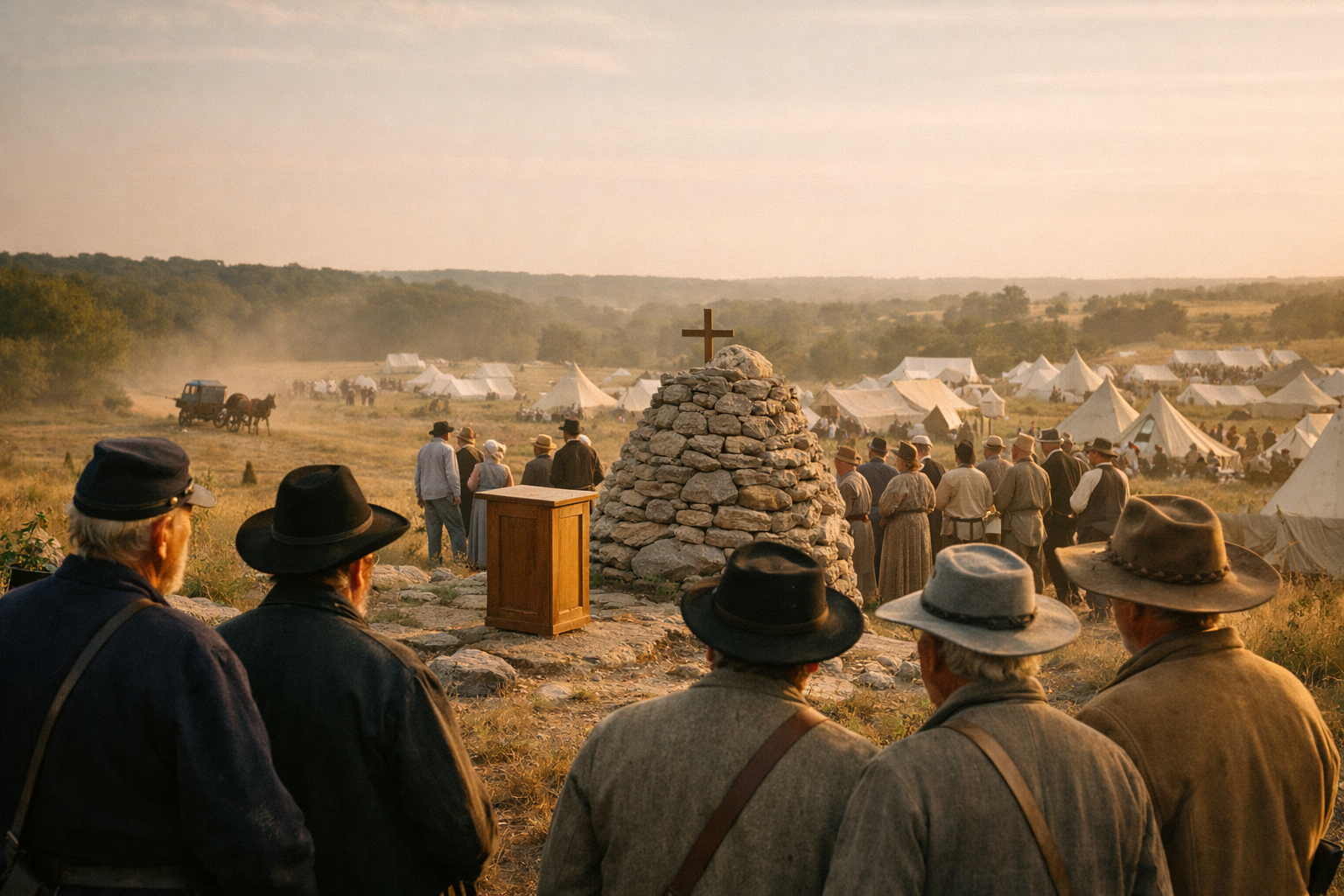
    The reunion expanded into a temporary encampment stretching nearly two miles. This tent city housed veterans and visitors who remained on the field, with Sibley tents recreating the physical arrangement of wartime camps and providing a direct sensory connection to earlier experiences.

    Refreshment stands and gathering areas appeared throughout the encampment, and families were present, giving the environment a dual character as both a memorial and a large public gathering.

    At the center stood Bloody Hill, and nearby the location of Lyon’s death was marked by a growing stone cairn built collectively by visitors over time.

    Veterans moved across the battlefield identifying positions they had once held. Some followed routes associated with Sigel’s column, while others stood along ridges where lines had formed and broken.

    In 1861, Lyon had assembled approximately 5,800 men at Springfield to confront a combined Southern force of nearly 12,000 under Sterling Price and Benjamin McCulloch. The struggle on Bloody Hill remained the focal point of their return.

    The terrain itself had not changed.

    The Scale of the Reunion

    Attendance reached into the thousands, with some estimates approaching 10,000 visitors across the three-day event. This represented a significant expansion from earlier gatherings in the city.

    The strain on infrastructure was visible, with overwhelmed hotels, heavily trafficked roads, expanded food systems, and decentralized water and sanitation solutions.

    Despite these pressures, the event remained functional. Springfield demonstrated that it could coordinate movement, resources, and space at a scale it had not previously attempted.

    Interactions on the Field

    Observers noted that interactions between Union and Confederate veterans remained orderly. Men who had once faced each other across the same ground now occupied it together, sharing meals, camps, and movement.

    At locations such as the Lyon cairn, both sides gathered in recognition of the same event from different perspectives.

    The act of gathering itself became the defining feature.

    Contemporary Descriptions and Historical Voices

    The reunion was documented in real time through newspapers and firsthand accounts. Reports described the atmosphere as notably calm, with veterans camping together as though there had never been a difference between them.

    Other accounts captured the contrast between past and present, linking the organized movement of the reunion to the memory of the battle.

    Veterans’ own recollections added further depth, as many revisited positions from both sides and, for the first time, understood how the battle had unfolded from the perspective of their former opponents.

    Logistics Strain and the Local Economy

    The scale of the reunion produced both economic activity and visible strain. Housing reached critical levels, forcing overflow into tent encampments and private residences, while food and water systems expanded through temporary stands and mass dining operations.

    The demand for food led to the establishment of refreshment stands across the battlefield, many operated by local families and businesses. The stand on Bloody Hill served not only as a platform for speeches but also as a central logistical hub.

    This reflected a broader trend, as battlefields were beginning to function as destinations long before formal preservation systems were established.

    The Battlefield Landscape in 1883

    The physical landscape remained largely unchanged from 1861. Wilson’s Creek continued to serve as a water source, while the hills and blackjacks still defined the terrain.

    Vegetation had increased, with dense scrub oak contributing to the same visibility challenges that had shaped the battle. Markers were informal, with the most prominent being the stone cairn marking Lyon’s death.

    Nearby structures such as the Ray House remained visible, and the Wire Road continued as the primary route through the area.

    Relic hunting was already underway, with local families collecting and selling artifacts, reflecting a growing desire among visitors to take a physical piece of the site with them.

    A City Tested by Scale

    The Blue and Gray Reunion of 1883 placed demands on Springfield beyond anything it had previously experienced. The city coordinated transportation, housing, food, and movement across multiple days and distances.

    What had been developed in earlier years was tested under pressure.

    The result was not perfection, but capacity.

    Springfield proved that it could manage a gathering larger than any it had hosted before.

    The Long-Term Significance of the 1883 Gathering

    The 1883 reunion was not an isolated event. It marked an early example of how large scale gatherings could reshape public memory through shared presence rather than conflict, and it also marked the beginning of a longer process of recognition and preservation.

    Future gatherings would expand in size, with later reunions drawing even larger crowds, and interest in the battlefield continued as visitors returned in the years that followed.

    The site began to shift in meaning, moving from a battlefield to a destination and ultimately to a place of memory. By gathering on the same ground where they had once fought, the veterans reshaped how the land was understood, not by changing it, but by returning to it together.

    Next in the Series

    In the years that followed, Springfield would continue to grow as a regional center for commerce, industry, and public gatherings. What had been demonstrated in 1883 would continue to build, as the city moved beyond becoming the Queen City of the Ozarks and began learning how to operate like one.