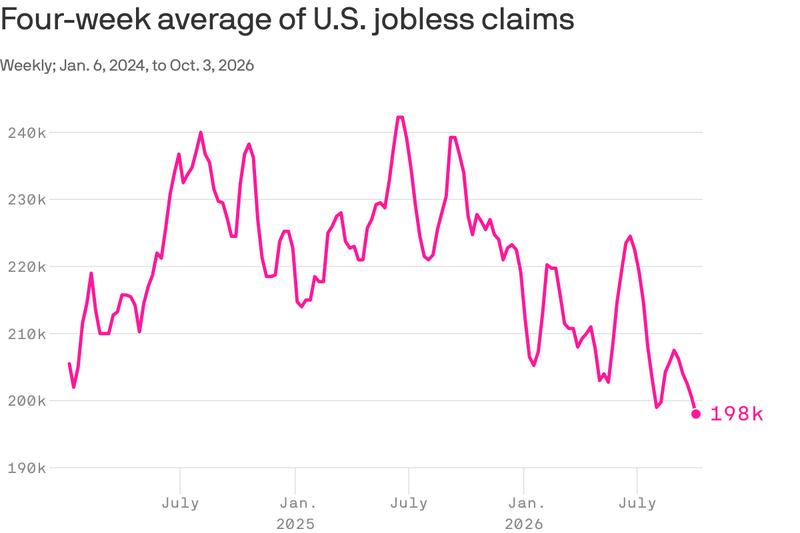
The U.S. Department of Labor marked a low-layoffs milestone, according to reporting dated October 8, 2026. The reading is one of the quieter signals in the American job market. It is also one of the most closely watched in Washington.
Low layoffs do not mean hiring is booming. They mean fewer employers are cutting people already on the payroll.
That distinction matters in a labor market that can look strong on one chart and brittle on another.
What looks like a single headline is actually a stack of surveys, claims counts, and corporate announcements that do not always move together.
What a Low-Layoffs Milestone Actually Measures
The federal government does not rely on a single layoff number.
The Bureau of Labor Statistics runs the Job Openings and Labor Turnover Survey, known as JOLTS. That survey estimates hires, quits, and layoffs and discharges at U.S. employers each month.
Layoffs and discharges in JOLTS count separations the employer starts. Quits count workers who leave on their own.
A low-layoffs print says employers are not dumping staff in large numbers. It does not say they are raising pay. It does not say they are posting more openings.
The Department of Labor also tracks weekly initial claims for unemployment insurance. Those claims are a faster, noisier read on people who just lost work and filed for benefits.
Private tallies sit beside the official ones. Challenger, Gray & Christmas has long published monthly counts of announced corporate job cuts. Those announcements can spike while the JOLTS layoff rate stays contained. Or the reverse.
Why Washington Treats Layoffs as a Political Number
Layoffs are not just a statistic. They are a kitchen-table event.
When a plant closes in a county seat, the unemployment office sees it before the national revision cycle does. When a federal print shows layoffs staying low, the White House and the opposition both reach for the same chart.
The Labor Department sits at the intersection of economic measurement and political argument. Secretaries of Labor do not set the JOLTS formulas. They do inherit the headlines those formulas produce.
Axios framed the latest reading as a milestone. The politics follow the frame. A low-layoff labor market is easier to defend. It is harder to use as a warning.
That does not settle whether wages are keeping up with prices. It does not settle whether young workers can find a first job. It answers a narrower question. Are employers firing in large numbers, or not.
How the United States Learned to Count Job Cuts
The modern layoff count is a 20th-century invention.
Unemployment insurance arrived with the Social Security Act of 1935. Weekly claims became a real-time proxy for sudden job loss. Frances Perkins, the first woman to serve in a U.S. Cabinet, ran the Department of Labor as that system was built.
The Bureau of Labor Statistics built household and establishment surveys that still define the unemployment rate and payroll employment. The Current Population Survey asks households who is working and who is not. The Current Employment Statistics survey asks employers how many people are on payrolls.
JOLTS came later. Regular publication began in the early 2000s, to measure the churn underneath those headline totals. Hires, quits, layoffs, and job openings finally had a dedicated monthly frame.
For years the BLS also ran Mass Layoff Statistics, which tracked large-scale cutbacks by employers. That program ended in 2013 after budget cuts. Researchers lost a direct federal window on big layoff events.
The gap never fully closed. Journalists and economists still stitch together JOLTS, claims, payrolls, and company announcements.
High-layoff history still sets the scale
The Great Recession of 2008 and 2009 showed what a high-layoff regime looks like. Payrolls collapsed. Claims surged. Quits fell as workers clung to jobs.
The COVID-19 shock of March and April 2020 was faster. Tens of millions of jobs disappeared in weeks. Many of those separations were temporary on paper. The claims system buckled under the volume.
The 2022-2023 technology-sector cuts were narrower. They dominated headlines out of San Francisco, Seattle, and New York. They did not, on their own, reproduce a 2009 labor market.
A low-layoffs milestone in 2026 sits against that history. It is a statement about the present cycle. It is not a promise about the next one.
The Three Clocks of American Job Loss
American job loss is timed on three clocks that do not strike together.
The first clock is weekly. Initial unemployment insurance claims land from the Department of Labor, typically on Thursday. They move fast. They also move with holidays, storms, and seasonal adjustment.
The second clock is monthly. JOLTS estimates the layoff-and-discharge rate and the quit rate. The figures arrive with a lag. They describe the prior month’s churn, not this week’s rumor.
The third clock is the monthly Employment Situation. Nonfarm payrolls come from the employer survey. The unemployment rate comes from the household survey. A person can leave a payroll and not yet show up as unemployed. A person can be unemployed and never have been laid off from a counted job.
Milestone language usually attaches to one clock. The other two can be telling a different time.
What Low Layoffs Do Not Prove
A tight layoff number can coexist with a hiring freeze.
Employers who stop posting jobs can still keep the people they have. Quits can fall because workers see fewer doors open. Unemployment can rise even when layoffs stay low if new graduates and re-entrants cannot get hired.
Labor economists call this a low-hire, low-fire market. It showed up in prior slowdowns. It is the version of weakness that does not produce dramatic pink-slip photographs.
Job openings can also mislead. A posted opening is not a filled job. A withdrawn opening is not a layoff.
The unemployment rate remains a household survey concept. Layoffs are an employer-side concept. They can diverge for months.
Readers who treat a single milestone as a full labor-market diagnosis will miss those gaps.
Who Is Missing From the Layoff Count
Not every lost livelihood looks like a layoff in federal data.
Self-employed workers do not appear in JOLTS layoffs. Gig workers on platforms may never have been on the payroll that the establishment survey sees. Farm labor and some household employment sit outside the standard nonfarm frame.
Related: Maduro Faces Fresh Torture Charges in Court Case
Temporary-help cuts can show up as industry job loss in payrolls before they show up as a famous brand’s announcement. A reduced workweek is not a layoff. An unpaid furlough may or may not match a claims filing.
The Worker Adjustment and Retraining Notification Act of 1988, the WARN Act, requires larger employers to give advance notice of many plant closings and mass layoffs. WARN notices are a legal trail. They are not the JOLTS estimate.
State workforce agencies see the local version first. National editors see the seasonally adjusted version later.
The milestone in the national story is real as a national story. It is not a map of every county.
The Data Trail Behind the Headline
The October 8, 2026 report pointed readers back toward the Labor Department’s own releases. Those releases are public.
JOLTS tables live on the Bureau of Labor Statistics JOLTS page. The survey’s layoff-and-discharge estimates are among the figures newsrooms reach for when they talk about a milestone.
Weekly unemployment insurance claims are published by the Department of Labor’s Employment and Training Administration, usually on Thursdays. The monthly Employment Situation report, often on the first Friday of the month, covers payroll employment and the unemployment rate.
None of those calendars were built for social media. All of them now feed it.
When a newsroom calls a print a milestone, it is usually because a series has reached a round number, a multi-year low, or a level last seen before a named shock. The underlying series still revises. First prints move. Annual benchmarks land later.
That is why a careful reading of the story stays with the measurement, not the victory lap.
Markets, Main Street, and the Quiet Signal
Financial markets watch claims and JOLTS because layoffs are a late-cycle tripwire.
In many expansions, employers hoard labor until they cannot. Then cuts arrive in a cluster. A sustained low-layoff stretch suggests that cluster has not started.
Main Street feels the same signal differently. A factory that does not cut a shift is not the same as a factory that adds one. A hospital that keeps nurses is not the same as a hospital that is hiring them.
The political argument in Washington often flattens those differences. The data do not.
Official claims tables remain on the U.S. Department of Labor site for anyone who wants the primary source rather than the frame.
Farmers watched commodity prices. Factory towns watched shift schedules. Payroll clerks watched the next claims print.
Layoffs.
Frequently asked questions
What did the Labor Department announce about layoffs in October 2026?
The U.S. Department of Labor marked a low-layoffs milestone, according to Axios reporting published October 8, 2026. The headline refers to employer-initiated job cuts staying low in federal labor data, not to a single company announcement. Official detail lives in Bureau of Labor Statistics and Department of Labor releases.
How does the U.S. government measure layoffs?
The Bureau of Labor Statistics estimates layoffs and discharges in the Job Openings and Labor Turnover Survey, known as JOLTS. The Department of Labor also publishes weekly initial unemployment insurance claims, a faster read on people who just filed for benefits after losing work. Private firms such as Challenger, Gray & Christmas track announced corporate cuts separately.
Do low layoffs mean the unemployment rate is falling?
Not necessarily. Unemployment can rise if hiring slows and new workers cannot find jobs, even while employers avoid firing existing staff. Layoffs are an employer-side measure. The unemployment rate comes from a household survey, and the two series can diverge for months.
Why do low layoff numbers matter in politics?
Job cuts are visible in communities and easy to argue about in Washington. A low-layoffs print is easier for an administration to defend and harder for opponents to use as an alarm. It still leaves open questions about wages, hours, and whether young workers can get hired.
Where can I find the official U.S. layoff data?
JOLTS tables are published by the Bureau of Labor Statistics. Weekly unemployment insurance claims are released by the Department of Labor. The monthly Employment Situation report covers payrolls and the unemployment rate. News headlines should be checked against those primary releases.
Sponsored · Put your business in front of ByteSize Network's readers, with every click measured. See advertising packages · Advertise on ByteSize Network