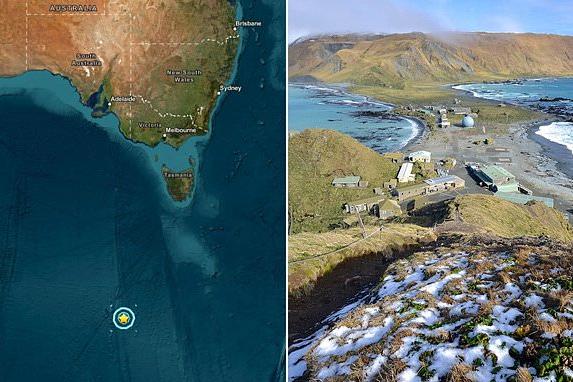
Magnitude 5.4 Earthquake Strikes Near Macquarie Island
A magnitude 5.4 earthquake occurred west of Macquarie Island on Thursday, October 8, 2026, at 06:46 UTC. The seismic event, with a shallow depth of 16 kilometers, was not reported felt by users or personnel at the Australian research station located on the island. Macquarie Island is positioned in a seismically active area, characterized by tectonic plate fault lines where two plates are sliding against each other. The Australian Antarctic Program maintains monitoring equipment at its Antarctic research stations, including Macquarie Island, to track seismic activity.
Official Statements and Regional Seismic Activity
Geoscience Australia confirmed the detection of the magnitude 5.4 earthquake. This event follows a magnitude 4.8 earthquake detected by Geoscience Australia near Leongatha, Victoria, on Saturday, October 3, 2026. Earlier in May 2026, two magnitude 6.0 earthquakes struck the remote Western Indian-Antarctic Ridge, an underwater plate boundary situated between the Antarctic and Australian plates. These incidents highlight the ongoing seismic activity in the broader region, which is under continuous observation by scientific bodies.
Background on Macquarie Island and Antarctic Seismicity
Macquarie Island, a subantarctic island, is a Tasmanian State Reserve and a UNESCO World Heritage site, known for its unique geological features and abundant wildlife. It hosts a permanent Australian research station, which plays a crucial role in scientific studies, including meteorology, biology, and geophysics. The island’s location at the boundary of the Australian and Pacific tectonic plates makes it a focal point for seismic research. The Australian Antarctic Program utilizes advanced monitoring systems to record and analyze seismic events, contributing to a global understanding of plate tectonics and earthquake patterns. For more information on the island’s geological significance, refer to Mail Online’s report.
Recent research has significantly advanced the understanding of seismic activity in the Antarctic region. Researchers from the Australian National University (ANU) discovered 360 glacial earthquakes in Antarctica that occurred between 2010 and 2023, many of which were previously unknown. This discovery, detailed in studies utilizing artificial intelligence, indicates that Antarctica is more seismically active than previously thought. The use of AI in seismic analysis has revealed hundreds of previously undetected earthquakes beneath the East Antarctic Ice Sheet, providing new insights into the dynamics of ice sheets and their interaction with the Earth’s crust. This advanced monitoring is crucial for understanding the potential impacts of seismic events on polar environments and global climate systems. Further details on Antarctic seismic research can be found through official Antarctic research programs.
Frequently asked questions
When did the earthquake near Macquarie Island occur?
The magnitude 5.4 earthquake occurred west of Macquarie Island on Thursday, October 8, 2026, at 06:46 UTC.
Related: Pennsylvania Measles Outbreak Exceeds 1,000 Cases, Five Deaths Confirmed
Was the earthquake felt on Macquarie Island?
No, the earthquake was not reported felt by users or personnel at the Australian research station on Macquarie Island.
Why is Macquarie Island seismically active?
Macquarie Island is located in a seismically active area due to its position on tectonic plate fault lines where two plates are sliding against each other.
What other recent seismic activity has occurred in the region?
A magnitude 4.8 earthquake occurred near Leongatha, Victoria, Australia, on October 3, 2026. In May 2026, two magnitude 6.0 earthquakes struck the remote Western Indian-Antarctic Ridge.
Sponsored · Want AI without handing over client files? Oriam AI installs private, on-premise AI for CPA firms, law firms, and insurance and title agencies. oriamai.online · Advertise on ByteSize Network