The Walnut Street Inn is far more than a luxury bed-and-breakfast. It stands as a living archive a silent witness to nearly 150 years of shifting economic power and the evolution of the Ozarks’ elite. At its 2026 listing price of $899,000, the property isn’t just a transaction; it is a provenance a rare intersection of 19th-century ambition and 21st-century luxury. To fully grasp its modern value, you have to peel back the layers to its 1883 genesis, tracing the lineage of influence that built Springfield from the ground up.
Before the Tracks Were Laid
The mid-nineteenth century in the American Midwest was defined by a single organizing force: the railroad. In the context of Springfield, Missouri, this transformation was catalyzed by the arrival of the St. Louis-San Francisco Railway known locally and nationally as the “Frisco” in 1870. Before those tracks arrived, Springfield functioned as a vital but isolated trading post, a site of significant Civil War contention whose growth had been repeatedly interrupted by military occupation and the limitations of wagon-based commerce. The population had harbored “bright anticipations” for a railroad connection as early as 1850, yet the promise went unfulfilled for two decades, partly due to the failure of General John C. Frémont to complete the purchase of the Atlantic and Pacific Railroad an enterprise that eventually collapsed under the weight of missed payments to the State of Missouri.
The true turning point came in 1868 when a consortium of New York and Boston capitalists, working alongside a select group of Springfield’s most influential citizens Dr. Robberson, Eli Parrish, Chas. Harwood, Thomas Whitlock, S.H. Boyd, and Wm. Massey purchased the Atlantic and Pacific Railroad and incorporated the South Pacific Railroad Company on May 12, 1868. Their primary objective was to push the line westward toward the burgeoning markets of the West. This partnership represented a fusion of Eastern industrial capital and intimate local land knowledge, the kind of alignment that would define Springfield’s economic DNA for generations.
The Frisco Arrives: An Economic Genesis
The arrival of the Frisco Railroad in 1870 was not merely a logistical milestone; it was an economic genesis that restructured the spatial, social, and financial hierarchy of the entire region. The initial phase of development was marked by an immense injection of capital over $2 million within the first two years and the establishment of a workforce exceeding 4,000 laborers, effectively making the railroad the largest employer in the city. By 1873, the principal repair shops of the line were relocated from Franklin (now Pacific), Missouri, to Springfield. With them came a massive roundhouse with twelve stalls and shops large enough to accommodate five locomotives at once for repairs, alongside an extensive blacksmithing facility. This consolidation of technical operations made Springfield the industrial heart of the Frisco system.
The socio-economic ripple effects of this railroad presence were felt in every sector of Springfield’s development. It is critical to understand that the wholesale grocery trade, the banking sector, the wagon manufacturing industry, and the city’s professional class did not arise independently alongside the railroad they arose because of it. The railroad created the demand for housing, food, and services, and the workforce it attracted stratified into distinct economic tiers that would directly shape the residential geography of the city.
The industrial working class the majority of those 4,000 workers employed in the maintenance and repair shops on the north side required immediate proximity to the rail yards. Their presence led to the rapid development of worker-oriented housing in the Mid-town area and the commercial densification of Commercial Street. Pioneering merchants like J.C. Jackson and H.H. Kaufholz established substantial brick and frame businesses on Commercial Street in 1870 specifically to service this stable, wage-earning population. Above them sat a technical and managerial elite: engineers, machinists, and managers whose presence is evidenced by the early chartering of the Brotherhood of Locomotive Engineers in 1871 with 44 members. These skilled workers and their families formed a “middle-class” buffer between the laborers and the high-level executives, their prosperity influencing the architectural variety of the Mid-town district, which came to feature American Foursquare, Craftsman bungalow, and Tudor Revival residences. At the apex of this hierarchy were the railroad executives, and the lawyers and bankers who managed the company’s vast interests. Their accumulated wealth from the $2 million initial investment and ongoing revenues became the primary engine behind the “conspicuous consumption” seen in Springfield’s mansion districts.
The Men Who Built the Mansions
The men who commissioned the mansions of Springfield were almost invariably those who had direct control over railroad operations, or who were savvy enough to monopolize the industries that fed into the rail system. Three figures stand above the rest as archetypes of this railroad-era power.
John O’Day and the Elfindale Estate
John O’Day represents the archetype of the railroad-era power broker. A lawyer from Albany, New York, who relocated to Springfield in 1865, O’Day was hired by the Frisco and rose to become a Vice President and a key figure in the decision to move the corporate headquarters to Springfield. His wealth allowed him to purchase 400 wooded acres for $1.25 an acre in 1888, upon which he constructed the Mansion at Elfindale an estate that served as both a private residence and a symbol of the railroad’s dominance over the regional economy. So significant was O’Day’s influence that subsequent homeowners throughout the district modeled the aesthetic of their own estates after his the Elfindale style became a standard-bearer for Gilded Age residential ambition in the Ozarks.
Harry Worman and the Modernization of Luxury
Harry Worman, a Frisco executive, demonstrated the railroad’s role in introducing modern technology to the Ozarks. In the early 1920s, Worman built a country retreat known as the Worman House that was far ahead of its time, featuring running water, electric lights, and the first telephone in the county. The lifestyle of the Worman family which included a private chauffeur and a chef who prepared “exotic meats” illustrates the extraordinary level of luxury available to those at the top of the Frisco hierarchy.
J.F.G. Bentley and the Banking Boom
While not an employee of the railroad, J.F.G. Bentley was a prime beneficiary of the business climate it created. A teacher who moved to Missouri after the Civil War, Bentley leveraged the economic activity of the railroad era to found the Bank of Ash Grove and later the Bank of Springfield. In 1892, he commissioned the Bentley House now the Museum of the Ozarks for $15,000. The home was a showplace of the Queen Anne style, utilizing walnut wainscoting and parquet floors that mirrored the materials used in the luxury rail cars of the day, a subtle but deliberate echo of the industry that had made his fortune possible.
Millionaires Row: The Architecture of Ambition
By the 1880s, Walnut Street had become the premier address for Springfield’s industrial and professional elite. The thirteen-block area now designated the Walnut Street Historic District running between McDaniel and Elm Streets to the north and south, extending from Sherman Parkway (later renamed John Q. Hammons Parkway) to National Avenue served as the primary residential corridor for the city’s most influential figures. Its 80 acres and over 150 one- and two-story dwellings constitute a comprehensive visual and historical record of Springfield’s transition from a frontier outpost to a sophisticated metropolitan center, reflecting the architectural ambitions and social stratification of the city between 1870 and 1940.
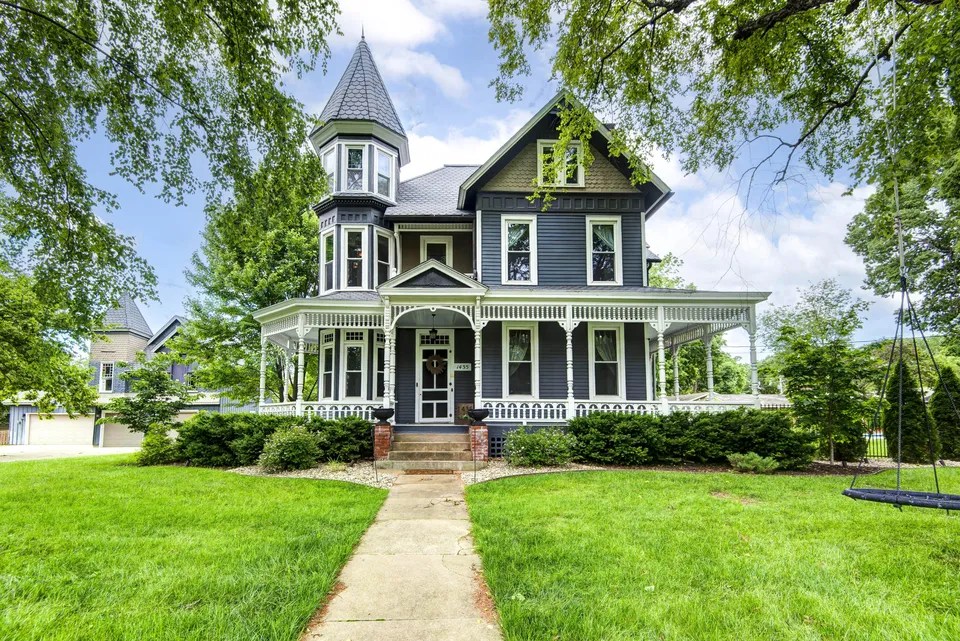
The most prominent architectural style in the district is the Queen Anne Victorian, characterized by asymmetrical silhouettes, expansive porches, turrets, wrap-around verandas, and intricate ornamentation including spindle work, friezes, and textured shingles. These homes were designed as “picturesque villas,” intended to project an image of aggressive self-confidence and newfound prosperity. The large verandas and “living halls” around which the parlor, library, and dining rooms were distributed allowed for a seamless blend of private family life and public social display. Notable examples include the Bentley House and the Sease Mansion at 1435 East Walnut a three-story Queen Anne built in 1886 by Colonel George Hartzell Sease on a rare 1.04-acre lot, retaining much of its original hardwood, intricate woodwork, and stained-glass accents. As architectural trends evolved at the turn of the century, the district also absorbed Italianate, Neoclassical, Colonial Revival, and Craftsman Bungalow styles, structures like the Landers Theatre and the Marquette Hotel moving away from the eclectic variety of the Victorian era toward a more formal, symmetrical classicism. This transition reflected the city’s maturation and its desire to align with the sophisticated urban designs found in larger Midwestern cities like St. Louis and Kansas City.
Charles and Katherine McCann: The Man Behind the House
The development of Millionaires Row was driven by a specific class of entrepreneurs what historians have called “Yankee-descended” businessmen who migrated to Southwest Missouri following the Civil War, bringing with them capital, credit-oriented business models, and a commitment to modernizing the region through civic and commercial institutions. Charles McCann was the quintessential representative of this class.
In 1879, Springfield was 50 years old and ready for real growth. Young men were still going west to seek their fortunes, and Charles McCann was one of them. From Indiana, with his first wife and two children, he came to Springfield and immediately became involved in business and civic affairs. He recognized the city’s potential as a logistics hub at a moment when wholesale trade was the engine of regional growth. His first wife died not long after their arrival, and in 1891 he married Miss Katherine Ashworth. In his journal he wrote: “While I had not made any resolution, it had always appeared to me as a matter of course that I would not marry again… but I became acquainted with Miss Ashworth, and as I grew to know her better, my interest and affection were aroused to an extent that I was impelled to ask her to make a home for me, and when she had consented to marry me, I had the sensation of beginning life anew.”
Beyond the Springfield Grocery Company, McCann was a director and president of the Springfield Club the organization that would become the modern Chamber of Commerce, and which served as the city’s premier forum for coordinating investment and infrastructure initiatives. He held major shares in the Springfield Wagon Company, which under his eventual leadership would become one of the four largest wagon manufacturers in the nation. His philanthropy was equally significant: he was the primary force behind the fundraising that built Springfield’s first public library in 1905. The Main Library building, located at 397 E. Central Street, remains a historic landmark today. McCann’s greatest civic achievement, however, was his instrumental role in securing the location of the Frisco railroad shops in Springfield a feat involving significant fundraising and land negotiations that locked in the city’s economic trajectory for decades. By ensuring that the railroad’s maintenance and manufacturing facilities were based in Springfield, McCann helped guarantee a steady influx of skilled labor and capital that in turn supported his own ventures in wholesale grocery and wagon manufacturing.
The Springfield Grocery Company
The establishment of the Springfield Grocery Company was not merely the opening of a retail store but the creation of a wholesale infrastructure that addressed the logistical needs of a vast, underserved periphery. In the late 1800s, wholesale trade was the engine of Springfield’s growth, and McCann’s firm became a cornerstone of this sector. The company was designed to operate on a scale that few local competitors could match, eventually extending its service radius to approximately 180 miles across Missouri, Kansas, Oklahoma, and Arkansas. The resilience of the Springfield Grocery Company is evidenced by its operation well into the twenty-first century, where the firm continues to serve the restaurant trade within its historic four-state footprint one of the oldest continuous business lineages in the Springfield area.
The Springfield Wagon Company
The most significant chapter in Charles McCann’s industrial career began in 1894 when he assumed the presidency of the Springfield Wagon Company. Founded in 1872, the company had already earned the moniker “The Old Reliable” due to the exceptional durability and craftsmanship of its products. Under previous leadership it had survived the devastating fire of 1883 and the Panic of 1873, eventually establishing itself as the largest manufacturer of its kind west of the Mississippi River. Under McCann’s tenure, the company solidified its reputation through genuine innovation: its wagons were characterized by their bright green and yellow paint, their light weight, and their sturdy construction. A key technological breakthrough was the design of a hinged drop-tongue, which made the wagons significantly easier to navigate through the uneven and rocky terrain of the Ozarks. By 1893, the plant was producing 75 wagons per week over 3,500 units annually placing Springfield at the center of the national wagon industry alongside giants like Studebaker. The company’s clientele extended well beyond farmers and freight haulers; under McCann’s leadership, the Springfield Wagon Company became the primary provider of specialized vehicles for the American circus industry. Major shows, including Ringling Brothers and Barnum & Bailey, relied on the firm for heavy animal cages and wide-tired wagons capable of traversing muddy fairgrounds.
900 East Walnut: Building the McCann-Jewell House
In 1894 the same year he assumed the presidency of the Wagon Company Charles McCann began construction of a private residence that would reflect his status as a titan of Missouri industry. Located at what was then 704 East Walnut Street (now 900 East Walnut), the house is a premier example of Queen Anne Victorian architecture. The timing of its construction is itself a case study in the opportunistic nature of Gilded Age capital. Despite being built during the “panic times” of the mid-1890s, the project proceeded because McCann had the liquidity to take advantage of plummeting labor and material costs. He recorded in his journal: “Good carpenters were paid only two dollars a day… I bought lumber, the best, in car loads for ten dollars per thousand feet delivered, and other items in the same proportion, yet this house cost me nearly $6000… I put in the latest improvements except electricity (and this exception was quite a mistake). I had Henry Hornsby cast for me 20 iron Corinthian columns, which gave the house a very handsome appearance, and when finished, it was one of the best looking homes in the street.”
The McCanns were known throughout Springfield’s social hierarchy for their love of entertaining. Their home was frequently the site of grand parties that occupied the entire ground floor. In the social hierarchies of late Victorian Springfield, these gatherings were not merely leisure activities but essential networking events that reinforced the bonds between the city’s leading industrial families. Katherine McCann was the vital social force behind this tradition, and the house was designed as much for public display as for private life.
In February 1904, W.A. Dennis approached McCann at the Springfield Club one night and proposed to purchase the Walnut Street residence. McCann recalled the encounter as “the quickest sale I ever made.” The transaction was not conducted through traditional real estate channels but through an informal negotiation at the private men’s club a detail that highlights the closed, intimate nature of the Springfield elite at the turn of the century, where capital was concentrated in the hands of a few families who managed the city’s wholesale, manufacturing, and railroad interests, and where real estate served as both a currency and a marker of status. Tragically, Dennis died approximately one month after the deal was made, and the property passed to his wife, who improved it and lived in it for some time before it eventually came to Harry S. Jewell.
The Jewell Era: A Hub of Social and Political Influence
The house’s subsequent ownership by Harry S. Jewell, the publisher of the Springfield News-Leader, further cemented its status as a hub of social and political influence in the city. The Jewell ownership oversaw the house’s transition through the Great Depression and World War II twin convulsions that claimed many of the district’s comparable mansions. Following the death of Mrs. Jewell in 1940, the structure underwent its first significant functional reconfiguration. To accommodate the needs of a grieving widower and the younger generation of the family, the house was subdivided into two distinct living units. Harry Jewell occupied the upper floor, which was converted into a self-contained apartment through the addition of a kitchen and a private south-facing entrance. The lower level was inhabited by Jewell’s granddaughter, her husband, and their two sons. This arrangement allowed the family to maintain the large estate during a period when many similar Victorian homes were being demolished or converted into boarding houses, and the south-facing entrance added during this era continues to serve as the primary guest entrance for the current inn. The Jewell era thus preserved the home’s integrity while inadvertently introducing the concept of multi-unit living that would eventually facilitate its conversion into a bed and breakfast.
The Rosen Era: Mid-Century Professionalism (1953–1987)
The purchase of the home by Dr. Max and Barbara Rosen in 1953 inaugurated a thirty-four-year period of stability that is arguably the most influential era in the property’s domestic history. The Rosens arrived at 900 East Walnut during the post-war baby boom and their tenure would see the house return to its function as a unified family residence, albeit one adapted to the professional needs of a modern medical practitioner. Dr. Rosen operated his practice directly out of the home for a significant portion of his career, a detail that continued the tradition of 900 East Walnut as a site of professional and civic significance. Because the property served as a professional office, it required a level of maintenance and dignity that might otherwise have been lost to the urban decay affecting many downtown Springfield neighborhoods during the 1960s and 70s.
One of the first major decisions the Rosens made upon acquiring the property was a significant structural modification: in 1953, the original three-story balconies on the south side of the building were removed. The intricate wood-carved Victorian balconies, then nearly 60 years old, were likely suffering from substantial rot and maintenance issues, and the post-war aesthetic favored cleaner, more functional lines over the highly decorative “gingerbread” style of the late nineteenth century. In their place, the Rosens added a large wooden deck, transforming the south side from a decorative facade into a functional outdoor living space better suited for a household that would eventually include five children.
Barbara Rosen (1923–2008) played a vital role in the cultural life of both the home and the Springfield community. She was noted for her ability to make the past “come alive,” a trait that suggests she was a primary keeper of the family’s history and the home’s lore. Her involvement in civic organizations the League of Women Voters and community educational institutions positioned the Rosen family at the center of Springfield’s intellectual and social discourse. Her interests in travel and reading transformed the interior of 900 East Walnut from a formal Victorian showroom into a curated space of global inquiry. The artifacts, books, and memories gathered during her family’s extensive journeys were integrated into the home’s atmosphere, creating a domestic environment that prioritized intellectual exploration. This cultural infusion is what gave the “Rosen Room” its distinct identity when the house was eventually converted into an inn.
The Brown Family and the Birth of the Walnut Street Inn (1987)
In 1987, after more than three decades, the Rosens sold the property to Gary, Nancy, and Karol Brown. This purchase was motivated by a vision to establish the first bed and breakfast in Springfield a move that required a massive investment in historical restoration and adaptive reuse. At the time, the B&B movement was gaining national momentum as a reaction against the perceived sterility of corporate hotel chains, and the Browns were the first to bring this concept to the Springfield market. The transformation from private home to public inn was not merely a business decision; it was a sophisticated act of historical restoration, one that had to satisfy both modern building codes and the strict aesthetic requirements of the Walnut Street Historic District.
The Browns’ most significant structural contribution was the reversal of the Rosen-era modification: they rebuilt the three-story south balconies that had been removed in 1953, restoring McCann’s original Queen Anne silhouette. Rather than a strict historical reproduction, they chose to incorporate a metal spiral staircase within the balcony structure providing modern fire safety and guest access while visually restoring the profile that had been missing for thirty-five years. To honor the family that had maintained the house through the mid-century, the Browns designated one of the primary second-floor rooms as the “Rosen Room,” intentionally curating its decor to reflect Barbara Rosen’s documented interests in travel, reading, and family life. Today that room serves as a thematic bridge between the house’s nineteenth-century origins and its twentieth-century life as a professional residence.
The 1988 Springfield Symphony Designers’ Showcase
A defining moment for the Walnut Street Inn occurred just months before its official opening. In 1988, the house was selected as the Springfield Symphony’s Designers’ Showcase Home a cornerstone of Springfield’s high-society calendar that involved twelve local interior designers, each given an individual room to decorate according to a specific theme. The Showcase served as a massive public unveiling. Thousands of residents and potential guests toured the property, marveling at the themed rooms that would eventually become the Inn’s hallmark. By the time the Walnut Street Inn opened its doors for business in May 1988, it was already ingrained in the public consciousness as a premier local landmark. The collaborative design approach ensured that no two rooms in the inn were alike, a quality that remains one of its most distinctive features to this day.
The Maschino Connection: A Legacy of Retail and Hospitality
The success of the Walnut Street Inn under the Browns cannot be fully understood without examining the broader entrepreneurial context of the family. Nancy Brown was not only an innkeeper but a steward of a multi-generational Springfield retail legacy: Maschino’s. Founded in 1903 by Nancy’s grandfather George Maschino, Maschino’s Hardware was a staple of the Springfield business community for decades. Under Nancy and Gary’s leadership after 1972, the store underwent a radical transformation pivoting toward high-end home goods, specializing in fireplaces, patio furniture, and fine china, and eventually becoming the premier bridal registry location in the region, serving as many as 157 brides simultaneously. The synergy between a luxury home goods store and a high-end bed and breakfast created a unified brand for the Brown family centered on the concepts of elegance, domesticity, and quality. Nancy Brown, who later became Nancy Dornan, also emerged as a leading voice in historic preservation and urban planning, co-authoring several books documenting the history of the Ozarks and becoming actively involved in Springfield’s “Forward SGF” comprehensive plan and Missouri Preservation. The Inn was, in many ways, the physical expression of her belief that a city’s past is its greatest asset for its future.
The day-to-day management of the Inn fell to Karol Brown, who was only nineteen years old when it opened. She managed the facility for the entirety of the nine years the Browns owned it, a period characterized by hard work, creativity, and marketing savvy that earned the Walnut Street Inn recognition from Country Inns Magazine as one of the “Top 12 Inns in the Country” placing the Springfield establishment alongside the most prestigious heritage hotels in the United States.
The Blankenship Legacy: Owner-Caretakers of Walnut Street (1996–2021)
The sale of the Walnut Street Inn in July 1996 to Gary, Paula, and Catherine Blankenship marked the beginning of a 25-year period of stable stewardship that respected and built upon the foundation laid by the Browns. The acquisition was more than a business transaction; it was a homecoming. The Blankenships were originally from the Springfield area but had departed in 1981, spending fifteen years in a high-intensity corporate lifestyle that saw them living in five major cities across the United States. Gary Blankenship’s career involved extreme professional mobility traveling over 100 nights per year and this extensive experience as a consumer of high-end lodging provided him with a unique perspective on the deficiencies of “cookie-cutter” hotel chains and the potential for a more personalized, family-operated hospitality model. The birth of their daughter Catherine served as the primary catalyst for their return to Missouri, as the couple sought to build a family business that offered stability and a connection to their roots.
The Blankenships’ approach to hospitality was centered on the concept of being “owner-caretakers.” Every guest interaction and every structural repair was handled with the long-term health of the property in mind. Gary Blankenship was known for his personal engagement with guests, often providing expert local knowledge on hiking trails at the Springfield Conservation Nature Center and Lake Springfield. He became a prominent voice in Springfield’s urban planning and preservation debates, serving as president of the Historic Walnut Street Association (HWSA) and advocating for the interests of small business owners and historic residents against what he perceived as misguided municipal policies. A significant point of contention arose over the city’s use of Tax Increment Financing (TIF) and “blight” designations. Blankenship noted the irony that while his carefully restored Victorian home was deemed “not blighted enough” to qualify for facade improvement funds, it was simultaneously labeled as “blighted” to justify the creation of a TIF district. In testimony, he argued that “perception is all we have in terms of selling ourselves,” highlighting the fundamental difficulty of attracting upscale clientele to an area the city had officially branded as dilapidated. His advocacy underscored a central tension in urban redevelopment: the conflict between grassroots, individual-led preservation and top-down government interventions that often prioritize new construction over the rehabilitation of existing historic assets.
The Blankenships also professionalized the B&B model, teaching workshops for aspiring innkeepers at Missouri State University and helping elevate the entire bed-and-breakfast sector in the Ozarks by backing preservation efforts with sound business practices. The trajectory of the Blankenship stewardship was irrevocably altered in November 2019 when Gary Blankenship passed away suddenly from a heart attack an event that sent shockwaves through the Springfield business and preservation communities, where he was remembered as a “neighborhood champion.” Following Gary’s death, Paula Blankenship assumed sole responsibility for the inn during one of the most turbulent periods in the history of the hospitality industry: the global COVID-19 pandemic. While widely praised for her admirable management of the property under extreme duress, the combination of personal loss and the relentless maintenance requirements of a 130-year-old structure eventually led to the decision to sell.
The Faucett Family and the Modern Era (2021–Present)
In January 2020, the inn was listed for sale with an initial asking price of $899,900, including the main house, the carriage house, and substantial parking assets. The market conditions of the pandemic necessitated a valuation adjustment, and in April 2021 the property was purchased by Faucett & Bates Inc. for $675,000. The new ownership entity led by Mary Faucett and her sons Andy and Chuck brought a different operational synergy to the inn. As the owners of the popular local restaurant Bambinos Cafe, the Faucetts were well-positioned to integrate the inn into a broader culinary and hospitality portfolio. Mary’s granddaughter, Madalyn Faucett, took on the role of managing partner, representing a new generation of family stewardship.
Since the acquisition, the Walnut Street Inn has undergone a series of modernizations to ensure its continued viability in the competitive lodging market, including a major kitchen remodel in 2023 and significant repairs to the house’s ventilation and electrical systems. The guest experience has been updated with smart TVs, new bedding, and modern amenities all while carefully preserving the Victorian aesthetic that the Blankenships worked so hard to maintain. Current management has also maintained the inn’s role as a cultural hub, hosting events like the “First Friday” art walks and “Dinner with Mary” evenings, which leverage the family’s restaurant background. These initiatives represent a shift toward a more diversified revenue model, combining traditional overnight stays with event catering and culinary experiences.
The 1894 Carriage House and the Sears Cottage
The property at 900 East Walnut is not a single building but a small campus of historically significant structures. The Carriage House, built simultaneously with the main house in 1894, originally functioned as a stable with a dirt floor. It remained an underutilized secondary structure through the Jewell and Rosen eras until 1991, when the Browns converted it into additional guest accommodations. Today it houses four secluded rooms, two of which are handicapped-accessible on the first floor, representing a successful example of adaptive reuse of secondary Victorian outbuildings.
Located two doors east of the main house, the Cottage Inn is a significant architectural specimen in its own right. Manufactured in 1904 by Sears in Chicago and shipped to Springfield via train a hallmark of early twentieth-century pre-fabricated logistics the cottage is less “Victorian” than the main house, reflecting the transition toward the Craftsman and catalogue-builder styles that would dominate American residential construction in the decades following the Gilded Age. Its inclusion in the Walnut Street Inn campus allows guests to experience the contrast between the custom-built opulence of the McCann era and the democratic accessibility of the early twentieth-century catalogue home.
The Neighborhood Then and Now: From Railroad Corridor to Cultural Gateway
The physical and economic context of 900 East Walnut has been radically transformed by the development of the John Q. Hammons Parkway corridor. Historically, the property sat at the corner of Walnut Street and Sherman Avenue. The renaming and upgrading of Sherman Avenue to John Q. Hammons Parkway in 1984 signaled the area’s transformation into a major urban thoroughfare. Developer James Quentin “John Q.” Hammons credited with single-handedly changing the skyline east of Park Central Square spearheaded projects that effectively relocated the economic center of gravity for downtown Springfield to the corridor adjacent to Missouri State University. His projects in the immediate vicinity of 900 East Walnut include Hammons Tower (completed in 1987 at $15 million, the tallest building in Springfield at 22 stories), the University Plaza Hotel and Convention Center (the city’s first premium downtown hotel), Juanita K. Hammons Hall for the Performing Arts (a major cultural anchor for Broadway tours and concerts), and Hammons Field (a baseball stadium constructed in 2002 on a former brownfield site).
900 East Walnut sits precisely on the boundary between the high-rise corporate environment of the Parkway and the residential-scale history of the Walnut Street Historic District. To the east lies the protected historic district; to the west, the intensely developed commercial core of downtown. While many of the original homes on Walnut Street were demolished to make way for surface parking or institutional buildings, 900 East Walnut survived partly because its scale and grandeur made it a difficult target for demolition, and partly because of the continuous reinvestment by owners who understood both its historical value and its commercial potential. The inn sits one block from the original path of Historic Route 66, making it a key destination for the growing international “Route 66 pilgrimage” tourism market. As Springfield intensifies its focus on the Route 66 Centennial in 2026, Walnut Street is positioned as a centerpiece of that celebration. The inn is also within walking distance of the Gillioz Theatre and Park Central Square, and adjacent to Missouri State University a significant driver of graduation-related and visiting-family lodging demand.
The Walnut Street Historic District itself continues to evolve as an open-air museum of Missouri history and a vibrant public stage. Annual events like Artsfest the largest outdoor fine arts festival in Southwest Missouri, held each May with over 110 juried artists and approximately 20,000 attendees and Cider Days the district’s premier fall festival, drawing thousands of visitors annually for over 27 years with regional crafts, live music, and the seasonal tradition of fresh apple cider have transformed Millionaires Row from a secluded residential enclave into event central for the city. The monthly First Friday Art Walk features the Walnut Street Inn as a prominent venue, spotlighting local artists in its dining room and parlor. The district’s horse-and-carriage mounting blocks still line the streets alongside the electric-gated driveways of contemporary owners, a physical metaphor for the constant dialogue between past and present that defines this corridor.
The institutional anchors of the district reinforce this identity. The Landers Theatre at 311 East Walnut built in 1909 by lumber businessman D.J. Landers, featuring Missouri limestone piers and terra cotta cornices, and hosting everything from live vaudeville to NBC’s Five Star Jubilee television broadcasts in 1961 remains a working cultural venue. The Marquette Hotel at 400 East Walnut, remodeled in 1928 into a Colonial Revival showpiece whose lobby still retains its original hexagonal white and brown tile spelling out the hotel’s name, speaks to the commercial evolution of the district across decades. Christ Episcopal Church, situated at the district’s west entrance, has long been cited as the crown jewel of the district’s ecclesiastical architecture, listed on the National Register in 1987 and providing a spiritual and social anchor for the families of Walnut Street for generations.
Preservation, Protection, and the Responsibility of Ownership
The preservation of 900 East Walnut Street is not merely a matter of private choice it is governed by the property’s status within the Walnut Street Historic District, which is listed on both the National Register of Historic Places and the Local Springfield Register. Any project affecting the exterior appearance requires a Certificate of Appropriateness from the Springfield Landmarks Board, established by Section 3-2300 of the city’s zoning ordinance. The board’s criteria for designation emphasize the building’s association with significant personalities such as McCann, Jewell, and Rosen, and its embodiment of the Queen Anne architectural type. The 2002 boundary expansion for the Walnut Street Historic District, which added properties in the 700 and 800 blocks of East Walnut, was a strategic move to ensure that the approach to the Parkway remained architecturally cohesive. The ongoing $60 million Grant Avenue Parkway Completion project, funded by federal BUILD grants and local sales tax, will further strengthen multi-modal connections between downtown and the Wonders of Wildlife area, potentially increasing the flow of high-value tourism through the Walnut Street corridor.
Millionaires Row is more than a collection of historic buildings; it is a testament to the vision of a specific generation of Springfieldians who utilized the wealth generated by the railroad to build a neighborhood that reflected their values: education, culture, industry, and refinement. The survival of the district through the challenges of the twentieth century the Great Depression, which led to the subdivision of mansions; the urban flight of the 1960s and 70s; the redevelopment pressures of the Hammons era is a reflection of the enduring quality of the original construction and the dedication of subsequent generations of preservationists who understood that the stories of the railroad magnates, bankers, and merchants of Walnut Street are worth telling for generations to come.
Back to 2026: What $899,000 Actually Buys
In 2026, the potential buyer of the Walnut Street Inn is buying into an established reality. They are not taking a risk on a growing frontier; they are acquiring a slice of established heritage a property whose survival is not accidental but the result of continuous reinvestment by owners who understood the changing needs of the city across seven distinct ownerships spanning more than 130 years. The property at 900 East Walnut has been a grocery magnate’s showplace, a newspaper publisher’s social nerve center, a mid-century physician’s professional home, the birthplace of Springfield’s boutique hospitality industry, a nationally recognized inn, and now a living museum of Ozarks history integrated into the city’s most dynamic tourism corridor.
The “repositioning” of the property as a luxury boutique inn reflects the broader shift in Springfield’s economy from manufacturing to the experience-and-service economy. Where the Frisco Railroad once defined the city’s identity through iron and labor, Walnut Street now defines it through history, architecture, and culture. As Missouri State University expands its footprint, as the Route 66 Centennial draws international visitors in 2026, and as the Grant Avenue Parkway project reshapes the pedestrian fabric linking downtown to the Wonders of Wildlife, The Walnut Street Inn sits precisely at the center of this momentum as it has sat at the center of Springfield’s story since the day Charles McCann, fresh from Indiana with two dollars’ worth of daily craftsmen and ten dollars’ worth of the best lumber money could buy, decided to build something that would last.
The iron Corinthian columns Henry Hornsby cast in 1894 still stand at the entrance. The house Charles McCann called one of the best looking on the street still stands at its corner, absorbing another century of Springfield into its walls. Preservation of Millionaires Row is not an act of nostalgia it is a strategic investment in the city’s future. And 900 East Walnut Street, listed at $899,000 in 2026, is the finest single expression of that investment that Springfield has to offer.

 Bytesizenetwork